
- Top Pick: KOTIN Gaming PC, Ryzen 7 9800X3D, RTX 5070 Ti 16GB, 32GB DDR5, 1T SSD
- Best Value: ZOTAC MEK Gaming PC Desktop, Ryzen 7 9700X, NVIDIA GeForce RTX 5070 Ti 16GB
- Premium Choice: HELLOLAND Black RGB Prebuilt Gaming Desktop PC, AMD Ryzen 7 5700X 3.4GHz, GeForce RTX 5070 12GB, 32GB DDR4 RAM, 1TB PCIe SSD, WiFi & Bluetooth, No Bloatware, ARGB Software, Windows 11 Tower Computer


AMD 9070 vs RTX 5070 is the comparison that stalls more 1440p builds than any other pairing this generation. Two cards, both launched at $549, one day apart, aimed at exactly the same buyer. If you are here, you have probably already watched two benchmark videos and still have a tab open on each card. This page skips the fifteen-minute build-up: the verdict is in the first section, the full spec table is in the second, and the third tells you what the 2026 memory market does to both prices. No suspense.
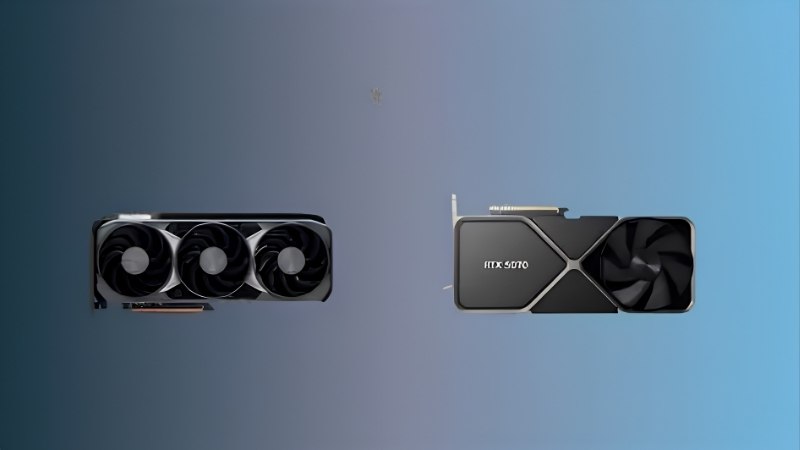
The Quick Verdict: AMD 9070 vs RTX 5070 at a Glance
The honest summary is that the RX 9070 is the better card for most 1440p gamers and the RTX 5070 is the better card for a specific, well-defined minority. The gap is not wide enough to make either purchase a mistake. It is wide enough to matter when the prices are this close. Here is how the win splits across the three axes that actually decide the sale.
As an Amazon Associate we earn from qualifying purchases at no extra cost to you.




Who Wins on Raw Rasterization
The RX 9070 wins. Across aggregated 1440p testing it runs roughly 3–6% ahead of the RTX 5070 in traditional rendering, and the lead is consistent rather than title-dependent. Representative 1440p numbers on the AMD card: around 102 fps in Cyberpunk 2077, 118 fps in Black Myth: Wukong, 148 fps in Elden Ring.
A 3–6% margin is not a reason to choose a card on its own. It becomes one when the same card also has more VRAM, draws less power, and costs less — which is the situation here.
Who Wins on Ray Tracing and Frame Generation
The RTX 5070 wins, and in path-traced workloads it wins by up to 40%. That is the single largest gap in this comparison and the strongest argument for buying NVIDIA at this tier.
The picture is less clean than it was a year ago. RDNA 4 rebuilt AMD’s ray accelerators, and in titles that received RDNA 4-specific optimisation — Cyberpunk 2077 being the notable case — the RX 9070 has actually taken the ray-traced win. Most ray-traced games have not been optimised that way, so NVIDIA still holds the category. But the trend line matters if you keep cards for years.
DLSS 4 Multi Frame Generation remains NVIDIA-exclusive and remains genuinely transformative where it is supported: multiple AI-generated frames per rendered frame, pushing a 100–120 fps scenario past 200 fps on a high-refresh panel. DLSS 4.5’s transformer model still leads FSR 4 on detail in motion — though FSR 4 is the first AMD upscaler built on machine learning rather than heuristics, and it competes credibly now.
Who Wins on Price Right Now
The RX 9070 wins, but by less than the MSRP sheet suggests. Both launched at $549. In practice the RTX 5070 sells for roughly $549–$609 depending on partner model, while the RX 9070 sits around $499–$549. That is a consistent $50 advantage to AMD at equivalent tiers.
Regional reality check: in markets where import duties dominate, the gap compresses hard — Indian retail has run about 3.5–4.5% apart, which is close enough to be noise. Price your specific market before you weight this factor.
Full Spec Comparison and Deep Dive Face-Off
The specifications explain why each card wins where it does, and one line in this table explains most of the result. These are the reference figures — partner cards vary on clocks and cooler, not on the fundamentals.
The Specification Table
| Specification | AMD Radeon RX 9070 | NVIDIA GeForce RTX 5070 |
|---|---|---|
| Architecture | RDNA 4 (Navi 48) | Blackwell (GB205) |
| Compute units / SMs | 56 CU | 48 SM |
| Shader cores | 3,584 stream processors | 6,144 CUDA cores |
| Boost clock | ~2,520 MHz | ~2,512 MHz |
| Memory | 16GB GDDR6 | 12GB GDDR7 |
| Memory bus | 256-bit | 192-bit |
| Bandwidth | 640 GB/s | 672 GB/s |
| Board power | 220W | 250W |
| Recommended PSU | 650W | 650–700W |
| Interface | PCIe 5.0 x16 | PCIe 5.0 x16 |
| Launch MSRP | $549 | $549 |
| Upscaling | FSR 4 | DLSS 4.5 + Multi Frame Generation |
1440p Gaming: Where the 16GB vs 12GB Line Decides It
Bandwidth is nearly tied — 640 GB/s against 672 GB/s — so the memory story is about capacity, not speed. 12GB is sufficient for 1440p today. It is the number that fails first, and it fails in a specific way: texture streaming hitches rather than a lower average frame rate, which benchmark charts do not capture and you notice immediately.
The 4GB difference is the strongest long-term argument in AMD’s column, and it compounds with frame generation. MFG costs VRAM rather than saving it, so the card with the smaller buffer is also the card paying a memory tax to use its headline feature.
Where the extra shader count does not save NVIDIA: the RTX 5070 has 6,144 CUDA cores against 3,584 stream processors, but these are not comparable units and the raster result shows it — AMD’s 56 CUs beat NVIDIA’s 48 SMs at 1440p despite the smaller-looking number. Anyone quoting core counts across vendors is selling something. Judge on measured frame rates and on the two specs that are directly comparable: 16GB versus 12GB, and 220W versus 250W.
Power, PSU and Case Clearance
220W versus 250W looks trivial and is not. The RX 9070 lands comfortably on a quality 650W supply; the RTX 5070 sits at the top of that bracket, and partner models with 700W recommendations exist. If you are reusing an older PSU, this 30W decides whether you buy one card or two components.
The rest is practical: 30W less heat matters in a compact case with limited airflow, and it matters for noise. Check length against your chassis before ordering — partner cards for both run 250–330 mm, and the review consensus that a card is “quiet” assumes a case with airflow you may not have.
Pros, Cons and the Alternative Worth Considering
Both cards are good. Neither is a trap. The question is which set of compromises matches your library and your build, so here is the ledger without the hedging.
RX 9070: Pros and Cons
Pros: 3–6% faster in rasterisation at 1440p. 16GB buffer with a 256-bit bus, which is the spec that ages best. 220W board power, cooler and quieter, comfortable on a 650W PSU. Around $50 cheaper at equivalent tiers. FSR 4 is finally an ML upscaler and closes most of the quality gap.
Cons: Loses ray tracing by up to 40% in path-traced titles. No Multi Frame Generation equivalent. Weaker in CUDA-dependent creative and AI workloads. RDNA 4 ray tracing optimisation depends on developers doing the work, and most have not.
RTX 5070: Pros and Cons
Pros: Decisive ray tracing and path tracing lead. DLSS 4.5’s transformer upscaler is still the quality benchmark, and Multi Frame Generation has no AMD answer. GDDR7 at 672 GB/s. NVENC for streaming, CUDA for creative and AI work. The feature set keeps gaining from driver updates in a way that favours long ownership.
Cons: 12GB on a 192-bit bus is the weakest specification in this comparison and the one you will regret at year four. Slower in raster. 250W and a tighter PSU margin. Typically costs more than the AMD card for less raw performance.
The Alternative If Both Miss Your Budget
Two directions. Upward: the RX 9070 XT carries a $599 MSRP and roughly 7–17% more raster performance — genuinely excellent value if you find one near list. Most sell for $700–$850 now, which puts it in a different bracket entirely. The RTX 5070 Ti has 16GB and a $749 MSRP but street pricing has run from $980 to well past $1,200.
Downward: an RX 9060 XT 16GB gives you the buffer that matters at 1440p for materially less money, at the cost of raw throughput. In a market where the tier above has repriced this badly, dropping a tier and keeping 16GB is a more rational move than it looks.
One option that is not on this list: waiting for the RX 9070 XT or RTX 5070 Ti to return to MSRP. Both have been above list for most of their lives, and the section below explains why that is unlikely to change on a timeline that helps your build.
What the 2026 Memory Crisis Means for This Choice
Neither of these cards is priced by its silicon anymore. Before you decide which to buy, it is worth knowing what decides when to buy — and whether waiting is a strategy or a mistake.
Both Cards Sit Above MSRP and Are Still Drifting
Component and laptop pricing has continued trending upward rather than settling, and GPUs at this tier are directly exposed. Both cards launched at $549 and neither reliably sells there. The RTX 5070’s $549–$609 spread and the RX 9070’s $499–$549 spread are not partner premiums — they are memory pricing passed through.
The practical consequence is uncomfortable: the $50 gap between these cards is smaller than the week-to-week movement in either one’s street price. A price advantage that a review measured last month may have inverted by the time you check out. Verify both today rather than trusting any published figure, including the ones on this page.
The Slowdown Is Real, but Weak
There is genuine good news and it deserves an honest reading. Prices have stopped climbing as steeply as they did in late 2025, and manufacturers have reported a stretch of relative stability while still warning that volatility is not over.
Read that precisely: stopped climbing steeply is not falling. A plateau at an elevated level is still an elevated level. If your plan was to wait for a return to $549, the market has not signalled that and is not about to.
New Supply Does Not Land Until 2027–2028
Real capacity is coming. OEMs can now source DDR5 from Chinese suppliers such as CXMT, and Micron is building two fabrication plants in Idaho. That is substance, not speculation.
The catch is the calendar. Those plants do not run until 2027–2028, so nothing they produce touches the price of a card you buy this year or next. Put the three data points together — prices still drifting up, a plateau rather than a decline, and no new capacity for two years — and the conclusion is that waiting is not a strategy at this tier. It is a bet against every signal the market is sending.
If you need a GPU for this build, buy on today’s numbers. It is worth checking current listings on both cards alongside a quality 650W or better power supply before the next adjustment lands, because the pricing quoted above will not hold.
See More:
- NVIDIA
- NVIDIA DeepStream
- NVIDIA GPU driver update
- NVIDIA GeForce NOW download
- NVIDIA RTX A2000 12GB driver
Final Verdict and Recommendation
The AMD 9070 vs RTX 5070 question has a default answer and an exception, and most people are the default. Buy the RX 9070 if you play mostly rasterised games, want the 16GB buffer that ages, run a 650W supply or a compact case, and want the roughly $50 back. That is the majority of 1440p buyers, and it is the better card for them on raster, VRAM, power and price simultaneously.
Buy the RTX 5070 if your library is ray-tracing heavy, if Multi Frame Generation on a 165Hz or 240Hz panel is something you will actually use, or if you stream, render or run AI workloads where NVENC and CUDA are not optional. In those cases the 40% path-tracing lead and the DLSS ecosystem are worth more than the raster deficit and the 12GB ceiling.
What should not decide it: waiting. Both cards are above MSRP, the price slowdown is a plateau rather than a decline, and new memory capacity does not arrive until 2027–2028. Price both in your market today, apply the two rules above, and buy the one your library points to.
Frequently Asked Questions
Which card is faster in raw rasterization?
The RX 9070 generally leads at 1440p and widens the gap at 4K, largely because it carries 16GB of memory against 12GB on the RTX 5070. In pure rasterized titles expect a mid single digit to low double digit advantage for AMD, with the margin growing as texture settings increase.
Does the RTX 5070 win on ray tracing?
Yes, though RDNA 4 narrowed the gap considerably. In heavy path traced titles NVIDIA still pulls clearly ahead, and DLSS 4 with multi frame generation lets the 5070 post much higher output frame rates. In lighter ray traced games with reflections or shadows only, the two are close.
Is 12GB of VRAM a problem on the RTX 5070?
It is the main long-term concern. 12GB is fine for 1440p today but already forces texture compromises at 4K with ray tracing, and frame generation itself consumes extra memory. If you keep GPUs four or more years, the 9070’s 16GB buffer is the safer purchase for future titles.
What power supply does each one need?
The RTX 5070 is a 250W board with a 650W system recommendation and usually a single 12V-2×6 or dual 8-pin input. The RX 9070 sits near 220W and is comfortable on 650W as well, typically with two 8-pin connectors. Neither demands a new PSU for most existing mid-range builds.
Which has better upscaling and drivers today?
DLSS 4 remains marginally ahead of FSR 4 on fine detail and is supported in far more games, plus it can be forced via driver overrides. AMD’s Adrenalin suite offers stronger built-in tuning and recording. If you play a lot of older titles, NVIDIA’s broader upscaler coverage is the practical advantage.

Write Your Review
No reviews yet. Be the first to share your experience!