
- Top Pick: PNY NVIDIA A2 16GB Ampere AI Graphics Card
- Best Value: NVIDIA Tesla K20X
- Premium Choice: Nvidia RTX A400
NVIDIA DeepStream is the company’s toolkit for building AI applications that understand video and sensor streams in real time, powering everything from smart city cameras to industrial inspection systems. Rather than analyzing footage after the fact, DeepStream lets developers process many live streams at once, detecting and tracking objects with the full power of NVIDIA hardware. This guide explains what DeepStream is and how it works, what you can build with it, and how to get started, so you can understand whether this powerful video AI platform fits your project.
What Is NVIDIA DeepStream?
Before diving into its capabilities, it helps to understand what DeepStream is at a high level. It is a software development kit designed specifically for building AI-powered analytics on video and other streaming data. Knowing its purpose and how it processes information makes it far easier to see where it fits into a real project.
The DeepStream SDK Overview
NVIDIA DeepStream is a streaming analytics toolkit for building intelligent applications that analyze video, image, and audio data using AI. It provides the framework to construct pipelines that ingest streams, run AI models on them, and output useful insights, all accelerated by NVIDIA hardware.
The key idea is efficiency at scale, since DeepStream is built to handle many simultaneous streams while running AI inference on each one, which would be extremely demanding without hardware acceleration. This makes it suited to real-world deployments where numerous cameras or feeds must be analyzed at once.
Because it is built on established streaming media technology and integrates deeply with NVIDIA’s AI stack, DeepStream gives developers a proven foundation rather than requiring them to build a complex video-AI pipeline from scratch. This foundation is a large part of what makes it valuable for serious vision-AI work.
How DeepStream Processes Video with AI
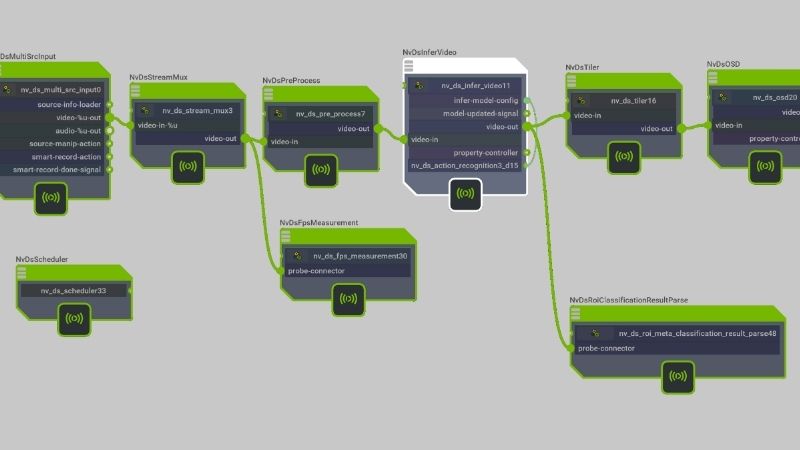
DeepStream works by constructing a pipeline that takes in video or other streams, decodes them, runs AI models to detect and understand what is happening, and then outputs the results, such as identifying and tracking objects across frames. Each stage is accelerated to keep up with real-time demands.
This pipeline approach means developers can assemble sophisticated analytics by connecting stages rather than writing everything from the ground up. The AI models do the actual understanding, while DeepStream efficiently manages the flow of data, the decoding, and the coordination needed to process streams quickly and at scale.
This separation of concerns is part of what makes the platform productive, since developers can focus on choosing and training the right AI models for their task while relying on DeepStream to handle the heavy engineering of moving and processing video efficiently. That division of labor lets teams build sophisticated analytics without becoming experts in the intricacies of high-performance video handling themselves.
Where DeepStream Runs
DeepStream is designed to run across NVIDIA’s hardware range, from powerful data center GPUs to compact edge devices intended for deployment in the field. This flexibility lets developers build applications that run wherever they are needed, whether in a central server or on a device near the cameras themselves.
Running analytics at the edge, close to where video is captured, is a major advantage for many applications, reducing the need to send huge amounts of video elsewhere for processing. DeepStream’s ability to run on both edge and data center hardware makes it adaptable to a wide range of deployment scenarios.
The edge option is particularly valuable for applications where bandwidth, latency, or privacy are concerns, since processing video where it is captured avoids streaming large volumes of footage across a network. A camera system analyzing feeds locally can react instantly and send only compact results rather than raw video, which is often more practical and cost-effective for large deployments spread across many locations.
What You Can Build with DeepStream
Understanding the platform naturally leads to the question of what it enables. DeepStream is used across many industries for intelligent video and sensor analytics, and it fits within NVIDIA’s broader ecosystem of AI tools. Seeing these possibilities clarifies who the platform is really for.
Common Use Cases and Applications
DeepStream powers a wide range of intelligent video applications, including smart city systems that analyze traffic and public spaces, retail analytics that understand customer behavior, industrial inspection that detects defects, and security and access systems. Its common thread is turning live video into actionable understanding.
Anywhere large numbers of camera feeds need to be analyzed intelligently in real time, DeepStream is a natural fit, which is why it is used in sectors ranging from transportation to manufacturing. The ability to process many streams efficiently is exactly what these demanding, large-scale deployments require.
What these varied applications share is a need to convert continuous streams of visual data into decisions or insights automatically, at a scale no human team could match. Whether counting vehicles, spotting defective products, or flagging unusual activity, the value comes from doing this reliably across many feeds at once, which is precisely the problem DeepStream was designed to solve.
How It Fits with Other NVIDIA Tools
DeepStream does not work in isolation but integrates with NVIDIA’s wider AI ecosystem, including its inference optimization and model deployment tools, so the AI models running in your pipeline can be highly optimized for performance. This integration is a key strength of building within the NVIDIA platform.
By connecting with these complementary tools, DeepStream lets developers take models trained and optimized elsewhere in the ecosystem and deploy them efficiently for real-time streaming analytics. This coherence across NVIDIA’s tools reduces friction and helps developers move from model to deployed application more smoothly.
Being part of a broader, well-supported ecosystem also means developers benefit from ongoing improvements across the whole stack rather than a single isolated tool. As NVIDIA advances its inference and model-deployment technologies, applications built on DeepStream can take advantage of those gains, which helps keep deployed systems performant and current without requiring a complete rebuild each time the underlying tools improve.
Pros and Cons of DeepStream
Weighing the trade-offs helps set expectations. On the plus side, DeepStream offers powerful, hardware-accelerated processing of many simultaneous streams, a proven pipeline framework that saves enormous development effort, flexibility to run from edge to data center, and tight integration with NVIDIA’s AI tools. For real-time video AI, that is a compelling combination.
On the downside, it is a specialized, developer-focused platform with a learning curve, it requires NVIDIA hardware to run, and it is aimed at serious applications rather than casual use. For those without a video-analytics need, it is not relevant, but for its intended audience building intelligent streaming applications, the capabilities justify the investment.
Getting Started with NVIDIA DeepStream
For those interested in exploring the platform, knowing what you need and where to learn makes the first steps far less daunting. A little preparation sets you up to make the most of DeepStream’s capabilities as you begin building.
What You Need to Begin
To start with DeepStream, you generally need compatible NVIDIA hardware, whether a suitable GPU or an edge device, along with the SDK and its supporting software components from NVIDIA’s developer resources. The hardware matters because real-time video AI is demanding and relies on acceleration.
A foundation in programming and some familiarity with AI concepts also helps, since DeepStream is built for developers rather than beginners to the field. Having the right hardware and background in place before diving in ensures you can actually build and run pipelines effectively rather than being held back by an underpowered setup or unfamiliar fundamentals.
It also helps to start with a clear, modest goal for your first project, such as detecting and counting a single type of object in one video stream, before scaling up to many feeds or more complex analytics. Beginning small lets you learn how the pipeline fits together and build confidence, so that expanding to a full multi-stream deployment later feels like a natural extension rather than an overwhelming leap.
Learning Resources and First Steps
NVIDIA provides documentation, sample applications, and tutorials for DeepStream, along with a community of developers, which makes learning the platform far more approachable. Starting with the sample pipelines is an excellent way to see how the pieces fit together before building your own.
Working through the official getting-started materials and examples helps you understand the pipeline structure and how to plug in AI models, giving you a working foundation to adapt. Tapping these resources and the community shortens the learning curve considerably, turning a powerful but complex platform into a productive tool for your video-AI projects.
Frequently Asked Questions About DeepStream
These quick answers resolve the questions that most often come up about NVIDIA DeepStream.
Is DeepStream for video only? It focuses on streaming analytics for video and related sensor data, making it ideal for intelligent video applications and multi-stream processing.
Do I need NVIDIA hardware? Yes. DeepStream is built to run on NVIDIA GPUs and edge devices, using their acceleration to process streams in real time.
See More:
Final Thoughts on NVIDIA DeepStream
NVIDIA DeepStream is a powerful platform for building real-time AI applications that understand video and streaming data, letting developers process many feeds at once with hardware-accelerated efficiency. With a proven pipeline framework, flexibility to run from edge devices to data centers, and tight integration with NVIDIA’s AI tools, it streamlines what would otherwise be an enormously complex undertaking. It is specialized and requires suitable hardware and development expertise, so it is aimed at serious video-analytics work rather than casual use. Start with a small, focused pipeline, lean on the sample applications, and expand as you learn. For developers building intelligent streaming applications, NVIDIA DeepStream offers a compelling, hardware-accelerated foundation for turning live video into real understanding, and its documentation and examples are the fastest way to put that foundation to work.
As an Amazon Associate we earn from qualifying purchases at no extra cost to you.





Write Your Review
No reviews yet. Be the first to share your experience!