
- Top Pick: AI for Robotics: Toward Embodied and General Intelligence in the Physical World
- Best Value: IoT Projects with NVIDIA Jetson Nano: A Step-by-Step Guide to Building Edge AI and Computer Vision Applications for Beginners (Edge AI Mastery: Building Intelligent IoT and TinyML Applications)
- Premium Choice: Physical AI and Robotics: A Standardized Engineering Path from Mechanical Design to Agentic Frameworks
NVIDIA Isaac is the company’s dedicated platform for building intelligent robots, bringing together simulation, perception, and AI tools that once required stitching together many separate systems. For developers and researchers working on everything from warehouse robots to autonomous machines, Isaac offers a unified, GPU-accelerated foundation. This guide explains what NVIDIA Isaac is and how its main components fit together, what you can actually build with it, and how to get started, so you can understand whether this powerful robotics platform is the right tool for your projects.
What Is NVIDIA Isaac?
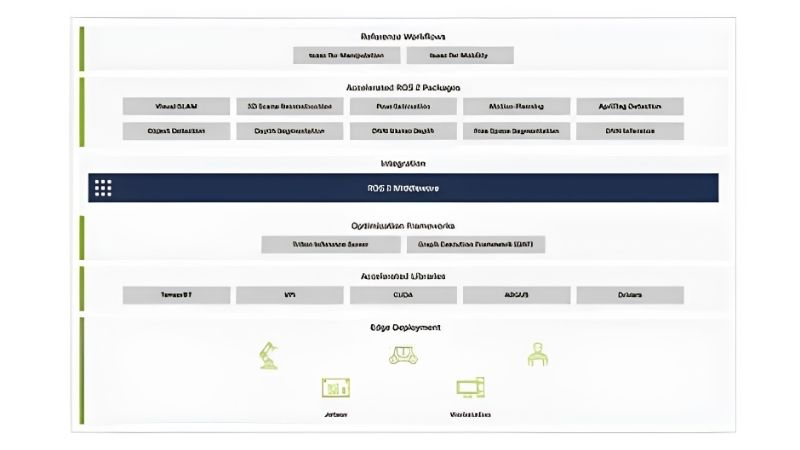
Before diving into its capabilities, it helps to understand what NVIDIA Isaac is at a high level. It is a comprehensive robotics platform that combines simulation, AI perception, and deployment tools, all accelerated by NVIDIA hardware. Knowing how its pieces work together makes it far easier to see where it fits into a robotics project.
The Isaac Robotics Platform Overview
NVIDIA Isaac is a collection of tools and frameworks designed to accelerate the development of AI-powered robots, spanning the entire workflow from simulation and training to real-world deployment. Rather than a single program, it is a platform whose parts address different stages of building a robot.
The platform’s key strength is bringing these stages together under one accelerated ecosystem, so developers can design, test, and deploy robotic applications more efficiently than by assembling disparate tools. This integration is a large part of its appeal, reducing the friction that has traditionally made robotics development slow and complex.
Because it is built on NVIDIA’s hardware and software stack, Isaac takes advantage of GPU acceleration throughout, which is especially valuable for the compute-heavy tasks of simulation and AI perception. This foundation is what allows the platform to handle demanding robotics workloads that would strain conventional approaches.
Isaac Sim and Simulation
A cornerstone of the platform is Isaac Sim, a powerful simulation environment where developers can build and test robots in a realistic virtual world before deploying them physically. This lets teams safely experiment, train AI models, and refine behavior without the cost, risk, and slowness of testing only on real hardware.
Simulation is invaluable in robotics because it allows countless scenarios to be run quickly and safely, generating training data and validating designs in ways that physical testing alone cannot match. By providing a high-fidelity virtual environment, Isaac Sim dramatically accelerates development and reduces the expensive trial-and-error that real-world robotics typically involves.
The ability to generate synthetic training data is a particularly powerful aspect of simulation. AI perception models need vast amounts of labeled data to learn, and gathering that from the real world is slow and costly, whereas a simulator can produce it quickly across endless variations of lighting, layout, and conditions. This makes Isaac Sim not just a testing tool but a genuine accelerator for the machine learning that modern robots depend on.
Isaac ROS and Real-World Deployment
Complementing simulation, Isaac ROS provides GPU-accelerated packages that bring high-performance perception and processing to real robots, integrating with the widely used robotics software ecosystem. This helps robots see, understand, and navigate their environments using the power of NVIDIA hardware.
The goal is a smooth path from a robot simulated in Isaac Sim to one operating in the real world, with the perception and intelligence developed in simulation carrying over to physical deployment. This continuity from virtual to real is central to the platform’s value, closing the gap that often makes moving from prototype to production so difficult in robotics.
Bridging the so-called sim-to-real gap has long been one of robotics’ hardest challenges, since behavior that works perfectly in simulation can falter when faced with the messiness of the real world. By designing simulation and deployment to work together within one platform, Isaac aims to narrow that gap, giving developers a better chance of carrying their tested intelligence into physical robots without starting over, which is a meaningful practical advantage.
What You Can Build with NVIDIA Isaac
Understanding the platform’s components naturally leads to the question of what it enables. Isaac is used across a wide range of robotics applications, and its hardware connection shapes how projects move from development to deployment. Seeing these possibilities clarifies who the platform is really for.
Common Use Cases and Applications
NVIDIA Isaac supports a broad spectrum of robotics applications, including warehouse and logistics robots, manufacturing automation, autonomous mobile machines, and research into advanced robotic behaviors. Its tools suit both industrial deployments and academic exploration, making it versatile across the field.
The common thread is robots that need to perceive and respond to their environment intelligently, which is exactly what the platform’s simulation and AI perception tools are built to enable. Whether the goal is a robot that navigates a busy warehouse or one that manipulates objects with precision, Isaac provides the foundation for developing that intelligence efficiently.
The platform’s breadth is part of what makes it appealing to organizations, since the same underlying tools can support very different projects. A logistics company automating a warehouse and a research lab exploring novel robot behaviors can both build on Isaac, applying its simulation and perception capabilities to their specific needs. That flexibility reduces the need to adopt entirely different toolchains for different kinds of robotics work.
Hardware and the Jetson Connection
Isaac is closely tied to NVIDIA’s hardware, particularly its edge computing platform for robots, which provides the onboard processing power that deployed robots need to run AI perception and control in real time. This connection between the development platform and the deployment hardware is a key part of the ecosystem.
The idea is a seamless pipeline where robots developed and trained using Isaac’s tools run on NVIDIA’s compact, powerful edge hardware in the real world. This tight integration between software and hardware is one of the platform’s biggest advantages, ensuring that the intelligence built in development can actually run efficiently on the robot itself.
This end-to-end approach, from simulation on powerful development machines to inference on compact edge hardware, is difficult to assemble from unrelated tools. By offering both halves within one ecosystem, NVIDIA reduces the integration headaches that often slow robotics projects, letting teams focus on their robot’s actual behavior rather than on making disparate software and hardware pieces cooperate, which is a significant part of the platform’s practical appeal.
Pros and Cons of the Isaac Platform
Weighing the trade-offs helps set expectations. On the plus side, Isaac offers a unified, GPU-accelerated platform covering the full robotics workflow, powerful simulation that speeds development, strong AI perception tools, and tight integration with NVIDIA’s deployment hardware. For serious robotics work, that comprehensive foundation is a major advantage.
On the downside, the platform is specialized and has a learning curve, it is aimed at developers and researchers rather than casual users, and getting the full benefit typically means investing in NVIDIA hardware. For those without a genuine robotics development need, it is simply not relevant, but for its intended audience, the depth and integration justify the commitment.
Getting Started with NVIDIA Isaac
For those interested in exploring the platform, knowing what you need and where to learn makes the first steps far less daunting. A little preparation sets you up to make the most of Isaac’s capabilities as you begin your robotics journey.
What You Need to Begin
To start with NVIDIA Isaac, you generally need compatible NVIDIA hardware for the compute-intensive simulation and AI tasks, along with the relevant software components from NVIDIA’s developer resources. A capable system is important because simulation and AI perception are demanding workloads that benefit greatly from strong GPU power.
Beyond hardware, a foundation in robotics concepts and programming helps, since the platform is built for developers rather than beginners to the field. Having the right setup and background in place before diving in ensures you can actually use the platform’s powerful tools effectively rather than being held back by an underpowered system or a steep unfamiliar learning curve.
Learning Resources and Ecosystem
NVIDIA provides extensive documentation, tutorials, and developer resources for Isaac, along with an active community of robotics developers, which makes learning the platform much more approachable. Starting with the official getting-started materials is the best way to build a solid understanding of how the components fit together.
The broader ecosystem, including integration with widely used robotics software and NVIDIA’s other AI tools, means skills and knowledge transfer well across projects. Tapping into these resources and the community helps you climb the learning curve faster and avoid common pitfalls, turning a powerful but complex platform into a genuinely productive tool for your robotics work.
Frequently Asked Questions About NVIDIA Isaac
These quick answers resolve the questions that most often come up about NVIDIA Isaac.
Is NVIDIA Isaac free to use? Many of its tools and resources are available to developers, though you generally need compatible NVIDIA hardware, and specific licensing can vary by component and use.
Who is Isaac for? It is aimed at robotics developers, researchers, and companies building AI-powered robots, rather than casual users or those without a robotics project.
See More:
- NVIDIA
- NVIDIA DeepStream
- NVIDIA GPU driver update
- NVIDIA GeForce NOW download
- NVIDIA RTX A2000 12GB driver
Final Thoughts on NVIDIA Isaac
NVIDIA Isaac is a powerful, unified platform for building intelligent robots, bringing simulation, AI perception, and deployment together in one GPU-accelerated ecosystem. With Isaac Sim for virtual testing, Isaac ROS for real-world perception, and tight integration with NVIDIA’s edge hardware, it streamlines a robotics workflow that has traditionally been fragmented and slow. It is specialized and demands both suitable hardware and development expertise, so it is squarely aimed at serious robotics work rather than casual use. Its learning curve and hardware requirements mean it rewards commitment rather than casual curiosity. For developers and researchers genuinely working in that space, though, NVIDIA Isaac offers a compelling, unified foundation for turning robotics ideas into working, intelligent machines, and tapping its documentation and community is the fastest way to put that foundation to use.
As an Amazon Associate we earn from qualifying purchases at no extra cost to you.





Write Your Review
No reviews yet. Be the first to share your experience!