
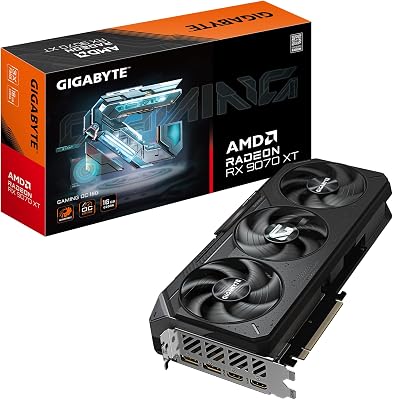
- Top Pick: GIGABYTE Radeon RX 9070 XT Gaming OC 16G Graphics Card, PCIe 5.0, 16GB GDDR6, GV-R9070XTGAMING OC-16GD Video Card
- Best Value: GIGABYTE Radeon™ RX 9070 XT Gaming OC ICE 16G Graphics Card (16GB GDDR6, 256-bit, PCIe 5.0, HDMI/DP 2.1, 2.7 Slot, Hawk Fan, Server-Grade Thermal Gel, Reinforced Structure)
- Premium Choice: ASUS Prime Radeon RX 9070 XT 16GB GDDR6 OC Edition Gaming Graphics Card
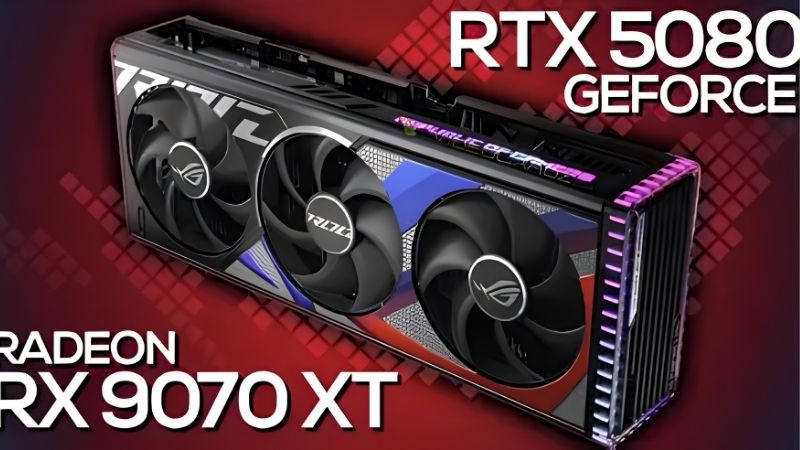
Radeon RX 9070 XT vs RTX 5080 is the most interesting mismatch in high-end gaming right now: a $599 AMD card lined up against a $999 Nvidia flagship that costs two-thirds more. On paper the RTX 5080 should win, and it does — but the size of that win, and whether it justifies the price, is the whole question. This comparison settles which card actually deserves your money in 2026.


The Quick Verdict: RX 9070 XT vs RTX 5080
Short version: the RTX 5080 is the faster card, roughly 15-20% ahead on average, and it is the pick if 4K ultra with maxed ray tracing is non-negotiable. But the RX 9070 XT delivers far better value, offering around 80% of the performance for about 60% of the price, which makes it the smarter buy for the vast majority of high-end gamers.
As an Amazon Associate we earn from qualifying purchases at no extra cost to you.


Who Wins on Raw Performance
Framed differently, the 5080 is the card that never makes you compromise, while the 9070 XT occasionally asks you to drop one setting from ultra to high in the most punishing titles. For many players that is a trade they will happily make, and for a few it is exactly the compromise they bought a flagship to avoid.
The RTX 5080 wins cleanly. Across a broad set of games it averages about 15% faster at 1440p and closer to 20% at 4K, where its higher memory bandwidth stretches the lead. At the very top of the settings ladder, it is simply the stronger GPU.
That said, the gap is smaller than the price implies. In many rasterized titles the 9070 XT trails by a margin most players would not notice without a frame counter on screen, which is exactly why the value debate is so live.
It is also worth remembering that both cards already exceed the refresh rate of most monitors in lighter esports titles, so the 5080’s lead only becomes visible in the heaviest, most demanding games at the highest resolutions.
Who Wins on Value
The RX 9070 XT, and it is not close. At a $599 MSRP against the 5080’s $999, the AMD card delivers dramatically more frames per dollar. When one card is roughly 20% slower but 40% cheaper, the math favors the cheaper card for anyone not chasing the absolute ceiling.
That freed-up budget is real: the difference can fund a better CPU, a faster monitor, or more storage, all of which improve your experience more than the last 20% of GPU headroom would.
Value is also about resale and longevity, and the 9070 XT’s 16GB buffer means it is not memory-starved for years to come. You are not sacrificing future-proofing to save money here, which is what makes the value case so strong.
Specification Comparison Table
Here are the core numbers side by side, drawn from each card’s official specifications, so the hardware gap is clear before we get into what it means in real games.
| Spec | RX 9070 XT | RTX 5080 |
|---|---|---|
| Architecture | RDNA 4 | Blackwell |
| Shaders / CUDA cores | 4,096 | 10,752 |
| Memory | 16GB GDDR6 | 16GB GDDR7 |
| Bandwidth | 640 GB/s | 960 GB/s |
| TDP | 304W | 360W |
| Upscaling / Frame Gen | FSR 4, AFMF | DLSS 4, Multi Frame Gen |
| Launch MSRP | $599 | $999 |
Deep Dive Face-Off: Speed, Ray Tracing, and Efficiency
The spec sheet shows two very different design philosophies. The 5080 throws far more shaders and faster memory at the problem; the 9070 XT counters with newer lithography and aggressive pricing. Here is where those choices actually land in games, criterion by criterion.
Raw Speed and 4K Gaming
It helps to be honest about your display before reading too much into the 4K numbers. Gamers on a 1440p high-refresh panel will see the two cards behave almost identically in day-to-day play, while only those with a genuine 4K screen and the settings cranked will consistently feel the 5080 pull away.
At 4K, the RTX 5080’s 960 GB/s of GDDR7 bandwidth and 10,752 CUDA cores give it a consistent edge, typically averaging around 90 FPS in demanding titles where the 9070 XT sits closer to 75 FPS. For a 4K-first buyer, that headroom is the reason to consider the Nvidia card.
Drop to 1440p and the margin narrows. The 9070 XT is a genuinely strong 1440p performer that clears high-refresh targets comfortably, so if that is your resolution, you are paying the 5080 premium for headroom you may never actually use.
The practical implication is that your monitor should drive this decision as much as the benchmark charts. A 1440p gamer and a 4K gamer will reach opposite conclusions from the very same numbers.
Ray Tracing and Upscaling: DLSS 4 vs FSR 4
The gap here is also the part of the comparison most likely to widen over time. As more titles ship with heavier path tracing and lean on AI upscaling, Nvidia’s more established feature set tends to benefit first, which is worth weighing if you keep a card for several years rather than upgrading each cycle.
This is where the extra money buys something concrete. The RTX 5080 has stronger ray-tracing hardware and DLSS 4 with Multi Frame Generation, an exclusive feature that can multiply frame output in supported games, backed by Reflex for latency control. In heavy path-traced titles, the 5080 pulls meaningfully ahead.
AMD has closed the gap considerably with FSR 4 and Fluid Motion Frames, and for rasterized gaming the two are close. But if ray tracing and the widest upscaling support are priorities, Nvidia’s software stack remains the more mature, forward-looking option.
It is worth being precise about what frame generation does: it adds interpolated frames for smoothness rather than raw responsiveness, which is why Reflex is bundled to keep input latency low. For visually rich single-player games, that trade is a clear win for the 5080.
Power, Thermals, and System Fit
The 9070 XT is the more efficient card, drawing 304W against the 5080’s 360W, and it typically runs cooler and quieter under sustained load. The 5080’s higher draw can mean a beefier power supply and more attention to case airflow.
Neither is exotic to cool, but the practical takeaway is that a 9070 XT build is easier on your PSU and thermals. If you value a quiet, efficient system, that is a real point in AMD’s favor beyond the price tag.
Factor the power difference into total cost as well: a higher-wattage card can nudge you into a pricier PSU and slightly higher running costs, small numbers individually but part of the honest comparison.
Price, Availability, and the Alternative
Specs decide which card is faster; the market decides which is worth buying. In 2026 both cards have spent time above their launch prices, so timing matters as much as the choice itself, and a little patience can save real money.
MSRP vs Street Prices in 2026
That divergence is the single biggest reason to shop on live prices rather than launch figures. A comparison that looks like $599 versus $999 on paper can, in a bad week for Nvidia stock, balloon into a far wider real-world gap that tilts the value case even harder toward the AMD card.
The 9070 XT launched at $599 and the 5080 at $999, but rising memory costs and constrained supply pushed real-world prices up across the high end. AMD’s card has generally tracked closer to its MSRP than Nvidia’s flagship, which has often sold well above list.
Supply pressure has been a factor throughout the year, so the sensible move is to treat each card’s MSRP as the fair-price anchor and judge any listing against it rather than against inflated retail asks.
That anchoring discipline matters most at the high end, where a 20% premium is measured in hundreds of dollars rather than tens. Overpaying here is an expensive mistake that a little research easily avoids.
Is Price Relief Coming?
There is modest good news. The steep price climb of late 2025 has eased and the market has shown a stretch of relative stability, though makers still warn that conditions can shift. In short, prices have levelled off rather than fallen.
Because meaningful new component supply is not expected to move the needle until 2027-2028, waiting indefinitely for a crash is a weak plan. Buying when a card hits a fair price is the better strategy this year.
The realistic expectation is gradual improvement in availability rather than a sudden drop in price. Treat any dip toward MSRP as the opportunity, not a signal that a bigger one is coming.
The Alternative If the 5080 Feels Too Steep
If you want more than the 9070 XT but cannot stomach the 5080’s price, the RTX 5070 Ti at a $749 MSRP is the natural middle ground, delivering roughly 85-90% of 5080 gaming performance with the same DLSS 4 features. It often makes both of these cards look like the extremes of the range.
Check the live price on all three before deciding — in a volatile market, the card sitting closest to its MSRP is frequently the real value, regardless of where it lands on the spec sheet.
Buying the right card at the wrong price is still a bad deal, so let current pricing, not just the benchmark ranking, guide the final call between these three options.
Final Verdict: RX 9070 XT vs RTX 5080
This comes down to a simple question of priorities: absolute performance or performance per dollar. Both cards are excellent; they simply serve different buyers, and the right pick is the one that matches how you actually play and what you value most.
Who Should Buy the RX 9070 XT
It is also the low-stress choice for a first high-end build. The efficient power draw, cooler operation, and price closer to MSRP mean fewer surprises on your electricity bill and less pressure to overspend on a power supply, leaving more of your budget for the parts you will actually notice.
Most high-end gamers. If you play at 1440p or 4K with a mix of settings, value efficiency, and want to keep several hundred dollars for the rest of your build, the 9070 XT is the smart-money choice and the better overall value.
Who Should Buy the RTX 5080
This is equally the pick for creators and hybrid users. If you render, stream, or dabble in local AI alongside gaming, the 5080’s extra compute and mature software ecosystem pay dividends outside of games, which can justify the premium for a machine that has to do more than one job.
Enthusiasts chasing the ceiling. If you game at 4K ultra with maxed ray tracing, want the strongest DLSS 4 experience, and the price is not a barrier, the 5080 is the faster, more future-proof flagship.
See More:
- TechPowerUp GPU
- Nvidia H200 GPU price
- RTX 5050 Mobile
- Nvidia competitors
- Nvidia Reflex low latency on or off
Pros and Cons at a Glance
The summary below distills the whole comparison into the trade-offs that actually change a purchase decision, so you can match a column to your own priorities in seconds.
| RX 9070 XT | RTX 5080 | |
|---|---|---|
| Best for | Value-focused 1440p/4K, efficient builds | 4K ultra, maxed ray tracing, top DLSS 4 |
| Strength | ~80% of the speed for ~60% of the price | ~15-20% faster, stronger RT + DLSS 4 |
| Weakness | Weaker ray tracing, FSR less mature | Costs ~$400 more, higher power draw |
To close the Radeon RX 9070 XT vs RTX 5080 debate: buy the 9070 XT for value, buy the 5080 for the ceiling, and consider the 5070 Ti if you land in between. Whichever you choose, high-end prices move quickly, so tap the link on our site to check today’s live price and stock before you commit.
Frequently Asked Questions
Are these two cards really in the same class?
Not quite. The RTX 5080 launched at 999 dollars against 599 for the RX 9070 XT and sits a clear tier above in raw performance, particularly at 4K. The comparison is about value: whether the NVIDIA card’s lead justifies the substantial price difference, or whether the Radeon delivers enough of the experience for far less money.
How much faster is the RTX 5080 in practice?
In rasterised games at 4K the 5080 typically leads by a wide margin, and in heavy ray-traced or path-traced workloads the gap grows further thanks to stronger RT cores and DLSS 4 with multi frame generation. At 1440p the difference narrows because both cards start bumping into CPU limits in many titles, which flatters the cheaper option.
What about VRAM, since both have 16GB?
Capacity is identical at 16GB, so neither has an advantage there, and 16GB remains sufficient for 4K gaming today. The RTX 5080 uses faster GDDR7 on a 256-bit bus for significantly more bandwidth, which helps at high resolutions with ray tracing. Some buyers consider 16GB tight for a card at the 5080’s price, given its likely service life.
What are the power and case requirements?
The RTX 5080 is rated at 360W with a single 16-pin 12V-2×6 connector and a recommended 850W supply, and partner models are frequently three slots thick and over 320mm long. The RX 9070 XT sits at 304W using two or three 8-pin connectors with a 750W recommendation. Measure your case clearance and check PSU cable availability before ordering either.
Which should I buy for 1440p high refresh gaming?
The RX 9070 XT is the better value at that resolution, where its raster performance is close and the price saving is large enough to fund a better monitor or CPU. Choose the RTX 5080 if you game at 4K, rely on path tracing, use CUDA-accelerated creative software, or want multi frame generation to drive a very high refresh display.
Ready to decide? Our #1 pick for 2026 is the Architecture.
Live price & availability on Amazon.



Write Your Review
No reviews yet. Be the first to share your experience!