
The Short Answer
For vertical mounting, choose a GPU that fits three measurements: the case’s supported vertical GPU length, the mount’s slot width, and the clearance between the card’s cooler and the side-panel glass. Most current full-size graphics cards are 11.0 to 13.4 inches (279 to 340 mm) long, 4.4 to 5.9 inches (112 to 150 mm) tall, and 2.0 to 3.5 slots thick. A 3-slot or 4-slot vertical kit is the safest choice for a modern midrange or high-end card.
As a practical rule, leave at least 0.8 inch (20 mm) between the GPU fan shroud and a glass side panel. For thicker, air-cooled cards, 1.2 to 1.6 inches (30 to 40 mm) is better. This open space lets the fans pull in air rather than recirculating warm air against the glass.
As an Amazon Associate we earn from qualifying purchases at no extra cost to you. Product prices and availability are accurate as of the date shown and are subject to change.
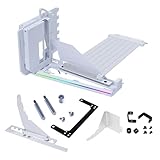


Also check your PCIe riser cable version. Use a PCIe 5.0 riser for a PCIe 5.0 motherboard and graphics card when possible; a PCIe 4.0 riser is appropriate for PCIe 4.0 systems. The connector is physically compatible across versions, but matching the cable to the platform avoids setup issues and potential bandwidth limitations. In 2026, a quality 3-slot or 4-slot kit with a PCIe 4.0 or 5.0 riser typically costs about $50 to $80, while basic 2-slot brackets can cost $17 to $30.
Standard Sizes
GPU dimensions vary widely by manufacturer, even for cards using the same graphics processor. Always use the dimensions listed for the exact card model—not the dimensions of a reference card or a different cooler version. The table below covers common desktop GPU size categories and the vertical mount capacity they usually require.
| GPU Size Category | Typical Length | Typical Height | Typical Thickness | Recommended Vertical Mount | Recommended Side-Panel Clearance |
|---|---|---|---|---|---|
| Compact / ITX | 6.7–8.3 in (170–210 mm) |
4.3–4.8 in (110–122 mm) |
2.0–2.5 slots (40–52 mm) |
2-slot or 3-slot | 0.8–1.0 in (20–25 mm) |
| Standard dual-fan | 9.5–12.0 in (241–305 mm) |
4.4–5.2 in (112–132 mm) |
2.2–3.0 slots (45–62 mm) |
3-slot | 1.0–1.2 in (25–30 mm) |
| Large triple-fan | 11.5–13.4 in (292–340 mm) |
5.3–5.9 in (135–150 mm) |
3.0–3.5 slots (62–72 mm) |
4-slot | 1.2–1.6 in (30–40 mm) |
| Extra-thick flagship | 12.0–14.0 in (305–356 mm) |
5.5–6.3 in (140–160 mm) |
3.5–4.0 slots (72–82 mm) |
4-slot, case-specific kit | 1.6 in minimum (40 mm minimum) |
| Single-slot / low-profile | 6.6–7.5 in (168–191 mm) |
2.7–4.1 in (69–105 mm) |
1.0–1.5 slots (20–31 mm) |
2-slot bracket | 0.6–0.8 in (15–20 mm) |
Slot thickness is especially important. A “3-slot” GPU is not always exactly three expansion slots wide: some cards measure 2.7 slots, while others are closer to 3.3 slots. A 4-slot vertical mount provides useful breathing room for GPUs up to about 3.5 slots thick. It is usually a better choice than forcing a thick card into a 3-slot bracket.
Mount dimensions matter, too. A typical universal vertical mount occupies seven rear expansion-slot openings and positions the GPU roughly 1.0 to 1.5 inches (25 to 38 mm) inward from the case’s original rear expansion area. This changes the available clearance compared with horizontal installation. Case-specific mounting frames may sit farther from the glass and are often the best option for wide, high-wattage GPUs.
How to Measure Your Space
- Remove the side panel and measure the case width. Measure from the motherboard tray to the inside face of the side panel. Most standard mid-tower cases offer about 7.5 to 9.0 inches (190 to 229 mm) of internal width, but the usable amount is reduced by the motherboard, vertical bracket, and GPU.
- Measure maximum GPU length. Measure from the rear expansion-slot area to the first obstruction at the front of the case. This may be a radiator, front fan, drive cage, pump, or cable bundle. Add no less than 0.4 inch (10 mm) beyond the card’s listed length for comfortable installation.
- Check vertical slot availability. Count the rear expansion slots your case provides. Most ATX mid-towers have seven slots. A universal vertical kit often uses all seven, while compact cases may require a dedicated mount designed for their layout.
- Measure GPU thickness. Find the manufacturer’s thickness in millimeters or slot count. If only millimeters are listed, divide by 20.32 to estimate slots. For example, a 61 mm card is approximately 3 slots thick.
- Calculate glass clearance. Add the vertical mount’s offset to the GPU thickness, then compare that total with the case’s internal width. The remaining space between the GPU intake fans and side panel should be at least 0.8 inch (20 mm), with 1.2 inches (30 mm) preferred for cards drawing 300 watts or more.
- Confirm power-cable room. Vertical mounting changes the direction of the GPU’s power connector. Allow at least 1.4 inches (35 mm) above or beside the connector for a gradual cable bend. For larger 16-pin power connectors, 1.6 to 2.0 inches (40 to 50 mm) is a safer target.
- Verify the riser cable length. A 175 mm riser is common for ATX cases and integrated mounting kits. Smaller cases may need 140 to 160 mm, while roomy layouts or external brackets may need 200 to 300 mm. Avoid sharply folding the riser cable.
By Room or Use Case
Compact Desk Setup or Small Bedroom
For a small desk, prioritize a compact GPU and an enclosed case with sensible airflow. A card under 11 inches (280 mm) long and 2.5 slots thick is the easiest fit. Look for a 2-slot or 3-slot mount, but do not choose a narrow bracket if the card’s cooler is near 3 slots wide. Compact vertical builds look clean, yet they can run warmer because the glass panel is usually close to the fans.
Choose a case with at least 1.0 inch (25 mm) of fan-to-glass clearance and front or bottom intake fans. A 200 to 250 watt GPU is generally easier to cool in this format than a 350 watt card.
Living Room Gaming PC
A vertical GPU can be a strong choice for a living room PC because it displays the card neatly through a tempered-glass panel and can make cable routing less visible. Choose a sturdy steel 3-slot or 4-slot mount for GPUs weighing more than 3.0 pounds (1.36 kg). Many large triple-fan cards weigh 3.3 to 5.0 pounds (1.5 to 2.3 kg), so a flimsy bracket is not ideal.
For a quiet living room build, favor a case with mesh intake and room for at least two 120 mm or 140 mm intake fans. If the card is thicker than 65 mm, use a 4-slot mount and avoid placing its fans directly against solid glass.
Showpiece RGB Build
For a display-focused build, select a vertical kit made specifically for your case when one is available. These kits usually place the GPU in a predictable location and may preserve better side-panel clearance than a universal bracket. A 4-slot kit is the most versatile option for premium cards, especially models measuring 12 to 14 inches (305 to 356 mm) long.
Plan for the visual details, including the riser cable, GPU support, and power-cable routing. White kits and black kits are widely available. Expect integrated PCIe 4.0 or 5.0 kits to fall around $75 to $80, while simpler brackets without a premium riser often land between $17 and $30.
Workstation or High-Wattage GPU
Vertical mounting is possible for a workstation, but airflow and structural support should come before appearance. Use a 4-slot mount, a reinforced case frame, and at least 1.6 inches (40 mm) of side-panel clearance for a 350 watt or higher GPU. If the card uses a thick vapor-chamber cooler, a horizontal position may provide better unrestricted intake airflow in a narrow case.
Do not block bottom intake fans with the mount or card. In workstation cases with multiple PCIe cards, vertical mounting may also obstruct adjacent expansion slots, so confirm that you will still have room for capture cards, sound cards, networking cards, or storage adapters.
Common Sizing Mistakes
- Buying by slot count alone. A “3-slot” card may exceed the usable width of a 3-slot bracket. Check the exact millimeter thickness.
- Ignoring side-panel clearance. A card can technically fit but still run poorly when its fans sit 0.2 to 0.4 inch (5 to 10 mm) from glass.
- Using the case’s horizontal GPU clearance. Vertical mounting moves the card to a different position. Re-measure from the bracket location.
- Forgetting radiator and fan depth. A front-mounted 360 mm radiator with 25 mm fans can reduce usable GPU length by 2.0 inches (50 mm) or more.
- Choosing an incompatible riser generation. A mismatched or low-quality riser may require BIOS changes or cause instability. Match the riser to the system’s PCIe generation when possible.
- Underestimating cable-bend space. Power cables need room to bend gradually, particularly on tall cards near a glass panel.
FAQ
Can any GPU be vertically mounted?
Most standard desktop GPUs can be vertically mounted if the case accepts a vertical bracket and the card fits the mount’s thickness, length, and clearance limits. Low-profile cards, unusually tall cards, and very thick 4-slot models may require a case-specific solution.
Is a 3-slot or 4-slot vertical GPU mount better?
A 3-slot mount works for GPUs up to roughly 62 mm thick. A 4-slot mount is better for cards measuring 62 to 82 mm thick and offers more flexibility for future upgrades. For most modern triple-fan cards, choose 4-slot if your case supports it.
How much space should be between a vertical GPU and glass?
Leave at least 0.8 inch (20 mm). For larger air-cooled GPUs, 1.2 to 1.6 inches (30 to 40 mm) is preferable. More space usually means the fans can draw cooler air with less noise.
Does vertically mounting a GPU affect performance?
The orientation itself does not reduce GPU performance. Performance can be affected if the side panel restricts airflow, if the riser cable is poor quality, or if the mounting position blocks intake fans. With proper clearance, a sturdy bracket, and a compatible riser cable, vertical mounting can work as well as a standard horizontal installation.






Write Your Review
No reviews yet. Be the first to share your experience!