
Our Short List of 3
All 5 Picks at a Glance
| Product | Specs | Action |
|---|---|---|
 Lincoln Electric Traditional MIG/Stick Welding Gloves | Check price on Amazon | |
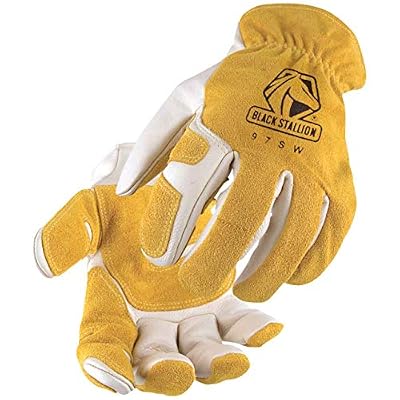 Black Stallion 97SW Grain Cowhide Drivers Glove | Check price on Amazon | |
 Lincoln Electric K2981 Grain Leather TIG Welding Gloves | Check price on Amazon | |
 Caiman Premium Goat Grain TIG and Multi-Task Welding Gloves | Check price on Amazon | |
 RAPICCA 16-Inch Leather Welding Gloves | Check price on Amazon |
Welding gloves look simple until the wrong pair slows you down. A glove that is too thick makes feeding filler rod feel clumsy, while a glove that is too thin leaves your hands exposed to spatter and radiant heat. The right choice depends less on brand loyalty than on the process you run most often, the fit of your hand, and how much forearm coverage the job demands. A MIG welder running long beads needs a lined gauntlet with reinforced wear points. A TIG welder needs thin, flexible leather and a close fit. A stick welder needs padding and a long cuff for overhead work. This guide compares five leather welding gloves that cover those jobs, from a classic lined MIG and stick gauntlet to a dexterity-first TIG glove and an extra-long forge-style pair, so you can match the glove to your work instead of buying on looks alone.
- Quick Answer
- How to Choose
- Lincoln Electric Traditional MIG/Stick Welding Gloves
- Black Stallion 97SW Grain Cowhide Drivers Glove
- Lincoln Electric K2981 Grain Leather TIG Welding Gloves
- Caiman Premium Goat Grain TIG and Multi-Task Welding Gloves
- RAPICCA 16-Inch Leather Welding Gloves
- Who Should Skip It
- FAQ
- Final Verdict
- Product and ASIN Reference
As an Amazon Associate, we earn from qualifying purchases.
Quick Answer
For most MIG and stick welders, the Lincoln Electric K2979-ALL is the straightforward pick, a lined split-cowhide gauntlet with Kevlar stitching. The Black Stallion 97SW suits lighter spot-welding and general shop work, the Lincoln Electric K2981 fits precision TIG, the Caiman 1540 covers TIG plus light multi-task jobs, and the RAPICCA 16-inch pair adds the longest forearm coverage for forge and furnace work.
How to Choose
Start with the process, because it decides how much insulation and dexterity you need. TIG work rewards thin goatskin or grain leather, a close fit, and a palm you can feel the filler rod through. MIG work calls for a lined glove with reinforced wear areas, since spatter and radiant heat are heavier than in TIG. Stick welding and self-shielded flux-core demand the most protection, so a padded lining and a long gauntlet make sense, especially overhead. If you run two processes regularly, two pairs will serve you better than one compromise pair that is wrong for both.
Fit matters as much as leather. Gloves that are too large fold at the palm and leave extra material at the trigger finger, which makes torch control sloppy. Gloves that are too tight pull at the seams and tire your hands. Measure your hand against the maker’s size chart and check whether the listing sells real sizes or a single one-size option.
Read the cuff, lining, and stitching as a system. A fleece or padded lining adds a heat barrier but costs dexterity. A longer cuff guards the wrist and lower forearm from spatter, but glove length alone does not close the gap between glove and sleeve. Kevlar thread and welted seams speak to seam strength in hot, abrasive conditions. None of these details proves a universal safe-contact time for hot metal, so treat any temperature claim on a listing as a description of the materials, not permission to hold a freshly welded part.
Remember that ordinary leather welding gloves are not certified electrical insulating gloves. Keep them dry, inspect them before every session, and replace a pair with scorched leather, open seams, or a damaged lining. Do not try to restore a compromised glove with tape or a flammable treatment.
Lincoln Electric Traditional MIG/Stick Welding Gloves
The Lincoln Electric K2979-ALL is the classic lined gauntlet that most welders should consider first. It is a 14-inch split-cowhide glove with a cotton sock lining, Kevlar-stitched welt seams, and reinforced thumb wear points. That combination covers the middle of the road well: enough lining for MIG spatter and occasional stick work, enough leather for grinding and torch work, and a long cuff that reaches well up the forearm. It is the pair to buy when you run MIG most days and switch to stick now and then.
The trade-off is fit. This glove is sold as one size fits most, and that is a genuine limitation. Welders with small hands often find the fingers too long and the palm too loose, which hurts trigger feel and makes the glove bunch when gripping a stinger. If one-size gloves have swamped your hand before, a sized glove such as the Caiman 1540 will fit you better. The cotton lining is comfortable, but it is not the heavy padded barrier of a dedicated stick gauntlet, so long overhead stick sessions may call for more insulation.
Black Stallion 97SW Grain Cowhide Drivers Glove
The Black Stallion 97SW is a lighter glove than the big gauntlets in this guide, and that is its appeal. It is a grain cowhide drivers glove with a reinforced palm, an elastic wrist band, and Kevlar stitching, built by Revco for spot welding and general shop tasks. The grain leather palm gives a better feel than split cowhide, the reinforced palm adds wear resistance where the hand grips, and the elastic wrist keeps the glove snug without a long cuff getting in the way. It suits welders who do short welds, tacking, and fitting work between longer runs.
The trade-off is coverage. This is not a long gauntlet, so it does not protect the forearm the way a 14-inch or 16-inch glove does. It is a poor choice for overhead stick welding or any job where spatter rains down on the wrist and sleeve. The lighter build also means less heat buffering than a fleece-lined or padded MIG glove, so sustained high-amperage work will outrun it. Treat the 97SW as a nimble glove for lighter duty, and keep a heavier gauntlet on hand for the hot jobs.
Lincoln Electric K2981 Grain Leather TIG Welding Gloves
The Lincoln Electric K2981 is the dexterity pick in this guide. It is a grain leather TIG glove with a soft hand, three-part sewn fingers, an unlined padded palm, Kevlar-stitched seams, and a 4-inch cuff. That construction is aimed squarely at TIG welding, where the non-dominant hand feeds filler rod and the dominant hand steadies the torch. Thin leather and a close fit let you feel the rod and control a small puddle, which is exactly what a thick MIG gauntlet cannot do.
The trade-off is protection. An unlined padded palm gives feel but little thermal insulation, so this glove is not the answer for heavy MIG spatter, self-shielded flux-core, or stick welding. TIG itself can still create serious radiant heat near large hot workpieces, so hand position and work holding matter even with a good TIG glove. Sizes vary across the K2981 family, so verify the exact size option on the listing before ordering. Do not buy this glove two sizes too large to make it feel cooler; loose leather is not a substitute for fit or task-appropriate protection.
Caiman Premium Goat Grain TIG and Multi-Task Welding Gloves
The Caiman 1540 is the flexible middle ground for welders who split time between TIG and lighter multi-task work. It pairs a premium goat grain palm with a split cowhide back and a 4-inch Kontour wrist cuff. The palm is unlined with padding in the palm and index finger, plus a reinforced drag patch that wraps to the side of the hand where a TIG welder rests the hand while moving along a joint. The back is fleece lined, so the glove is partly lined, and the seams are sewn with Kevlar thread. Sizes run from small through 2XL, which makes fitting far easier than with a one-size glove.
The trade-off is a little bulk on the back of the hand compared with a pure unlined goatskin glove, and the cowhide cuff and back add some stiffness until the glove breaks in. It is not a heavy stick gauntlet either, so it should not be carried over to sustained high-spatter work. For its intended role, though, the 1540 is a strong pick: it keeps fingertip feel for TIG while adding back-of-hand cover and a real size range. The maker advises against washing the gloves, so keep them dry and let them air out between uses.
RAPICCA 16-Inch Leather Welding Gloves
The RAPICCA 16-inch gloves are the longest coverage pick in this guide. They are built from fire-resistant leather with an insulating aluminum foil middle layer and a flame-retardant cotton liner, with double leather-reinforced padding on the wing thumb. The 16-inch length covers the forearm well past the wrist, which helps with forge work, furnace work, and any job where sparks and hot material threaten the lower arm. The listing also describes them for fireplace, wood stove, fire pit, and grill use, which makes them a useful second pair for a home shop.
The trade-off is bulk and fit. These gloves are sold as one size, and a 16-inch gauntlet is a heavier, stiffer glove than a fitted TIG pair. Fine torch control and filler feeding are not what this glove is for. If your main work is precision TIG, buy the K2981 or the Caiman 1540 instead. If your main work is stick welding, forge work, or furnace work where forearm coverage matters most, the extra length earns its place.
Who Should Skip It
A single pair of welding gloves is the wrong purchase if your work spans very different processes. A TIG welder who also runs stick should not try to make one glove do both jobs; the thin glove will be overwhelmed by stick spatter, and the thick glove will ruin TIG control. Buy two pairs in that case. Occasional welders should also skip the heaviest padded gauntlets, which are a clumsy tool for the light tacking an occasional welder actually does.
Skip any glove whose size you cannot verify before ordering. One-size gloves are a gamble for small or very large hands, and a glove that does not fit protects poorly. Also skip leather welding gloves for jobs they were never meant to cover: they are not electrical insulating gloves, they are not cut-proof gloves for sharp sheet metal, and they should never be worn around rotating machinery such as drills and lathes, where a glove can catch and pull a hand in.
FAQ
Can I use TIG welding gloves for MIG welding?
Not as a default substitution. TIG gloves prioritize finger movement and commonly have lighter construction, while MIG can expose the hand to more spatter and radiant heat. Use an appropriately lined, reinforced MIG glove when that exposure requires it.
Why do new welding gloves feel so stiff?
Leather thickness, lining, seam design, and fit all affect the first impression. A thick stick glove may remain less dexterous than a TIG glove even after use. Check your measured size and process before assuming stiffness will disappear, and do not cut out a lining or soften the leather with unapproved chemicals.
Are welding gloves safe for picking up freshly welded metal?
No general-purpose welding glove provides an unlimited safe contact time or temperature. Use the proper hot-material handling tools and allow cooling rather than trusting any glove to hold hot work.
How long should the cuff be on a welding glove?
It depends on the work. A 4-inch cuff covers part of the wrist and suits TIG and light MIG work where dexterity matters. A 14-inch gauntlet suits MIG and stick work with heavier spatter. A 16-inch glove suits forge and furnace work. Longer cuffs add coverage but also bulk.
Final Verdict
The best welding gloves are the ones matched to your process, your hand, and your position at the work. For most MIG and stick welders, the Lincoln Electric K2979-ALL is the sensible default: a lined split-cowhide gauntlet with Kevlar stitching that handles mixed work without a second purchase. Welders with small hands or a need for lighter duty should look at the Black Stallion 97SW for spot welding and shop work. TIG welders should choose the Lincoln Electric K2981 for pure control, or the Caiman 1540 when the job mixes TIG with lighter multi-task work and a real size range matters. For forge, furnace, and maximum forearm coverage, the RAPICCA 16-inch pair rounds out the set.
Product and ASIN Reference
| Product | ASIN |
|---|---|
| Lincoln Electric Traditional MIG/Stick Welding Gloves K2979-ALL | B00547HD0O |
| Black Stallion 97SW Grain Cowhide Drivers Glove | B003RXWW30 |
| Lincoln Electric K2981 Grain Leather TIG Welding Gloves | B00597ZLOO |
| Caiman Premium Goat Grain TIG/Multi-Task Welding Gloves 1540 | B07T1NYXHM |
| RAPICCA 16-Inch Leather Welding Gloves | B07DVX6RB6 |



Write Your Review
No reviews yet. Be the first to share your experience!