
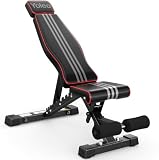
- Top Pick: YOLEO Adjustable Weight Bench, ASTM-Certified 827LBS, Extended Backrest | Extended Head and Spine Support, 90 Positions Incline Decline Flat, 3s Fast Folding and Space Saving
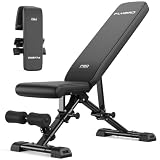
- Best Value: FLYBIRD WB5 Weight Bench, ASTM-Certified 800LBS Adjustable Weight Bench Workout Bench Foldable for Home Gym, 90° to -30° FID and 30in Extended Backrest for Bench Press Strength Training Exercise
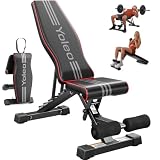
- Premium Choice: YOLEO Adjustable Weight Bench, ASTM-Certified 827LBS, 98% Pre-Assembled | Foldable Gym Bench with 84 Positions Incline Decline Flat, Wider Seat for Home Gym
For heavy lifting and long-term durability, the REP AB-5200 is the benchmark adjustable bench in reviewer roundups; for small spaces and dumbbell work with a real decline, the Bowflex 5.1S is the usual pick; and for a budget bench for light to moderate training, the Flybird adjustable bench is the common starting point. Decline range is where these differ most, so check it before buying.
As an Amazon Associate we earn from qualifying purchases at no extra cost to you.

At a glance
| Bench | Best for | Key stated specs (per reviewers) | Limits |
|---|---|---|---|
| REP AB-5200 | Serious home lifters | 10 back pad angles, four seat pad adjustments; Garage Gym Lab lists 1,000 lb capacity; weight listed around 115 to 125 lb depending on outlet | Decline needs an adjustable post upgrade, which adds -8, -6 and -4 degree angles per Breaking Muscle; one buyer found the decline shallow |
| Bowflex 5.1S | Small spaces, dumbbell work | Six positions including decline and 30, 45, 60 and 90 degree incline; 600 lb rating and vertical stow per Home Gym Verdict | Sources disagree on the exact decline angle; reviewers mention a gap between seat and backrest when flat and softer padding |
| Flybird adjustable bench (FB149 listed) | Beginners, budget | 7 backrest positions; capacity listed at 620 or 700 lb depending on source | Some wobble under heavy loads reported by Wise Insights |
Capacity and weight numbers differ between outlets, so read the maker’s page for the exact variant you buy.
What incline and decline benches are for
An incline position (commonly 30 to 45 degrees) shifts emphasis to the upper chest and shoulders, while a decline position targets the lower chest and is also used for decline sit-ups. A bench with flat, incline and decline lets one frame cover presses, rows, dumbbell work and abs. Many popular adjustable benches offer incline and flat only, so a true decline is a deliberate feature to check.
How to choose
Decline: built in or optional
The REP AB-5200 gets its decline from an optional adjustable post according to Breaking Muscle, and Garage Gym Lab suggests the AB-5000 if decline is a priority. The Bowflex 5.1S includes decline but reviewers report differing angles, from about 17 to 20 degrees, so confirm on the maker’s spec page.
Weight capacity and stability
A higher rated capacity usually reflects a heavier frame. Flat benches with a wide base resist rocking during heavy dumbbell presses. Lighter benches can wobble under load, as one reviewer reported about the budget Flybird.
Pad comfort and gaps
A gap between seat and back pad can feel awkward when flat. Firm padding supports heavy pressing; very soft foam can compress and shift your stability.
Seat adjustment
Adjustable seat angle helps lock you in on incline presses. The AB-5200 is listed with four seat pad adjustments.
Footprint, weight and storage
Folding or upright-stowing benches suit shared rooms. Heavy benches stay put but are harder to move. If your space doubles as a gaming room, stowing matters.
Set-up and safety
Tighten all fasteners, check the pin or ladder locks before each session, and use spotters or safety arms when pressing heavy weights. Respect the maker’s rated capacity, which usually includes your body weight plus the load.
Pick X if you …
| You want | Pick | Reason |
|---|---|---|
| A bench to last years under heavy loads | REP AB-5200 | High listed capacity and solid build per reviewers |
| Decline without extra parts | Bowflex 5.1S | Decline listed as built in |
| Space-saving storage | Bowflex 5.1S | Stows vertically |
| The lowest-tier cost for light training | Flybird adjustable bench | Budget class, seven backrest positions |
| Barbell bench pressing with a rack | Heavier-frame bench such as AB-5200 | Stability |
Alternatives
- Flat-only utility benches: sturdier per tier, but no incline.
- Dedicated decline benches: specialised for sit-ups and decline press.
- Adjustable dumbbells plus floor work: a path if space is tight.
- Power rack with built-in bench: an all-in-one for serious setups.
Common mistakes
- Assuming every adjustable bench includes decline.
- Ignoring the weight rating and loading beyond it.
- Skipping fastener checks after the first few uses.
- Buying a heavy bench for an apartment where it must be moved daily.
- Pressing heavy without safety arms or a spotter.
Space and floor considerations
Measure the bench’s length and width, and leave clearance behind your head and around the sides so dumbbells can be moved safely. A rubber mat protects flooring and reduces sliding, especially on laminate or tile. Check ceiling height for overhead presses when seated on an upright bench, as an upright back pad raises your head position. Heavier benches such as those with a listed capacity near 1,000 lb tend to stay put, while lighter ones may creep on smooth floors during hard sets. If the room is shared with a gaming desk, a vertically stowing or folding bench is easier to tuck away, while a fixed heavy frame suits a dedicated corner. Assembly usually needs a basic set of hand tools, and it is sensible to recheck fasteners after the first week of use because bolts can settle. Use pins and ladders fully engaged, and never adjust the bench with a loaded barbell nearby. If you are new to lifting, a qualified coach can help set safe positions and loads.
Frequently Asked Questions
Do I really need a decline bench?
Not for most programmes. Incline and flat cover the majority of exercises. Decline mainly adds lower-chest emphasis and sit-up variations.
How much weight can an adjustable bench hold?
Capacity varies by model; reviewers list roughly 600 to 1,000 lb across these three. Read the maker’s rating, which usually includes the lifter.
Is the Flybird stable enough for heavy dumbbells?
One reviewer reports it holds up for moderate workouts but shows some wobble under heavier loads, so heavy lifters usually look to sturdier frames.
Why does the AB-5200 get so much praise?
Reviewers cite its strong build, wide adjustment range and high capacity. Its decline requires an adjustable post accessory.
Can I use a bench for barbell bench press?
Only if the maker rates it for it and it sits stable at the right height. Use a rack or safety arms for heavy sets.
How do I keep a folding bench from wobbling?
Use it on a flat floor, tighten all bolts, lock pins fully, and consider a rubber mat. Persistent wobble means the load or frame is mismatched.


Write Your Review
No reviews yet. Be the first to share your experience!