
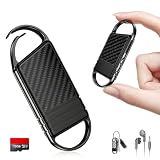
- Top Pick: 64GB Voice Activated Recorder Device – Qunifyed Digital Voice Recorder with AI Noise Reduction, Portable Recording Device for Meetings, Interviews, Lectures, Work
- Best Value: 128G (1600 Hour) Magnetic Voice Activated Recorder – Nanezan Recording Device MP3 Records with 70 Hours Battery Time, USB-C Audio Recorder for Work, Lectures, Meetings, Interviews
- Premium Choice: 132G (9800 Hour) Voice Activated Recorder – Elasound Voice Recorder with AI-Intelligent Triple Noise Reduction, Portable Audio Recorder for Work, Lectures,100H Continuous Recording Device
The best discreet recorders for lawful use are compact digital voice recorders such as the Sony ICD-UX570 series, a Zoom H1n for higher audio quality, and wearable AI recorders such as Plaud Note for meeting transcription; which one fits depends on battery life, microphone quality and how openly you intend to use it. Before buying any device, read your local recording consent rules, because secretly recording other people is illegal in many places.
As an Amazon Associate we earn from qualifying purchases at no extra cost to you.


Legal Check Before You Buy
Recording laws differ by country and, in some places, by state. Some jurisdictions allow recording a conversation if one participant consents, while others require everyone in the conversation to agree. Recording conversations you are not part of, or recording in places where people expect privacy, can be a crime. Using recordings as evidence can also depend on how they were obtained. This article is not legal advice. If you need recordings for a workplace dispute, a safety concern or a legal matter, speak to a lawyer or a local authority before recording.
The safest practice is open recording: tell people they are being recorded and get their consent. Many of the devices below work equally well when placed visibly on a table.
What to Look For
- Microphone type: Built-in stereo microphones capture a room well; omnidirectional ones suit meetings, while directional ones favor sound in front.
- Battery and storage: Look at stated recording hours and whether storage is built in or on a card.
- Size and ease of use: Compact bodies fit a pocket, but small buttons can be fiddly.
- Audio format: Makers list formats such as MP3 and linear PCM (WAV). Higher quality formats take more space.
- Transfer method: USB, app or cloud sync affects how easily you can move files.
- Transcription: Some wearables include AI transcription by subscription; read the maker’s privacy terms for how data is stored.
At a Glance
| Device | Best for | Maker-stated points | Limits |
|---|---|---|---|
| Sony ICD-UX570 series | Lectures, interviews, pocket use | Maker lists a slim body with built-in USB, stereo microphones and long battery life | Basic app-free interface; no transcription |
| Sony ICD-PX series | Budget voice notes | Maker lists a simple recorder with built-in memory | Less audio refinement |
| Zoom H1n | Higher audio quality | Maker lists X/Y stereo microphones and microSD card recording | Larger than a pocket recorder; uses batteries |
| Olympus (OM System) voice recorders | Conference and dictation work | Maker offers a range of handheld recorders | Model lineup is confusing; compare carefully |
| Plaud Note | Meetings and AI summaries | Maker describes a thin wearable recorder with app-based transcription | Subscription for some features; cloud processing |
Compact Recorders vs Wearable AI Recorders
Traditional recorders such as the Sony and Zoom models store audio locally and are straightforward. You press record, move files over USB and play them back. They are well suited to interviews, lectures and personal voice notes. Wearable AI recorders, such as Plaud’s cards, use an app to transcribe and summarize. They are convenient for meetings but depend on a service, and audio often passes through the maker’s servers. Read the privacy policy if the content is sensitive.
Smartphones as Recorders
A phone you already own is the most discreet and least suspicious recording device in many contexts, and voice memo apps are free. Reviewers regularly note phones produce acceptable audio at close range. A dedicated recorder improves sound at a distance and saves battery on your phone, but for casual note-taking the phone is often enough.
Decision Table
| Pick this if… | Choose | Why |
|---|---|---|
| You record lectures or interviews with permission | Sony ICD-UX570 style recorder | Slim, simple, long battery |
| You want better sound for music or podcasts | Zoom H1n | Stereo mics with card storage |
| You want meeting notes and summaries | Plaud Note style wearable | App-based transcription |
| You need a basic backup | Entry-level voice recorder | Low cost, no app |
| You only need occasional notes | Your phone | No extra purchase |
Audio Quality Tips
- Place the recorder close to the speaker, ideally within a few feet.
- Avoid placing it on a hard table where vibrations transfer; use a soft mat.
- Use a windscreen outdoors.
- Record a short test and listen with headphones before an important session.
- Charge or replace batteries before each use and confirm free storage.
Warnings About Hidden Devices
You may see products marketed as disguised recorders, for instance pen or key-fob styles. Many such items have inconsistent quality and vague specifications, and their use can be illegal depending on how and where they are used. This guide does not recommend covert use. If you are worried about being recorded, the privacy rules in your area may allow you to ask a lawyer or authorities about steps to take.
Common Mistakes
- Assuming recording consent rules are the same everywhere.
- Buying on battery claims without reading the conditions under which they were measured.
- Ignoring storage and file format, then running out of space mid-session.
- Uploading sensitive conversations to cloud transcription without reading privacy terms.
- Not backing up important recordings.
Legitimate Uses
Most buyers have ordinary reasons to want a small recorder. Students record lectures with the instructor’s permission. Journalists and podcasters record interviews with consent. Professionals capture meeting notes, and writers dictate ideas while walking. Musicians record rehearsals and song sketches. Each of these works better with a device you can place in plain view and forget about, which also avoids legal trouble. Keep recordings organized by date and topic, store sensitive files securely and delete material you no longer need. If you plan to share a recording, tell the participants first and respect any workplace policy or confidentiality agreement that applies.
Frequently Asked Questions
Is it legal to record a conversation secretly?
It depends on where you are and who is in the conversation. Some places allow one-party consent, while others require all parties to agree. Get legal advice if you are unsure.
Which recorder has the best battery life?
Makers publish stated recording hours for each model, and those figures vary by setting and format. Compare the manufacturer’s listed numbers and note that real-world use often differs.
Do I need a dedicated recorder if I have a phone?
For casual notes, a phone is usually enough. A dedicated recorder offers better microphones, more battery life and fewer interruptions from calls.
Are AI wearable recorders safe for private conversations?
That depends on the maker’s policies for storing and processing audio. Read them and avoid recording sensitive discussions unless you are comfortable with the terms.
What file format should I record in?
WAV or linear PCM gives the best quality but uses more storage, while MP3 saves space. For speech, a medium-quality MP3 is common; for music or interviews meant for editing, choose WAV.







Write Your Review
No reviews yet. Be the first to share your experience!