
A planetary gearbox is the simplest way to give a small stepper motor real low-speed authority. Instead of fitting a larger motor, you bolt an inline reducer to the frame you already own: the motor keeps spinning at a comfortable speed, the output shaft turns far more slowly, and torque at that shaft climbs in proportion to the reduction. For CNC axes that creep rather than race, rotary tables, sliders, and compact robot joints, that trade is usually exactly what the mechanism needs.
- Quick Answer
- How to Choose
- STEPPERONLINE MGL Series Planetary Gearbox 10:1 for Standard NEMA 17 Motors
- STEPPERONLINE Planetary Gearbox 5:1 for 9.5mm Short Shaft NEMA 17 Motors
- STEPPERONLINE 5:1 Planetary Gearbox NEMA 17 Stepper Motor 1.68A
- STEPPERONLINE 27:1 Planetary Gearbox High Torque NEMA 17 Stepper Motor
- STEPPERONLINE 100:1 Planetary Gearbox NEMA 17 Stepper Motor
- Who Should Skip It
- FAQ
- Final Verdict
- Product and ASIN Reference
Listings here mix two formats: gearbox-only reducers that clamp onto a motor you supply, and geared motors with the gearbox permanently integrated. Each section below states plainly which format the pick is. This guide stays strictly on planetary reduction for NEMA 17 class steppers, with ratios from a mild 5:1 up to a deep 100:1.
As an Amazon Associate, we earn from qualifying purchases.
Quick Answer
For most builders, the STEPPERONLINE MGL Series 10:1 is the cleanest starting point because it is a gearbox-only reducer that fits standard NEMA 17 motors with standard shafts. Choose the 5:1 short-shaft gearbox if your motor has a stubby shaft, and pick a geared motor such as the 27:1 or 100:1 unit when you want one matched assembly instead of separate parts.
How to Choose
Start with the ratio, because it sets everything else. A low reduction around 5:1 preserves useful output speed while adding a welcome torque margin, suiting extruder drives and axes that still travel at a reasonable pace. A mid-range ratio near 10:1 or 27:1 suits rotary tables, indexing heads, and robot joints that move deliberately and hold position against a load. A deep ratio such as 100:1 turns the output into a slow, forceful crawl, excellent for dosing wheels and tracking drives, and poor for anything that must reposition quickly.
Next, confirm the format. A gearbox-only reducer keeps your existing motor and wiring, and lets you swap ratios later by changing only the gearbox. A geared motor removes pairing guesswork because the factory matched the gearbox to its motor, but the ratio is fixed for life and a failure in either half replaces the whole assembly.
Shaft fit is the detail that ruins the most orders. Standard NEMA 17 motors present a 5mm shaft of generous length, while short-body motors may offer only a stubby shaft for the gearbox input to grip. The MGL series below is built for standard-length shafts, whereas the short-shaft 5:1 exists for motors whose shafts are too short for a standard input. Measure shaft diameter and exposed length before ordering, and compare both with the listing.
Backlash deserves a sober look. Every affordable planetary stage has some free play at the output, expressed in arc-minutes, and two-stage boxes carry more than single-stage boxes. For a feeder, slider, or gripper, the figures here are rarely a practical problem. For a milling axis that reverses under cutting load, that play shows up as dimensional error, so budget for a precision series or design the axis to approach from one direction.
Finally, respect torque limits. A gearbox multiplies motor torque, but it also has a maximum permissible torque, and exceeding it wears the planet gears quickly. Match the reducer to the load you actually move; a modest ratio that runs cool beats an extreme ratio living at its limit.
STEPPERONLINE MGL Series Planetary Gearbox 10:1 for Standard NEMA 17 Motors
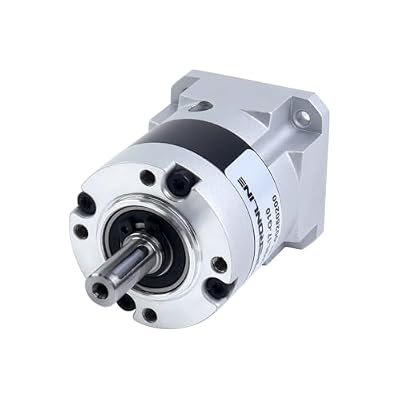
This is the pick designed as a reducer for the motor you already own, in the most generally useful ratio. The MGL17-G10 is a gearbox-only unit with a 42mm flange for NEMA 17 frames, a 10:1 reduction, and a no-load backlash rating of 30 arc-min or less. STEPPERONLINE positions the MGL series as the flexible sibling of its MG line: where the MG series expects short shafts, the MGL input accepts standard NEMA 17 shafts, with an input length range of 21.5 to 25mm. If you already hold a normal 5mm-shaft NEMA 17, this reducer bolts on without drama.
A 10:1 ratio is a measured upgrade rather than a transformation. Your axis keeps a usable top speed, gains roughly tenfold output resolution per step, and picks up enough torque to stop marginal stalling on rotary tables, feeders, and indexing fixtures. Maker series data lists an IP54 rating and a weight of about 0.29kg. Because the motor stays separate, a worn gearbox never forces you to replace a healthy motor.
The honest limitation is backlash. Thirty arc-minutes is a standard-grade figure, fine for feeders, sliders, and turntables, and too loose for a backlash-critical milling axis. Check exposed shaft length before ordering; a short-body motor may not reach deep enough into this input, the mismatch the next pick addresses.
Specs
| Item | Detail |
|---|---|
| Format | Gearbox only |
| Model | MGL17-G10 |
| Frame fit | NEMA 17, 42mm flange |
| Gear ratio | 10:1 |
| Backlash at no-load | 30 arc-min or less |
| Input shaft fit | 5mm standard shaft, 21.5 to 25mm length |
| Protection rating | IP54 per maker series data |
STEPPERONLINE Planetary Gearbox 5:1 for 9.5mm Short Shaft NEMA 17 Motors

Short-shaft motors are the awkward corner of the NEMA 17 world. Compact steppers save space, but their stubby shafts leave a standard gearbox input with almost nothing to clamp. This gearbox-only STEPPERONLINE reducer is built for that case: the listing specifies a 9.5mm short shaft length, a 5:1 ratio, and backlash of 30 arc-min. It corresponds to the maker’s short-input MG pattern, whose published input range runs from 6.5 to 10.5mm, so a motor in that window finally gets a reducer that fits.
The 5:1 reduction is deliberately mild. It suits extruder drives that need a stronger push without slowing filament feed to a crawl, light belt axes that stall only on acceleration, and small pumps or feeders. A single stage also keeps backlash tight for this price class and efficiency high, which matters behind a small short-body motor.
Be precise about compatibility. Fitted to a standard-length shaft this box is the wrong part; fitted to a short shaft it is close to the only simple option here. The listing title rounds the fit to 9.5mm while the maker’s series range is broader, so treat your own shaft measurement, not the headline, as the deciding check.
Specs
| Item | Detail |
|---|---|
| Format | Gearbox only |
| Frame fit | NEMA 17 |
| Gear ratio | 5:1 |
| Backlash | 30 arc-min per listing |
| Input shaft fit | Short shaft, 9.5mm per listing title |
| Stages | Single stage class |
STEPPERONLINE 5:1 Planetary Gearbox NEMA 17 Stepper Motor 1.68A

If you would rather skip pairing parts, this geared motor pairs a 1.68A NEMA 17 with an integrated planetary gearbox at a nominal 5:1. The honest detail, visible in the maker’s own data for this motor family, is that the exact ratio is 5.18:1, which is why the output step angle works out to about 0.35 degrees per full step. That is not a defect; it is how this design is built. For an extruder, feeder, or small rotary axis, the behavior matches any other mild reduction, with one factory-matched assembly.
The motor side is a healthy specification for the frame size, and the gearbox raises permissible output torque well beyond what the bare motor could hold; maker data for the 0.4A sibling lists a maximum permissible gearbox torque of 3Nm with momentary headroom above that. Wiring is the usual four-lead bipolar arrangement, so any common driver handles it.
Choose this unit for a fresh build when you value a known-good pairing over flexibility. The trade is real: the ratio never changes, and if the gearbox wears out, you replace the whole geared motor.
Specs
| Item | Detail |
|---|---|
| Format | Geared motor, integrated |
| Frame | NEMA 17, 42 x 42mm |
| Gear ratio | 5.18:1 exact, sold as 5:1 |
| Rated current | 1.68A per phase |
| Output step angle | About 0.35 degrees |
| Gearbox type | Planetary, single stage class |
STEPPERONLINE 27:1 Planetary Gearbox High Torque NEMA 17 Stepper Motor

The 27:1 geared motor is the middleweight bruiser of this guide. Its maker model is the 17HS19-1684S-PG27, built on a full-length 48mm NEMA 17 body, and the published torque curve for that model caps the gearbox at a maximum permissible torque of 3Nm. The exact ratio behind the headline is 26.85:1, another rounded title worth knowing about when you compute steps per revolution: use the exact figure in your firmware.
That combination makes this the natural pick for rotary tables holding a workpiece against probing forces, camera and antenna positioners that move slowly and stop precisely, and compact robot joints that lift real weight. Output speed remains usable for positioning, unlike the 100:1 unit below.
The costs are size, mass, and accumulated backlash. A two-stage stack carries more free play than the single-stage 5:1 boxes, and the long assembly is nose-heavy and needs a proper mount. For a joint or table that mostly turns one way and holds, those are fair trades; for a fast XY axis, look elsewhere.
Specs
| Item | Detail |
|---|---|
| Format | Geared motor, integrated |
| Model | 17HS19-1684S-PG27 |
| Frame | NEMA 17, 48mm motor body |
| Gear ratio | 26.85:1 exact, sold as 27:1 |
| Max permissible torque | 3Nm per maker torque curve |
| Best fit | Rotary tables, positioners, robot joints |
STEPPERONLINE 100:1 Planetary Gearbox NEMA 17 Stepper Motor

At 100:1, the conversation changes. This geared motor turns its output shaft once for every hundred motor revolutions, making it a slow, stubborn actuator for dosing wheels, valve drives, tracking mounts, and turntables that should creep smoothly and resist being back-driven. The maker sells it as a low-speed, high-torque DIY CNC and automation unit, and that framing is accurate: finesse and holding power are the product, not speed.
Output resolution is extremely fine, so a controller can meter out tiny movements without exotic microstepping, and a modest motor behaves like a much larger one at the shaft. The same depth is the warning label: top output speed is very low, and output backlash is the loosest of this guide.
Fit it where the load moves slowly, mostly in one direction, and benefits from being hard to push backwards: a tracker, a timed feeder, a rotating display, a dosing rig. In those roles it replaces a complicated belt-and-pulley stack with one bolt-on assembly.
Specs
| Item | Detail |
|---|---|
| Format | Geared motor, integrated |
| Frame | NEMA 17 |
| Gear ratio | 100:1 |
| Character | Low speed, high torque |
| Best fit | Trackers, dosing, turntables, valve drives |
| Tradeoff | Very low top output speed |
Who Should Skip It
Skip planetary reduction entirely if your axis already meets its torque target direct-drive; a gearbox only adds backlash, friction, length, and cost. Skip these standard-grade boxes for a precision milling axis that reverses under load, because 30 arc-min class backlash will show up in the finished part. Skip the geared motors if you are still experimenting with ratios, since the gearbox-only picks let you change reduction without replacing the motor. Skip the 100:1 unit for any axis that must reposition quickly, and skip every pick here if your motor is not a NEMA 17 frame, because none fit NEMA 23 or NEMA 34 faces.
FAQ
Does a planetary gearbox increase stepper torque?
Yes, in proportion to the ratio, minus friction losses. A 10:1 gearbox delivers roughly ten times the motor torque at the output shaft while turning ten times more slowly, subject to the gearbox’s own maximum permissible torque.
Will a gearbox-only reducer fit my existing NEMA 17 motor?
Only if the shaft matches. Standard motors with a 5mm shaft of normal length suit the MGL 10:1 here, while short-body motors with a stubby shaft need the short-shaft 5:1 instead. Measure diameter and exposed length, then compare both with the listing before ordering.
How much backlash should I expect from these gearboxes?
The gearbox-only listings here are rated at 30 arc-min or less at no load, and multi-stage geared motors generally carry more free play than single-stage boxes. That level is fine for feeders, sliders, and grippers, and it is the main reason these are not precision milling components.
Why do listings say 5:1 or 27:1 when the exact ratios differ?
Planetary ratios come from gear tooth counts, which rarely land on round numbers. STEPPERONLINE’s own data shows 5.18:1 behind a 5:1 headline and 26.85:1 behind a 27:1 headline. Use the exact ratio when calculating steps per revolution so distance and angle commands stay accurate.
Final Verdict
Buy the MGL Series 10:1 if you already own a standard NEMA 17 motor and want the most flexible reduction here. Buy the short-shaft 5:1 if a compact motor’s stubby shaft has shut every other gearbox out. Among the geared motors, the 5:1 1.68A unit is the easy everyday choice, the 27:1 is the torque pick for tables and joints, and the 100:1 is a specialist for slow, stubborn loads. Match format to motor and ratio to load, and planetary reduction becomes the cheapest torque you can bolt on.
Product and ASIN Reference
| Product | ASIN |
|---|---|
| STEPPERONLINE MGL Series Planetary Gearbox 10:1 for Standard NEMA 17 Motors | B0DZH4M1FX |
| STEPPERONLINE Planetary Gearbox 5:1 for 9.5mm Short Shaft NEMA 17 Motors | B0BPH9SLGV |
| STEPPERONLINE 5:1 Planetary Gearbox NEMA 17 Stepper Motor 1.68A | B00WATUFIG |
| STEPPERONLINE 27:1 Planetary Gearbox High Torque NEMA 17 Stepper Motor | B00QEUZ9EM |
| STEPPERONLINE 100:1 Planetary Gearbox NEMA 17 Stepper Motor | B00QEWAL98 |



Write Your Review
No reviews yet. Be the first to share your experience!