
- Top Pick: 24V Cordless Weed Wacker, 2 x 4.0Ah Battery Powered Weed Eater with Wheel | 3 in 1 Stringless Weed Trimmer with 5 Types Blades, Electric Grass Trimmer/String Trimmer for Lawn Yard Garden Landscaping
- Best Value: 24V Electric Weed Wacker Cordless,Battery Powered Weed Eater String Trimmer | 3 in1 Grass Trimmer with 2x2000mah Batteries and Charger, Blade Stringless Weed Trimmer/Brush Cutter/Edger for Lawn & Yard
- Premium Choice: WORX 20V 12" 2-in-1 Cordless String Trimmer & Electric Lawn Edger, WG163 | Command Feed, Works for Lawn Weed Removal Tasks, 2 x 2.0Ah Batteries & Charger Included, PowerShare
A battery trimmer that uses a blade or fixed cutting element instead of spooled line suits people who are tired of bumping, re-feeding and re-winding string, while a conventional string trimmer with a good bump head remains the better choice for fences, rocks and delicate trim work. Which route fits depends on what you cut: dense weeds and brush favor blade heads, manicured lawn edges favor line.
As an Amazon Associate we earn from qualifying purchases at no extra cost to you.

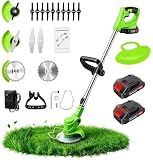


What “stringless” actually means
The word covers three different designs, and shoppers often compare them as if they were one product. Knowing the differences prevents most disappointment.
- Blade-head trimmers: a small steel or polymer blade spins in place of line. Makers of this style market it as maintenance-free because there is nothing to feed or break off.
- Fixed-line or “pre-cut” heads: short lengths of tough line are locked into the head, so there is no bump-feed mechanism. Some makers sell these as a stringless-style upgrade for existing trimmers.
- Blade attachments for a standard trimmer: several outdoor-equipment makers, including Stihl and Echo, offer grass or brush blades that fit certain trimmer shafts. These are a separate accessory, and each maker lists which models are compatible.
Because the market changes quickly, treat the product classes below as the buying framework, and read the maker’s own specification page for the exact model before buying. Battery platforms matter as much as the trimmer itself, and a tool that shares a battery with a mower or blower you already own is usually the more sensible purchase.
At a glance: which design fits which yard
| Design | Best for | Stated strengths | Limits |
|---|---|---|---|
| Blade-head cordless trimmer | Overgrown edges, thick weeds, rough ground | No line to feed or replace; makers describe quick work on tough growth | Hits rocks, fence posts and hard edging harder than line does; blade needs occasional replacement or sharpening |
| Fixed-line head on a standard trimmer | Owners who want to skip bump feeding | Fewer line jams; simple swap on compatible shafts | Cut quality depends on line thickness; head must match the trimmer thread |
| Standard string trimmer with brush blade accessory | Mixed use, occasional brush clearing | One tool can do trim and brush work | Blade guards and handle type must be right for the accessory; heavier |
| Conventional line trimmer | Fine lawn edging, around plants and fences | Gentler on obstacles, widest choice of models | Line runs out; feeding mechanisms can jam |
The key specs that matter on a cordless trimmer
Battery platform and voltage
Cordless outdoor tools are built around battery families. EGO runs a 56V platform, Ryobi has a 40V line, Greenworks sells 24V, 40V and 60V families, and Stihl, Echo and Milwaukee run their own systems. A higher voltage rating does not guarantee better cutting by itself, but it generally sits with larger batteries and motors aimed at heavier work. The practical rule is to buy into the platform that already powers other tools in your garage, since a bare-tool price tier is far lower than a kit with a new battery and charger.
Motor type
Brushless motors are listed by most makers as more efficient and longer lasting than brushed designs. For blade heads, which load the motor in short heavy bursts, a brushless motor is the more sensible option on premium tiers.
Cutting swath
Swath is the width the head cuts in one pass. Larger swaths clear open ground faster but are clumsy near beds and fences. Blade heads often have a smaller diameter than a line head, so check the maker’s stated swath rather than assuming.
Shaft design and weight
A straight shaft reaches under shrubs and keeps the head farther from your legs, while a curved shaft is lighter and easier to maneuver on small lots. Check the stated weight with the battery installed. Heavy trimmers become tiring long before the battery runs down.
Runtime and charge time
Makers publish runtime figures, but those are usually measured on light work at a specific setting. Dense weeds and blade heads draw more current, so expect shorter runs than the headline figure. A second battery is a better solution than a larger battery on one tool if your yard is large.
Budget tiers and what to expect
Budget tier
Entry-level 20V to 24V trimmers, including lines from Worx, Black+Decker and Greenworks, handle small yards. Many use standard line heads. If a budget model advertises a blade or fixed-line head, read the manual for what vegetation it is rated for; light weeds and grass are the usual limit.
Mid-range tier
Mid-range models from Ryobi, Greenworks and Kobalt, typically on 40V to 60V systems, add brushless motors, adjustable shafts and better balance. This is where most households find the best mix of power and battery sharing with other tools.
Premium tier
EGO, Stihl, Echo, Milwaukee and similar makers target heavier use. Reviewers at outlets such as Consumer Reports and Pro Tool Reviews regularly place these brands near the top for trimmer performance, and Stihl and Echo are the names to look at if you want a brush blade accessory that the maker lists as compatible with a specific shaft.
Pick the design if
| Pick this if you | Choose | Why |
|---|---|---|
| Spend more time fixing line than trimming | Fixed-line or blade head | Removes the feeding step entirely |
| Clear thick weeds and saplings along a fence line | Blade-capable trimmer with the maker’s blade guard | Blades cut stems that line often bounces off |
| Edge beside flower beds, patios and mailboxes | Conventional line trimmer | Line is more forgiving around hard objects and plants |
| Already own a battery platform | Same-brand bare tool | Saves the cost of another battery and charger |
| Have limited strength or a small yard | Light curved-shaft model | Lower weight and easier handling |
Safety and compatibility notes
Blades are not interchangeable with line heads on every shaft. The guard, the gearbox and the shaft stiffness are all designed for specific accessories, and mounting an unapproved blade can be dangerous. Always follow the manufacturer’s manual, use the supplied guard, and wear eye protection, long pants and sturdy shoes. Remove the battery before changing a head or clearing a jam. Keep bystanders and pets well away, because stones and debris can be thrown. If a head vibrates heavily or the blade is chipped, stop using it and have it serviced or replaced.
Common buying mistakes
- Treating “stringless” as one product type. A blade head, a fixed-line head and a blade accessory behave very differently.
- Ignoring the battery platform. Buying a stranded battery system makes every future tool more expensive.
- Chasing voltage numbers. Compare battery capacity, motor type and shaft design, not only the voltage badge.
- Buying a blade for delicate work. Blade heads are for rough growth, not precise edging near fragile plants.
- Skipping the weight check. A trimmer you dislike carrying will sit unused.
Alternatives worth considering
- Cordless string trimmer with a premium bump head: The most widely supported design, with plenty of replacement heads and line types available.
- Cordless brush cutter: If the real job is clearing dense overgrowth, a dedicated brush cutter is built for it rather than adapting a trimmer.
- Cordless lawn edger or grass shears: For tidy edges along paths and beds, a purpose-built edger can be faster and neater than any trimmer.
Frequently Asked Questions
Are stringless trimmers better than string trimmers?
Not universally. Blade and fixed-line heads remove the hassle of feeding line and tend to suit rough, overgrown areas. Line heads remain gentler around fences, plants and hard edging, so many owners use whichever suits the job.
Can any trimmer take a blade?
No. Only models whose maker lists a blade accessory as compatible should be fitted with one. The guard, gearbox and shaft are matched to the accessory, so follow the manual for your exact model.
How long do cordless trimmer batteries last?
Makers publish runtime figures, but they depend on the load. Thick weeds and blade heads drain the battery faster than light grass, so a spare battery is the practical answer for larger yards.
Do I need a brushless motor?
It is not required for small jobs, but makers describe brushless motors as more efficient and longer lived. For blade heads and heavy growth, a brushless motor is the more sensible choice.
Are blade trimmers safe around children and pets?
They require the same caution as any cutting tool. Keep children and pets well clear, use the supplied guard, wear eye protection and remove the battery before any maintenance. Follow the manufacturer’s instructions for the specific model.
Which battery platform should I choose?
Choose the one that already powers your other outdoor tools. If you are starting fresh, compare which platform offers the mower, blower and trimmer range you expect to want over the next few years.





Write Your Review
No reviews yet. Be the first to share your experience!