
- Top Pick: Teton 55L Scout Internal Frame Backpack for Hiking, Camping, Backpacking, Travel, Rain Cover Included, Black
- Best Value: Teton 75L Explorer Internal Frame Backpack for Hiking, Camping, Backpacking, Rain Cover Included, Olive
- Premium Choice: Amazon Basics Internal Frame Hiking Backpack for Camping and Backpacking, Adjustable Straps, Rainfly Included, 75 Liters, Black
The Osprey Atmos AG 65 suits most hikers carrying roughly 30 to 40 pounds, the Gregory Baltoro 65 suits people who regularly haul heavier loads, and a budget-tier pack such as the REI Co-op Traverse 60 suits occasional trips where ventilation matters less. Internal frame packs hide a metal or composite frame inside the body of the pack, so the load rides close to your back and transfers to your hips. That design is the standard for multi-day trips, and the right choice comes down to load weight, torso length, ventilation and how much you are willing to carry in the pack itself.
As an Amazon Associate we earn from qualifying purchases at no extra cost to you.
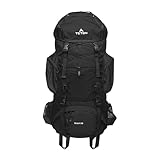


Internal Frame Packs at a Glance
| Pack | Best for | Key stated specs | Limits |
|---|---|---|---|
| Osprey Atmos AG 65 | All-round multi-day trips with warm weather and sweaty backs | Full metal frame, suspended mesh Anti-Gravity back panel, adjustable torso, 50 or 65 litre options, S/M and L/XL sizing; Switchback Travel lists it at about 4 lb 10 oz | Reviewers describe it as heavy for ultralight users; comfort drops past about 40 lb |
| Osprey Atmos AG LT 65 | Lighter loads, 30 to 40 lb | Lighter build of the Atmos concept; Gear and Home names it a top internal frame pick for that load range | Less suspension for heavy loads |
| Gregory Baltoro 65 | Heavy loads, winter gear, group food and shared kit | FreeFloat A3 suspension, U-shaped main opening; women’s version is the Deva | Reviewers note it is a bit heavy; Switchback Travel says the latest version dropped the included rain cover |
| Osprey Aether 65 | Serious haulers wanting more padding | Named by Switchback Travel as a more padded, heavier alternative to the Atmos | Weight and bulk |
| REI Co-op Traverse 60 | Budget-conscious beginners | Internal frame, 60 litre class | Less ventilation than the Atmos, according to Switchback Travel |
Specs here come from the makers’ general product descriptions and reviewer summaries from Switchback Travel, Cleverhiker and The Big Outside. Maker specifications change between production years, so read the label inside the specific pack you receive.
How to Choose an Internal Frame Pack
Start with torso length, not height
Pack sizing follows the distance from the base of your neck to the top of your hip bones. Two people with the same height can need different sizes. Osprey simplified the Atmos range to S/M and L/XL, with an adjustable torso length inside each size, according to Switchback Travel. Most makers publish a measuring guide on their sites. A pack that is too long puts weight on the shoulders; one that is too short leaves the hipbelt riding on the ribs.
Match capacity to the trip
A 50 to 65 litre pack covers most three to five day trips in three seasons. Winter trips, bulky sleeping bags and bear canisters push many hikers up toward 70 to 75 litres. Packing a bigger pack half full is easy; squeezing gear into a pack that is too small leads to external straps and lopsided loads.
Check the load rating honestly
Makers publish recommended load ranges, and reviewers generally treat them as a comfort ceiling. Switchback Travel puts the Atmos at around 30 to 40 lb for all-day comfort, with a stretch to around 50 lb. Cleverhiker reports the Baltoro was more forgiving than the Atmos with a very heavy load. If your base weight plus food and water usually lands above 40 lb, lean toward a beefier suspension.
Ventilation versus stability
Suspended mesh back panels, as on the Atmos AG, keep the pack away from your back for airflow, which helps in hot climates. The trade-off is that the load sits a little farther from your body, which some hikers find slightly less stable on rough scrambling. Packs that hug the back, such as many Gregory designs, feel more planted but run warmer.
Features that matter on the trail
- Hipbelt that wraps around the hip bones and carries most of the weight.
- Side zips or a U-shaped main opening for reaching gear without unpacking from the top.
- Stretch side pockets that reach a water bottle while walking.
- A sleeping bag compartment or a removable lid for flexibility.
- A rain cover, either included or bought separately.
Budget Tiers Without Prices
| Tier | What you typically get | Example |
|---|---|---|
| Budget | Simpler suspension, fewer adjustments, heavier fabrics | REI Co-op Traverse 60 |
| Mid-range | Adjustable torso, vented back panel, good organization | Osprey Atmos AG 65 and Atmos AG LT 65 |
| Premium | Heavy-load suspension, extra padding, refined adjustment | Gregory Baltoro 65, Osprey Aether 65 |
Pick X If… Decision Table
| Pick this | If you |
|---|---|
| Atmos AG 65 | carry about 30 to 40 lb, hike in warm weather and want airflow plus lots of pockets |
| Atmos AG LT 65 | have already trimmed your base weight and want less pack weight |
| Baltoro 65 | often exceed 40 lb, hike in winter or carry shared group gear |
| Aether 65 | want a heavily padded Osprey with more load capacity than the Atmos |
| Traverse 60 | are starting out and want a capable pack without premium features |
Fit Notes for Men’s and Women’s Packs
Makers typically offer women’s versions with shorter torsos, narrower shoulder straps and angled hipbelts. Osprey’s women’s Atmos equivalent is the Aura, and Gregory’s Baltoro counterpart is the Deva. Anyone can wear either style; the right test is where the hipbelt lands and whether the shoulder straps wrap without gaps. Load the pack with weight in a store if you can, because empty packs feel fine and reveal little about fit.
Common Mistakes
- Buying by litres alone. Two 65 litre packs can differ by a pound or more and carry very differently.
- Ignoring torso length. A well-reviewed pack that does not fit your torso will still hurt.
- Overpacking because the pack is big. Weight discipline matters more than any suspension.
- Skipping the hipbelt check. If the belt does not sit on the hip bones, the weight lands on your shoulders.
- Forgetting the rain cover. Some current models omit one, so budget for a cover or a liner bag.
Alternatives to Consider
If trips are short, a 40 to 50 litre internal frame pack such as the Atmos 50 size can replace a larger pack and keeps weight down. Ultralight hikers with base weights well under the typical range may prefer a frameless or minimal frame pack, though those carry heavier loads poorly. Hikers who rarely go beyond day trips do not need an internal frame pack at all; a simpler daypack with a hipbelt is lighter and cheaper.
Care and Break-In
Adjust the torso length and hipbelt before every season, as straps loosen with use. Reviewers mention the Atmos hipbelt needs an adjustment period, so a few short loaded walks before a big trip help. Wash packs in a tub with mild soap and let them air-dry, since heat and harsh detergents can damage coatings.
Frequently Asked Questions
What is an internal frame backpack?
It is a pack with a metal, plastic or carbon frame built into the body, usually stays or a perimeter wire. The frame holds the shape and moves weight to your hips. Compared with older external frame designs, the pack hugs the body and handles uneven terrain better.
How much weight can an internal frame pack carry comfortably?
It depends on the model. Reviewers put the Osprey Atmos AG at about 30 to 40 lb for comfort, and heavy-haul designs like the Gregory Baltoro are favored beyond that. Always compare your own packed weight with the maker’s stated range.
Is a 65 litre pack too big for a weekend trip?
Not necessarily. Many hikers use 50 to 65 litres for a weekend in cooler months when sleeping bags and clothing take more room. If you pack light in summer, a 40 to 50 litre pack is often enough.
Do women need a women’s-specific pack?
Not required, but women’s versions usually have shorter torso ranges, narrower shoulders and hipbelts shaped for wider hips. Many people with smaller frames find them more comfortable. Fit on the body matters more than the label.
Are mesh back panels worth it?
For hot weather and long climbs, reviewers report the airflow is a real benefit. The trade-off is slightly more pack depth and a load that sits a bit farther from the body. In cold weather the benefit matters less.
How should I test a pack before a long trip?
Load it with the weight you expect to carry and walk for a few hours, adjusting the hipbelt, sternum strap and load lifters as you go. Hotspots or numb shoulders point to a fit problem. If problems persist, ask the retailer or maker about sizing before the trip.



Write Your Review
No reviews yet. Be the first to share your experience!