
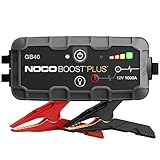
- Top Pick: NOCO Boost GB40 12V 1000A UltraSafe Portable Lithium Jump Starter | Spark-Proof & Reverse Polarity Protection, For Car, Truck, Motorcycle, SUV, Boat, ATV, RV, up to 6.0L Gas & 3.0L Diesel
- Best Value: OXILAM Jump Starter 6000A for All Gas/12L Diesel, Car Battery Jumper Starter Portable, 12V Lithium Jump Box with Jumper Cables, LED Display, LED Light, Power Bank with USB, Type C Port
- Premium Choice: JOLTEKON Car Battery Jump Starter with Air Compressor 4500A 150PSI, Car Jumper Starter Portable (9L Gas/8L Diesel), Jump Box Car Battery with Auto-Shutoff Tire Inflator, Jumper Cables and Light
For most drivers with a petrol car, a lithium jump pack from a known brand such as NOCO, Gooloo or Antigravity covers emergencies, while a smart trickle charger such as a Battery Tender or CTEK unit suits anyone who parks a vehicle for weeks. Buyers who want one box that does both should look at the hybrid class: a jump starter with a built-in power bank and a separate mains charger, or a lead-acid “jump box” with an onboard charger. The right pick depends on engine size, how often the car sits, and whether jump starts or battery upkeep is the real problem.
As an Amazon Associate we earn from qualifying purchases at no extra cost to you.


Jump starter versus battery charger: two different jobs
A jump starter delivers a short, high-current burst so a weak battery can crank the engine. A battery charger pushes a modest current for hours to restore and maintain charge. The search term “car battery charger jump starter” mixes the two, and many products blur the line, so decide first which failure you are trying to prevent.
- Dead battery on the road: a portable jump starter. Nothing else solves it without a second car.
- Car stored for winter or used rarely: a maintainer or smart charger that floats the battery at full charge.
- Both problems: a lithium pack for the glovebox plus a small maintainer in the garage. Two cheap tools usually beat one compromised hybrid.
At a glance: the main product types
| Type | Typical examples | Best for | Main limits |
|---|---|---|---|
| Compact lithium jump pack | NOCO Boost series, Gooloo, Antigravity XP series | Cars, SUVs and small trucks; glovebox storage | Battery slowly self-discharges; needs a top-up every few months; avoid extreme heat |
| Jump pack with power bank and light | Many Gooloo and similar models | Commuters who also want USB charging and a work light | Marketing “peak amps” figures are not a cranking guarantee |
| Lead-acid jump box with onboard charger | Clore Automotive Jump-N-Carry line | Workshops, trucks, diesel engines | Heavy and bulky; needs recharging after use |
| Smart charger / maintainer | Battery Tender, CTEK, NOCO Genius | Stored cars, motorcycles, boats, seasonal vehicles | Cannot start a dead engine on the road; needs mains power |
| Jump starter with air compressor | Various multi-function units | Drivers who want tyre inflation as well | Compressor features add size and weight |
How to choose the right jump starter
Match the engine, not the headline amps
Makers print large “peak amp” numbers on the box, and those figures are measured under conditions that do not map neatly to a cold morning. A more useful guide is the engine size and fuel type the maker states the unit can start. Makers such as NOCO publish a recommended engine size and note when a model is rated for petrol only or for diesel as well. Diesel engines draw considerably more current to crank, so shoppers with a diesel truck should choose a model that explicitly lists diesel capacity and treat anything vague as unsuitable.
Battery chemistry and cold weather
Modern portable packs are mostly lithium-ion or lithium iron phosphate. Reviewers commonly point out that lithium packs lose output in freezing temperatures and should not be left in a hot cabin for long periods. Read the maker’s stated operating and storage temperature range, and keep the pack charged. If the car lives somewhere very cold or very hot, a lead-acid box or a pack with a stated wide temperature range is the safer match.
Safety features worth insisting on
A good jump pack lists protection against reverse polarity, short circuit, overcurrent and overheating. Many also use a smart clamp cable that will not send current until it detects a proper connection. The maker’s manual is the authority on connection order; follow it exactly, and read it before you need it. Never use a jump starter on a battery that is cracked, swollen or frozen.
Extras that matter
- Clamp quality: thick cables and solid clamps matter more than a long cable.
- Manual override: some NOCO models include a button that forces output for a deeply drained battery; makers describe it as a last resort.
- USB output: useful for phones, but check the stated output wattage if you hope to charge a laptop.
- Light: a flashlight with strobe mode is handy on a roadside at night.
Smart chargers: what to look for
A smart charger monitors the battery and moves through stages automatically. CTEK and Battery Tender both sell models that the makers describe as suitable for long-term connection. Look for support for your battery type, since flooded lead-acid, AGM and lithium iron phosphate batteries need different profiles. A model with a lithium mode is worth having if you own a motorcycle or recent vehicle with an LFP battery. Amperage matters too: a 1 to 2 amp maintainer is fine for upkeep, while a 5 amp or higher charger revives a flat battery faster.
Budget tiers
| Tier | What you get | What you give up |
|---|---|---|
| Budget | Basic lithium pack from Gooloo or similar, or a simple 1 to 2 amp maintainer | Lower rated engine size, fewer extras, shorter support history |
| Mid-range | NOCO Boost-class packs, Antigravity units, CTEK or Battery Tender smart chargers | Still limited for large diesel engines |
| Premium | High-capacity packs with larger rated engines, or Clore lead-acid boxes for heavy use | Weight, size, and more than most commuters need |
Pick this if you are…
| If you are… | Pick | Why |
|---|---|---|
| A commuter with a petrol hatchback | Compact lithium pack | Small, fits in the glovebox, enough for typical engines |
| Owner of a V8 truck or diesel | Larger lithium pack with stated diesel rating, or lead-acid jump box | Higher cranking demand |
| Someone who stores a classic car or boat | Smart maintainer from CTEK or Battery Tender | Prevents the dead battery rather than curing it |
| A road-tripper | Jump pack with power bank and light | Doubles as a phone charger and torch |
| A shop or fleet user | Clore Jump-N-Carry style box | Built for repeated use |
Compatibility and fit notes
Start-stop vehicles and cars with AGM batteries are generally fine with modern jump packs, but owners should read the vehicle manual, because some makers specify jump points under the bonnet rather than the battery terminals. Hybrid and electric vehicles have a small 12 volt battery and often have their own jump procedure; the vehicle manual comes first. Only 12 volt systems are covered by typical car packs, so a 24 volt truck needs a unit that states 24 volt support.
Common mistakes
- Buying on peak amps alone and ignoring the stated engine size.
- Leaving the pack in a hot car all summer, or never recharging it.
- Using a trickle charger on a battery that is no longer holding charge; a failed battery needs replacing, not charging.
- Connecting clamps in the wrong order or to a fuel line, painted bracket or moving part.
- Expecting a small maintainer to rescue a deeply flat battery quickly.
Alternatives to consider
- Jumper cables and a second car: cheapest, but requires another vehicle and some know-how.
- Roadside assistance membership: removes the equipment altogether for drivers who rarely need help.
- Replacing an ageing battery: if the battery is several years old and cranking slowly, a new battery may fix the problem that a jump pack only masks.
- Solar trickle maintainer: a low-output panel for a parked vehicle without mains access; keep expectations modest.
Frequently Asked Questions
Can a jump starter charge a dead battery?
No. A jump starter gives the engine enough power to crank, and the alternator then recharges the battery as you drive. If the battery will not hold charge afterwards, it likely needs testing and replacing.
How often should I recharge a portable jump pack?
Makers generally advise topping up every few months, and always after use. A pack left empty for long periods can degrade, so set a calendar reminder.
Is it safe to leave a smart charger connected for weeks?
Makers such as CTEK and Battery Tender design their maintainers for long-term connection, but only follow this with the specific model your manual approves. Keep the charger in a ventilated, dry spot and stop using it if it gets unusually hot.
Will a jump starter work on a diesel engine?
Only if the maker lists diesel capacity. Diesels need more cranking current, so choose a model whose stated engine size comfortably exceeds yours.
Can I jump an electric or hybrid vehicle?
Many can be jumped on the 12 volt system, but the procedure varies. Follow the vehicle manual, and contact the maker or a qualified technician if the instructions are unclear.
Why does my pack say it works at low temperature but fails in winter?
Lithium cells deliver less current when very cold. Keep the pack indoors until needed, keep it charged, and consider a lead-acid box for harsh climates.





Write Your Review
No reviews yet. Be the first to share your experience!