
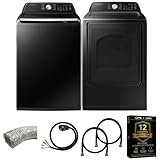
- Top Pick: Samsung Smart 4.7 Cu Ft Top Load Washer & 7.4 Cu Ft Electric Dryer, Sensor Stops Overdrying, Low Vibration Quiet Wash, WaterJet w/Power Cords, Hoses, Vent Duct, 1 Year CPS Protection Bundle (Black)
- Best Value: LG WashTower Stacked Smart Laundry Center 4.5 Cu.Ft. Front Load Washer Fully Automatic & 7.4 Cu.Ft. Gas Dryer in Black Steel w/Steam WKGX201HBA
- Premium Choice: Frigidaire Gas Washer/Dryer Laundry Center – 3.9 Cu. Ft Washer and 5.5 Cu. Ft. Dryer
For a gaming den, studio flat or closet laundry nook, the best 27 inch depth washer and dryer is usually a compact 24-inch-wide front-loader pair, and the right one depends on whether you need a vented dryer, a ventless heat-pump dryer, or a single stacked unit. Full-size American front-loaders are commonly deeper than 27 inches once the door and hoses are counted, so the compact European-style class is where most buyers should look.
- Why depth is the number that decides everything
- At a glance: compact pair families to shortlist
- Vented, condensing or heat-pump: pick the dryer type first
- How to measure before you buy
- Stacking and side-by-side options
- Pick X if
- Common mistakes to avoid
- Alternatives if 27 inches is still too tight
- Gamer-specific notes
- Frequently Asked Questions
As an Amazon Associate we earn from qualifying purchases at no extra cost to you.


Why depth is the number that decides everything
Depth is the measurement people forget until delivery day. A machine that fits the width of a closet can still stick out into the room, block a door swing or crush the hoses behind it. Makers list a cabinet depth, and many also list a depth with the door open or with the connections attached. Always plan around the larger figure, plus a few inches at the back for hoses, the vent and the power cord.
Compact laundry sold in North America tends to be built around a 24-inch width, a roughly 33-inch height for a single machine, and a depth in the mid-20s of inches for most European-engineered models. That class suits a 27-inch-deep alcove because it leaves a little breathing room. Always read the specification sheet of the exact model number, because depth differs even inside one brand family.
At a glance: compact pair families to shortlist
| Family | Best for | Key points as the makers describe them | Limits |
|---|---|---|---|
| Bosch compact 24-inch washers and dryers | Apartment owners who want a quiet, well-known pair | Compact front-loader washer plus a matching compact dryer; dryers are offered in vented and heat-pump styles in the line | Smaller drum than full-size; cycles run longer |
| Miele compact W1 and T1 style pairs | Buyers who want long-life premium build | Miele positions its 24-inch pair as a premium compact option with a heat-pump dryer in the range | Premium tier; drum capacity is modest |
| LG compact and all-in-one units | Tiny spaces with no room for two machines | LG lists compact washers and ventless combination washer-dryer units with a single footprint | Combination units dry slower and take smaller loads |
| Blomberg compact pairs | Budget-to-mid shoppers who still want a 24-inch pair | Blomberg sells compact washers with matching condensing or vented dryers | Fewer smart features |
| Summit and Equator compact units | Tight budgets, RV and basement installs | Both brands list small-footprint washers, dryers and combination units | Basic controls, smaller capacity, simpler build |
Vented, condensing or heat-pump: pick the dryer type first
Vented dryers
These need an exterior vent run. They dry fastest and often cost less, but if your nook has no duct to the outside, they are out. Venting an electric dryer incorrectly is a genuine fire hazard, so have the vent run installed to the maker’s manual and local code.
Condensing and heat-pump dryers
These collect moisture instead of venting it, so they can sit in a closet or a bedroom-adjacent alcove. Heat-pump models use less energy per load according to the makers, at the cost of longer cycles. Reviewers who cover compact laundry commonly note that ventless machines also warm the room less, a plus when a gaming PC is already running nearby.
All-in-one washer-dryers
A single drum that washes and dries saves the most space, but reviewers consistently point out that the drying capacity is smaller than the wash capacity, so heavy loads must be split. They suit one or two people who do small, frequent loads.
How to measure before you buy
- Measure the alcove depth from the wall to the outermost point the machine could reach, including any door frame or baseboard.
- Subtract several inches at the back for hoses, a drain, a power cord and, if relevant, a vent elbow.
- Measure the path to the room: stairwells, door widths and tight turns.
- Confirm the electrical supply. Many dryers need a dedicated circuit and a specific outlet type; a licensed electrician should confirm this.
- Check the floor. A front-loader can vibrate hard on a weak floor, so upper-floor and loft installs deserve extra attention.
Stacking and side-by-side options
With limited width, stacking is the standard trick. Makers of compact machines generally offer a stacking kit for their matching pair, and some sell a one-piece tower. Stacking only works with the same brand and compatible models, so confirm that the washer and dryer you pick are listed together in the stacking-kit instructions. Side-by-side placement needs about double the width, which is often impractical in a closet.
Pick X if
| If you want | Pick | Why |
|---|---|---|
| Quiet operation near a bedroom or streaming setup | Bosch compact pair or Miele compact pair | Both brands position their compact lines around low noise and vibration control |
| No vent hole at all | A heat-pump or condensing compact dryer, or an LG all-in-one | No external duct needed |
| Absolute minimum footprint | A single all-in-one washer-dryer | One cabinet instead of two |
| Lowest spend | Summit, Equator or Blomberg compact units | Simpler controls and fewer extras |
| Longest service life | Miele premium compact | The brand markets durability testing for its machines, per its own pages |
Common mistakes to avoid
- Trusting a product title rather than the specification sheet for the exact depth.
- Forgetting that a dryer door often swings in a direction that needs clearance on the hinge side.
- Buying a ventless dryer and putting it in a sealed closet with no airflow; follow the manual on ventilation and clearances.
- Ignoring load capacity. A compact drum can mean a bulky comforter does not fit.
- Skipping the stacking kit and balancing one unit on the other.
- Choosing a washer-only compact when the space has no dryer plan at all.
Alternatives if 27 inches is still too tight
If no pair fits, consider a wall-mounted compact washer, a laundry tower from a maker that lists a shallower cabinet, or a portable countertop washer for light loads. For dryers, a wall-mounted ventless unit or a drying rack with a dehumidifier is a low-tech fallback. Another route is a shared building laundry room, which frees the gaming room entirely.
Gamer-specific notes
A PC desk near the laundry nook adds heat and electrical load. Keep power strips and cables off the floor, away from washer hoses and any possible leak, and do not run an extension cord to a dryer. A spin cycle can shake a flimsy shelf or desk against a shared wall, so a sturdy base and anti-vibration pads (where the maker permits them) help. Choose a model with a delay-start feature so loud cycles run when you are not recording or on voice chat.
Frequently Asked Questions
Do all 24-inch washers fit a 27-inch-deep space?
No. Width class and depth are separate measurements. Many compact models are in the mid-20s of inches deep, but some run deeper, and hoses and doors add more. Read the specification sheet for the exact model number.
Can I stack a compact washer and dryer from different brands?
Generally not safely. Stacking kits are designed and rated for specific matching models. Use the same brand and the model pairing listed in the maker’s instructions.
Is a ventless dryer worth it in a small apartment?
If you cannot run a vent to the outside, it is often the only practical choice. Reviewers note cycles are longer than vented units, but the energy use per load is lower according to makers of heat-pump models.
Are all-in-one washer-dryers any good?
They are convenient for tiny homes, and reviewers describe them as best for small, frequent loads. Drying a full wash load in one go is typically not possible, so expect to split large loads.
Do I need a special outlet?
Many compact dryers use a dedicated higher-voltage circuit, while some heat-pump and combination units run on a standard outlet. Follow the manual and have an electrician confirm the circuit before installation.
How much clearance do I leave around the machines?
The manual lists minimum clearances for the sides, back and top, and they differ by model. Following those figures protects airflow and makes service access possible.







Write Your Review
No reviews yet. Be the first to share your experience!