
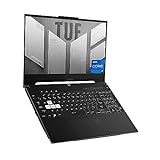
- Top Pick: EXCaliberPC 2022 ASUS TUF Dash F15 FX517ZR-F15.I73070 (i7-12650H, 16GB RAM, 512GB NVMe SSD, RTX 3070 8GB, 15.6" FHD 144Hz, Windows 11) Gaming Notebook
- Best Value: ASUS TUF Dash 15 (2022) Gaming Laptop, 15.6" 144Hz FHD Display, Intel Core i7-12650H, GeForce RTX 3060, 16GB DDR5, 512GB SSD, Thunderbolt 4, Windows 11 Home, Off Black, FX517ZM-AS73
- Premium Choice: ASUS TUF Dash F15 Gaming Laptop 2022 15.6” 144Hz FHD 11th Intel i7-11370H 24GB DDR4 1TB NVMe SSD NVIDIA GeForce RTX 3050Ti 4GB GDDR6 WiFi 6 Thunderbolt Backlit KB RJ45 Win 10 w/ONT 32GB USB, TUF516PE
ASUS TUF Dash F15 RTX 3060: What the 100W Power Limit Actually Costs You
The ASUS TUF Dash F15 with RTX 3060 trades roughly 15-20% GPU performance for a laptop that’s 19.9mm thick and 2kg, compared to 25-28mm/2.3-2.5kg rivals running the same GPU at 130W. That’s the real trade-off in one sentence, and everything below explains how it plays out in clocks, temperatures, and battery math rather than just spec-sheet numbers.
- ASUS TUF Dash F15 RTX 3060: What the 100W Power Limit Actually Costs You
- Same GPU Name, Different Chip Behavior
- The 30-Minute Clock Drop, Explained
- The 100W vs 130W Trade-Off in Numbers
- Charging Over USB-C: What It Actually Supports
- Soldered RAM: The Upgrade Limitation That Matters Long-Term
- Decision Matrix: Is the 100W 3060 Dash F15 Right for You?
- Bottom Line
Same GPU Name, Different Chip Behavior
“RTX 3060” on a spec sheet doesn’t mean much on its own because Nvidia lets laptop makers configure the same GPU die across a wide TGP (Total Graphics Power) range, from 60W up to 130W. The Dash F15 ships its 3060 at 100W (sometimes listed as 105W with Dynamic Boost), while thicker 15-inch competitors push the identical silicon to 130W. That 30W gap is the entire story of why two laptops with the same model number benchmark differently.
As an Amazon Associate we earn from qualifying purchases at no extra cost to you.


- 100W 3060 (Dash F15): boost clocks typically land in the 1425-1550MHz range under sustained load.
- 130W 3060 (thicker chassis): boost clocks commonly sustain 1650-1750MHz, roughly 12-18% higher core frequency.
In real frame rates, that translates to about 8-15% fewer FPS in GPU-bound titles at 1080p, less in CPU-bound esports titles, more in demanding ray-traced games. If you’re cross-shopping, the RTX 3070 variant of the Dash F15 (also power-limited, usually 100-125W depending on the SKU) narrows that gap versus a 130W 3060, so it’s worth comparing against full-power 3060 rivals too, not just against the 3060 Dash directly.
The 30-Minute Clock Drop, Explained
Thin chassis laptops almost always show a two-stage performance curve: a strong first 10-15 minutes, then a step down once the vapor chamber and fans reach thermal equilibrium. On the Dash F15’s 100W configuration, expect this rough pattern during a sustained 3D workload:
| Time into load | GPU clock (approx.) | GPU temp (approx.) | Notes |
|---|---|---|---|
| 0-5 min | 1500-1550MHz | 65-72°C | Fans ramping, chassis still cool |
| 10-15 min | 1450-1500MHz | 75-78°C | Slight throttle begins |
| 30 min+ | 1350-1425MHz | 78-82°C | Steady state, power-limited not just thermal-limited |
The drop after the 30-minute mark isn’t purely thermal throttling in the classic sense, it’s the GPU hitting its 100W power ceiling while temperatures stabilize just under the throttle point. That’s actually a sign of a well-tuned thin design: the chip is being held at its power budget rather than spiking hot and cutting clocks erratically. A 130W laptop has more thermal headroom to dump, so its clock curve is flatter, but it’s also moving more heat through a thicker heatsink stack and usually louder fans to do it.
Practical takeaway: for renders, exports, or long gaming sessions past 45 minutes, plan around the steady-state clock (roughly 1350-1425MHz), not the launch benchmark number you see in most reviews.
The 100W vs 130W Trade-Off in Numbers
Here’s a simplified power-to-performance comparison using typical 3060 mobile behavior:
| Metric | 3060 @ 100W (Dash F15) | 3060 @ 130W (thick rival) |
|---|---|---|
| Chassis thickness | ~19.9mm | ~25-28mm |
| Weight | ~2.0kg | ~2.3-2.5kg |
| Sustained core clock | 1350-1425MHz | 1550-1650MHz |
| 1080p gaming FPS delta | Baseline | +8-15% |
| Battery life (light use) | Better, smaller battery drain under idle GPU states | Slightly worse, larger cooling fans draw more even at idle |
If your use case is mostly 1080p esports titles (Valorant, CS2, Overwatch 2), the FPS gap barely matters because both configurations sit well above 144Hz already. If you’re running Cyberpunk-class AAA titles at max settings, the 130W card’s 8-15% edge is more noticeable, especially with ray tracing enabled.
Charging Over USB-C: What It Actually Supports
The Dash F15 supports USB-C charging via its USB4/Thunderbolt-capable port, which is genuinely useful for travel since you can skip the bulky 180-200W barrel adapter. But there’s a power ceiling to understand before you rely on it:
- Standard USB-C PD chargers max out around 100W (some newer GaN chargers hit 140W).
- The laptop’s stock barrel adapter delivers around 180-200W to feed both the CPU and the 100W GPU under full load.
- On USB-C at 100W, you can charge the battery and run light workloads (browsing, coding, video), but the moment you push a sustained GPU load, the laptop will draw more than the USB-C brick supplies and pull the difference from the battery, meaning it slowly discharges even while “charging.”
Worked example: if the system draws 130W total under gaming load and your USB-C charger supplies 65W (a common compact GaN brick), the battery covers the remaining 65W gap. At a typical 76Wh battery, that’s roughly a 70-minute runway before the battery is drained, assuming no other savings from Optimus/hybrid graphics switching. For actual gaming sessions, bring the barrel charger. For work travel with light use, a 65-100W USB-C charger is genuinely sufficient and is the real benefit of this port.
Soldered RAM: The Upgrade Limitation That Matters Long-Term
This is the trade-off buyers most often miss. Many Dash F15 configurations use part of the RAM soldered directly to the motherboard, with only one SO-DIMM slot open for expansion. Common configurations:
- 8GB soldered + 1 SO-DIMM slot: you can add a second stick, but you’re stuck with whatever soldered amount shipped, usually 8GB, permanently.
- 16GB soldered, no slot (on some SKUs): zero upgrade path at all.
Before buying, check the exact SKU’s memory configuration, because it varies by region and retailer batch. If you’re buying for a 4-5 year lifespan and plan to run memory-hungry workloads (Chrome plus a VM, or modern AAA titles that now recommend 16-32GB), buy the highest RAM configuration available at purchase rather than assuming you’ll upgrade later. A single added SO-DIMM stick typically costs far less than the price difference between the 8GB and 16GB soldered SKUs bought new, but if the base amount is 8GB soldered, you’re capped at 8GB+32GB (whatever the slot supports) for the machine’s whole life, not a clean 32GB or 64GB dual-channel setup.
Decision Matrix: Is the 100W 3060 Dash F15 Right for You?
| Your situation | Recommendation |
|---|---|
| Want thinnest/lightest 15″ gaming laptop, mostly esports titles | Dash F15 100W 3060 is a strong fit |
| Play AAA titles at max settings, thickness doesn’t matter | Choose a 130W 3060 or the 100-125W 3070 variant instead |
| Travel frequently, want to drop the power brick | Dash F15 works well for light use; keep barrel charger for gaming days |
| Plan to upgrade RAM significantly in 2-3 years | Buy the highest RAM SKU now; don’t count on future upgrades |
| Run sustained renders/exports over 30+ minutes regularly | Budget for the ~1350-1425MHz steady-state clock, not launch benchmarks |
Bottom Line
The Dash F15’s 100W RTX 3060 isn’t a worse GPU than a 130W 3060, it’s the same chip tuned for a chassis that’s roughly 25-30% thinner and lighter than most 15-inch gaming laptops. You lose 8-15% peak performance and get real, if limited, USB-C charging flexibility. The soldered RAM is the detail that most affects long-term value, since it locks in your ceiling on day one rather than after warranty. Usually priced in the $900-$1,300 range depending on the 3060 vs 3070 configuration and RAM/storage tier, it’s a fair deal if you value portability over squeezing out the last 10% of frame rate.










Write Your Review
No reviews yet. Be the first to share your experience!