
Most game carts have two wheels and behave like a wheelbarrow: you lift one end, balance the load, and fight every rut and root between the field and the truck. A four-wheel game cart changes that equation. With wheels at both ends, the cart carries the full weight of the animal, tracks straight on its own, and lets you pull rather than lift, which matters enormously on the last tired mile of a hunt.


The four-wheel requirement is a hard filter here, and many carts that look similar turn out to be two-wheel designs on closer reading. Two carts passed the check with their wheel count, capacity and construction stated on the listing: a heavy-duty pivoting-axle model rated to 500 pounds, and a lighter folding cart rated to 300.
Quick Picks
As an Amazon Associate we earn from qualifying purchases.
| Product | Best for | Key spec from title |
|---|---|---|
| Hawk Crawler Multi-Use Deer Cart | Heavy loads and rough, uneven ground | 4 wheels, 500 lb capacity, dual pivoting axles |
| VEVOR Game Cart | Lighter loads and easier transport | 4 wheels, 300 lb capacity, 15-inch solid tires |
How to Choose
Why four wheels change the job
A two-wheel cart concentrates the animal’s weight between the axle and your hands, so your arms and lower back carry a share of every load for the entire haul. A four-wheel cart puts the whole load on the ground. The pull becomes a steady drag rather than a lift-and-balance act, the cart does not tip sideways on side slopes, and one hunter can move an animal that would otherwise take two people or several trips with a pack frame. The costs are real too: four-wheel carts are heavier, wider and more complex, and they shine on trails, fields and logging roads rather than in thick brush where a narrow two-wheeler threads between trees.
Capacity: match the rating to the animal
Dressed weight is what the cart feels. A large whitetail dresses out well under 200 pounds in most regions, while a big mule deer, an elk quartered for transport, or a hog can push far past that. The Hawk Crawler’s listing states a 500-pound capacity, which covers any single deer and most combined loads of animal plus gear. The VEVOR is rated at 300 pounds, still enough for the majority of deer hunts. Ratings assume the load is balanced over the axles; a load stacked toward one end effectively overloads that end’s wheels. Buy for the heaviest animal you realistically hunt, not the average one, because the hard haul is the one you will remember.
Wheel design decides where the cart can go
Wheel size and construction decide whether a cart rolls over obstacles or digs into them. Both carts here use large wheels, 14-inch on the Hawk and 15-inch on the VEVOR, and diameter is what lets a wheel climb over roots, rocks and frozen ruts instead of stopping against them. Foam-filled and solid rubber tires, as listed on these two models respectively, share one decisive advantage in the field: they cannot go flat. A pneumatic tire gives a slightly softer ride but risks a puncture miles from the truck, exactly when the cart is loaded heaviest. For a tool used a few days a year in rough country, puncture-proof wheels are the sensible default.
Axle design, frame and folding for transport
The Hawk Crawler’s dual pivoting axles are the sophisticated option: each axle can rotate, letting the wheels follow uneven ground and even climb over obstacles while the load stays level, and the listing describes 360-degree pivoting action. A fixed-axle cart like the VEVOR is simpler and lighter, and on maintained trails the difference is small. Then consider the trip to the hunt: both carts fold, which matters because a game cart rides in the truck bed or SUV alongside everything else. Note the cart’s own weight as well, 45 pounds for the Hawk against roughly 27 to 30 for the VEVOR, because you lift it in and out at every stop.
The 2 Best Options
Both carts below state their wheel count, capacity and tire type on the listing, which is more than many lookalike models manage.
1. Hawk Crawler Multi-Use Deer Cart
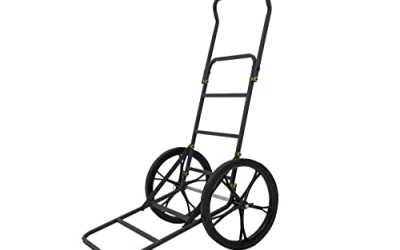
The Hawk Crawler is the serious hauler of this pair. Its listing states a 500-pound capacity carried on four 14-inch foam-filled wheels, so punctures are impossible. The defining feature is the dual pivoting axle design: the axles rotate to let the wheels walk over logs, rocks and ruts while the frame and load stay comparatively level, the terrain where ordinary carts hang up. The frame folds for transport, and the load bed uses a DuraMesh sling rather than a solid deck, saving weight and shedding mud. At 45 pounds it is not light, but for moving a whole deer over rough ground in one trip, nothing here is stronger.
Specs
- Wheels: 4 wheels, 14-inch foam-filled tires
- Capacity: 500 lb
- Axles: dual pivoting axles with 360-degree rotation
- Frame: folding frame
- Load surface: DuraMesh sling
- Cart weight: 45 lb
- Model: HWK-HA3420
Best for: Hunters who haul whole deer or heavy loads over rough, uneven ground in a single trip.
Watch out for: At 45 pounds it is the heavier cart to load into the truck, and its width suits trails better than dense brush.
2. VEVOR Game Cart
The VEVOR is the lighter, simpler interpretation of the four-wheel idea. Its listing states four wheels explicitly, with 15-inch solid rubber tires, an alloy steel frame and a 300-pound load capacity, and the cart folds down for transport at roughly 27 to 30 pounds depending on the listing source. That capacity still covers most deer a hunter will dress in the field, and the big solid tires roll over trail debris without flat risk. It lacks the Hawk’s pivoting axles, so on genuinely rough, off-trail ground the load will jolt and tilt more. For trail hunting, farm use and easy handling, it is a rational choice.
Specs
- Wheels: 4 wheels per listing
- Tires: 15-inch solid rubber
- Capacity: 300 lb
- Frame: alloy steel, folding
- Cart weight: approximately 27 to 30 lb
- Model: YL1501
Best for: Trail and farm hunters who want four-wheel stability in a lighter, easier-handling cart.
Watch out for: Fixed axles transmit more shock over rough ground, and the 300-pound rating leaves less margin for the largest animals plus gear.
Which One Fits Your Situation
You hunt far from the road on rough ground
Take the Hawk Crawler. The pivoting axles are designed for exactly this: wheels that climb over obstacles instead of stopping at them, under a load rated to 500 pounds. When the haul is long and the ground is broken, that axle design saves more energy than any other feature on either cart.
Your hunts follow trails, fields and farm lanes
The VEVOR is enough cart. Maintained surfaces do not reward pivoting axles, and its lighter weight makes it easier to load, unload and store across a season. The 300-pound capacity still handles a typical deer with room to spare, and the solid tires will never strand you with a flat. It also stores flatter against a garage wall than the pivoting-axle design.
You often hunt alone
Both four-wheel designs beat a two-wheel cart for a solo hunter, because neither asks you to lift part of the load. Choose by terrain: the Hawk for rough country where its axles keep the cart moving, the VEVOR for gentler ground where its lighter frame is quicker to deploy at the tailgate.
You also move firewood, feed and gear around property
The Hawk’s 500-pound rating and mesh sling make it the better year-round utility cart for heavy chores between seasons. The VEVOR serves lighter property work well and stores smaller. Either way, a four-wheel cart earns its garage space outside hunting season instead of sitting idle for eleven months.
Common Mistakes
- Assuming a cart is four-wheel from its photos; several popular game carts are two-wheel designs, so confirm the wheel count in the listing specifications.
- Loading the animal with its weight concentrated at one end, which overloads one axle and makes steering exhausting even on a capable cart. Strap the load so its center sits between the axles, and re-check the balance after the first hundred yards, because loads settle and shift as you roll.
- Ignoring the cart’s own weight; a heavy cart that is a struggle to load into the truck will eventually be left at home.
- Choosing pneumatic tires for remote hunting, where one puncture under a full load turns the haul into a drag.
- Skipping a practice roll before the season; folding mechanisms and axle movement are far easier to learn in the driveway than in the dark with a deer down.
Frequently Asked Questions
Is a four-wheel game cart really easier than a two-wheel cart?
On trails and open ground, yes, substantially. The four-wheel design carries the entire load on its axles, so you pull rather than lift and balance, and the cart resists tipping on side slopes. In very thick brush a narrow two-wheel cart can still thread tighter lines. Most hunters who haul on paths, fields or logging roads find the four-wheel format the clear improvement.
How much weight can these carts realistically handle?
The listings rate the Hawk Crawler at 500 pounds and the VEVOR at 300 pounds, with the load balanced over the axles. A dressed whitetail typically falls well within either rating. Quartered elk, large hogs or an animal plus heavy gear argue for the higher-rated cart. Exceeding a rating risks bent axles and failed wheels at the worst possible moment, so treat the printed capacity as a ceiling.
Why do both carts avoid air-filled tires?
Because a flat tire under a loaded cart, miles from the road, is a hunt-ending failure. Foam-filled tires, as on the Hawk, and solid rubber tires, as on the VEVOR, cannot puncture. They ride slightly harsher than pneumatic tires, but a game cart travels at walking pace, so reliability wins the trade easily. On a cart that may sit unused for months, that reliability is worth more than a softer roll.
Can a game cart be pulled by an ATV or e-bike?
Some hunters tow carts behind ATVs or hunting e-bikes on suitable terrain, but neither listing here is presented as a tow-rated trailer, and towing changes the loads on the frame and axles completely. Treat these as hand-pulled carts unless the manufacturer’s own documentation says otherwise. If powered towing is your plan, shop for a cart or trailer explicitly rated for it.


Write Your Review
No reviews yet. Be the first to share your experience!