
A good day scope is hard to give up, and a thermal clip-on lets you keep it. Instead of buying a second optic, a front attachment mounts in front of the scope you own and turns it into a thermal sight after dark, then comes off in minutes when the sun comes up. The decision is not thermal or not — it is which attachment matches your scope, your ground, and how far you need to identify game before the shot.


This roundup is for night hunters chasing hogs and coyotes with a day scope they already trust, for predator-control shooters who want thermal without a second zero, and for buyers who hunt mixed ground and need one attachment to cover it. Every add-on below was chosen from the name and specifications on its Amazon page, and every one mounts in front of a day scope — none of them is a standalone thermal scope, which is a different product covered in a separate roundup on this site.
Quick Picks
As an Amazon Associate we earn from qualifying purchases
| Product | Best for | Key spec from title |
|---|---|---|
| AGM Rattler-C V2 35-384 | All-round first clip-on | 384×288 sensor, 35 mm lens |
| AGM Rattler-C V2 50-640 | Long-range open fields | 640×512 sensor, 50 mm lens |
| Burris BTC35 V3 | Lightest setup with app control | 400×300 sensor, video recording |
How to Choose
Sensor resolution and sensitivity
Sensor resolution decides how much detail the image holds when the animal is small in the frame, and it is the main split between the add-ons here. The 640×512 sensor in the AGM 50-640 shows more of the animal at distance than the 384×288 sensor in the 35-384, while the Burris sits between them at 400×300. Sensitivity, listed as NETD, is the second number to compare: both AGM models state less than 20 mK, which keeps the image usable in fog and low thermal contrast, while the Burris listing gives no NETD figure, so judge it on its sensor and its fast F1.0 lens instead. All three use a 12-micron pixel pitch.
Day-scope fit and the adapter
A clip-on is only as good as its fit on your scope, so check the mount before anything else. Both AGM models run at 1x base magnification and are built for low-power variable optics and magnified scopes in the 1x to 6x range, and they ship with an ADM Picatinny mount while the front quick-release adapter that mounts directly to the day scope is sold separately. The Burris uses a threaded SmartClip eyepiece plus a quarter-inch interface for a quick-detach mount, so measure your objective bell and confirm the adapter size. A clip-on on a scope set past its recommended magnification gives a soft image.
Detection range and identification
Detection range is the distance at which the sensor sees a heat source at all, and it is always longer than identification range, which is the distance at which you can tell a hog from a calf. The AGM 35-384 lists detection to 1,800 metres and the 50-640 to 2,600 metres, which is why the bigger lens leads on open ground. The Burris listing gives no detection range, so do not rank it on that number; its 35 mm F1.0 lens and 400×300 sensor put it in the same class as the 35-384. Treat every detection figure as a ceiling measured in clear conditions.
Battery, recording, and weight
A clip-on is dead weight once its battery runs out, so run time belongs near the top of the checklist. The AGM 35-384 runs up to 11 hours and the 50-640 up to 9 hours, each on a replaceable rechargeable battery with a second battery in the box, and both take a 5V power bank through USB-C. The Burris runs about 2 hours on its pair of 16340 cells, which hot-swap, and it records video and photos through the BurrisConnect app. Weight runs from 16.2 ounces on the Burris to about 1.2 pounds on the AGM pair, and that difference shows on a rifle carried all night.
The 3 Best Options
AGM Rattler-C V2 35-384
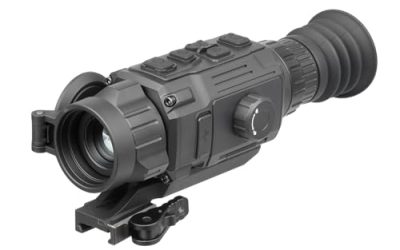
The 35-384 is the all-round pick of this roundup, pairing the mid-size sensor here with the longest battery and the widest day-scope compatibility. Its 384×288 sensor at 12 microns, behind a 35 mm lens, detects heat out to 1,800 metres, and the 1x base magnification keeps the day scope’s own zoom in charge of the picture. The 1024×768 OLED display, 16 GB of recording memory, and IP67 sealing cover wet nights, while Wi-Fi streams the view to a phone. It is the attachment to choose when one clip-on has to handle brush, fields, and fence lines.
Specs
- 384×288 thermal sensor, 12 micron pixel pitch, NETD less than 20 mK
- 35 mm lens, 1x base magnification, 1-8x digital magnification, 50 Hz refresh
- Detection range 1,800 m, 1024×768 OLED display
- Up to 11 hours battery, two NE-4400 rechargeable batteries included
- USB-C charging, Wi-Fi module, 16 GB video and photo storage
- IP67 waterproof, 1.19 lb weight
- ADM Picatinny mount included, front quick-release adapter sold separately
Best for: Hunters who want one clip-on for mixed ground and the longest run time in this roundup.
Watch out for: The front quick-release adapter that mounts directly to a day scope is sold separately, so confirm the adapter size for your objective bell before ordering.
AGM Rattler-C V2 50-640
The 50-640 is the reach pick of this roundup, built for shooters who identify game across open fields and want the sharpest image at distance. Its 640×512 sensor at 12 microns, behind a 50 mm lens, detects heat out to 2,600 metres, and the 1x base magnification leaves the day scope’s zoom to do the aiming. The 1024×768 OLED display, 16 GB of recording memory, and IP67 sealing carry over from its smaller sibling, as does the Wi-Fi streaming. It suits open-country predator work where the animal is small in the frame and the shot is long.
Specs
- 640×512 thermal sensor, 12 micron pixel pitch, NETD less than 20 mK
- 50 mm lens, 1x base magnification, 1-8x digital magnification, 50 Hz refresh
- Detection range 2,600 m, 1024×768 OLED display
- Up to 9 hours battery, two NE-4400 rechargeable batteries included
- USB-C charging, Wi-Fi module, 16 GB video and photo storage
- IP67 waterproof, 1.20 lb weight
- ADM Picatinny mount included, front quick-release adapter sold separately
Best for: Long shots across open ground where sensor detail and detection range matter most.
Watch out for: The 9-hour battery is shorter than the 35-384, and the 50 mm lens adds length, so confirm the balance on your rifle setup first.
Burris BTC35 V3
The BTC35 V3 is the lightest pick here and the only one with phone-based recording built in from the start. Its 400×300 VOX sensor at 12 microns sits behind a 35 mm F1.0 lens with manual focus, and the 1x, 2x, and 4x digital zoom pairs with a picture-in-picture window. Video and photos record through the BurrisConnect app, which also handles remote control of the device settings, and the rotary dial control works with gloves on. It is the pick for hunters who want the smallest package on the rifle and app control in the pocket.
Specs
- 400×300 VOX thermal sensor, 12 micron pixel pitch, 50 Hz refresh
- 35 mm F1.0 lens, manual focus, 1x, 2x, and 4x digital zoom
- 1024×768 display, picture-in-picture window
- Video and photo recording through the BurrisConnect app
- Two 16340 rechargeable batteries, battery life about 2 hours at 25 C
- M33.5 threaded eyepiece SmartClip, quarter-inch interface for quick-detach mount
- 16.2 oz weight, 5.9 x 2.9 x 2.5 in size
Best for: Hunters who want the lightest clip-on and phone-based recording and remote control.
Watch out for: The battery lasts about 2 hours, the shortest here by a wide margin, so carry spare 16340 cells and confirm the SmartClip fits your objective bell.
Which One Fits Your Situation
You already own a day scope you like
Keeping your day scope means keeping its glass, its eye relief, and its zero, so the clip-on should add thermal without changing anything else. The AGM 35-384 does that with the longest battery here and a sensor that covers real hunting distances. It fits low-power variable optics and magnified scopes in the 1x to 6x range, records to 16 GB, and comes off in minutes. Pick it when the day scope stays and thermal is the add-on.
Open fields and long shots
Coyotes cross open fields at distance, so identification range and sensor detail decide the pick. The AGM 50-640 pairs the 640 sensor with a 50 mm lens and a 2,600-metre detection range, which is the longest here. The 1x base keeps the day scope’s zoom in charge, and the two batteries in the box cover a long night. Accept the shorter run time and the extra length, and it identifies game further out than either of the other two.
Lightest kit and phone control
Some hunters count every ounce and want the phone to run the optic. The Burris BTC35 V3 is the lightest here at 16.2 ounces, and its BurrisConnect app records video and photos and controls the device settings remotely. The rotary dial works with gloves, and the picture-in-picture window keeps the animal in view while zoomed. Accept the short battery and carry spares, and it is the smallest package on the rifle.
Hunting with a low-power variable optic
A low-power variable optic is the natural partner for a clip-on, since the attachment runs at 1x and the scope supplies the zoom. Both AGM models state they are built for scopes in the 1x to 6x range, so either fits; choose the 35-384 for the longer battery and lighter carry, or the 50-640 when the same rifle also shoots open ground. Check the front adapter size either way, since it is sold separately.
Common Mistakes
- Buying a standalone thermal scope when you wanted a clip-on, or the reverse — check the listing says clip-on or front attachment before ordering.
- Forgetting the AGM front quick-release adapter is sold separately, then finding the included Picatinny mount does not fit your setup.
- Setting the day scope past its recommended magnification with the clip-on fitted and getting a soft image.
- Judging a clip-on by detection range alone, when identification range is the number that decides a shot.
- Ignoring battery life: the Burris runs about 2 hours on its pair of 16340 cells, so spares belong in the pack.
Frequently Asked Questions
Do I have to re-zero my day scope after fitting a clip-on?
No. A clip-on runs at 1x base magnification and carries no reticle of its own, so the day scope’s zero stays exactly as it was. What changes is the picture, not the point of aim. Follow the maker’s collimation steps when you first fit the attachment, then confirm the point of impact at the range before hunting with it.
Will a clip-on fit any day scope?
Not any scope. The attachment must match the objective bell diameter and the scope’s magnification range. Both AGM models are built for scopes in the 1x to 6x range and need a front quick-release adapter, sold separately, sized to the bell. The Burris uses a threaded SmartClip eyepiece. Measure the bell and check the adapter size before ordering.
Can I use a thermal clip-on in daylight?
Yes. A thermal clip-on reads heat, not light, so the image stays usable from dawn to dark and in fog, smoke, and rain. The picture is a heat map, not a daylight image, so colours and fine detail look different. That is normal for thermal, and it is why identification takes practice before the first night hunt.
Clip-on or standalone thermal scope — which is better?
It depends what you own. A clip-on keeps your day scope, its glass, and its zero, and it comes off in minutes at dawn. A standalone thermal scope gives a dedicated reticle and a longer battery, but it means a second optic and a second zero. Choose the clip-on when you like your day scope; choose a standalone scope when you want one optic that never comes off.

Write Your Review
No reviews yet. Be the first to share your experience!