
- Top Pick: Piscifun Torrent Baitcasting Reel 18LB Carbon Fiber Drag 7.1:1 Baitcasters Unequaled Affordable High-tech Innovation Baitcast Fishing Reels Right Handed
- Best Value: SylvanFlux Metal + Nylon Baitcasting Reel – 7.2:1 High-Speed, Metal Spool, Dual Magnetic Brake, 8kg Drag, Long-Casting Anti-Backlash Lure Reel for Bass & Multi-Species Fishing (Black, Right Hand)
- Premium Choice: KastKing Spartacus II Baitcasting Reels, 7.2:1, Green, Right | Max Drag: 17.6 lb, 7+1 BB, 6 oz, Graphite Frame, 5-Button Magnetic Brake, Ultralight and Super Smooth
A cheap baitcasting reel makes sense if you pick one built around a smooth drag, a reliable magnetic or centrifugal brake and a gear ratio matched to your lure, and if you are a beginner or casual angler, a budget low-profile reel from Shimano, Daiwa, Abu Garcia, Lew’s or KastKing is a safer starting point than the lightest or flashiest option. This guide explains what matters at the low end, how the common budget lines differ, and which buyer each suits.
As an Amazon Associate we earn from qualifying purchases at no extra cost to you.

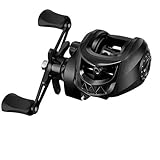


What you get from a budget baitcaster
Entry-level baitcasters have improved a lot, and the main compromises now sit in weight, bearing count, and the precision of the casting brake. Reviewers at fishing outlets often point out that a budget reel is perfectly capable of handling bass, trout and inshore fishing, while premium models mainly add smoother bearings, lighter frames and finer brake tuning. A good budget reel should cast without constant backlash, hold its drag under pressure and survive a season of regular use.
Reel lines that regularly come up as cheap options
| Reel line | Best for | Notes from the maker and reviewers | Limits |
|---|---|---|---|
| Shimano SLX (including the SLX DC variant) | Anglers who want a step up from basic | The maker positions it as a mid-entry reel with a stated lightweight build; the DC variant uses digital control braking | Often above the lowest budget tier |
| Daiwa Tatula | Bass anglers wanting a durable all-rounder | The maker lists several ratios and sizes; reviewers often praise value | Choose ratio carefully, models differ |
| Abu Garcia Max and Revo series | Beginners and all-round use | Widely sold, with parts easy to find; the Max line is the budget end | Lower tiers carry fewer bearings |
| Lew’s Speed Spool and similar | Bass fishing, versatile use | Popular among tournament and casual anglers, with a range of price tiers | Some versions are heavier |
| KastKing Royale Legend and Spartacus lines | Tight budgets | Known for feature-heavy specs at low cost; maker lists bearing counts and drag figures | Long-term durability reports vary |
| Piscifun and similar value brands | Casual use | Marketed with high bearing counts and metal frames | Quality control can vary between batches |
Specs that matter at the low end
Gear ratio
Gear ratio tells you how many times the spool turns for one handle turn. Around 6:1 is described by many anglers as a general-purpose setting, 7:1 and above for fast-retrieve lures such as spinnerbaits and topwaters, and around 5:1 for deep crankbaits where slow, steady power helps. If you will use one reel for everything, a mid-range ratio is the practical choice.
Braking system
Magnetic brakes are common at the budget level and are straightforward to adjust. Centrifugal brakes are also used. Digital control systems like the one in Shimano’s SLX DC are priced higher but are intended to reduce backlash. As a beginner, a reel with an external brake dial is easier to tune than one that requires opening the side plate.
Drag
Makers list maximum drag in pounds. For bass and general freshwater fishing, you rarely need the top figure, but smoothness matters more than the headline number. Reviewers frequently note that cheap reels can be a little jerky when drag starts.
Weight and frame
Graphite frames keep weight down, and metal frames add stiffness. Lighter reels are more comfortable over a full day of casting. Check the stated weight in ounces on the maker page.
Bearings
A higher bearing number on a spec sheet looks attractive, but the quality of the bearings and the machining matter more than the count. Reviewers caution against treating the number as the main measure.
Handedness and line capacity
Baitcasters are made in right-hand and left-hand retrieve. Choose the one that matches how you hold the rod. Line capacity is stated by the maker for particular line weights, and you should match it to the species and line you plan to use.
Pick this if
| You are | Pick | Reason |
|---|---|---|
| A first-time baitcaster user | A budget Abu Garcia Max or Daiwa Tatula with an external brake dial | Easy to tune and parts widely available |
| A bass angler on a small budget | Lew’s or KastKing value models | Strong spec sheet for the cost |
| Prone to backlash | Shimano SLX DC or a similar digital-control reel | Electronic assistance, though at a higher tier |
| Using light lures | A reel stated by the maker for light lure weights | Light lures are harder to cast on heavy spools |
| Fishing heavy cover | A reel with a higher drag and a sturdier frame | Strength under load |
How to avoid backlash on any budget reel
- Tighten the spool tension knob until the lure falls slowly with the thumb off the spool.
- Start with the brake set higher than you think you need, then lower it as you gain confidence.
- Use a lure that is heavy enough for the reel; very light lures are hard to throw without a tangle.
- Thumb the spool lightly as the lure lands to stop it overrunning.
- Use quality line. Cheap, stiff line causes more tangles than a reel ever does.
Rod pairing
A baitcaster performs best on a rod built for it. Look for a medium or medium-heavy power rod with a fast action for general bass use. A rod rated for the lure weight you plan to throw will help the reel cast cleanly. Pairing a budget reel with a well-matched rod often does more than spending more on the reel alone.
Care and longevity
Rinse the reel lightly with fresh water after saltwater use, wipe it dry, and apply reel oil to the bearings as the maker suggests. Do not blast a reel with a pressure hose, since water can push into the internals. A budget reel kept clean can last several seasons for casual use.
Alternatives
- Spincast reels. Simpler and nearly backlash-free, they suit kids and first-time anglers.
- Spinning reels. Easier with light lures and for finesse presentations.
- Used mid-range baitcasters. Secondhand Shimano or Daiwa models often beat new low-end reels, if you can inspect the condition.
Frequently Asked Questions
Is a cheap baitcasting reel good enough for beginners?
Yes, a budget baitcaster is a sensible starting point if you choose one with an accessible brake dial. The main learning curve is thumb control, and that applies to expensive reels too. Practice in an open yard before heading to the water.
What gear ratio should I buy?
A mid-range ratio around 6:1 is a common all-purpose choice, with higher ratios for fast lures and lower ones for deep crankbaits. If you only want one reel, pick the all-rounder.
Do more bearings mean a better reel?
Not necessarily. Quality of the bearings and machining matters more than the number on the box, so use bearing count as a rough hint only.
Can a baitcaster handle light lures?
Some can, but light lures are harder to cast on baitcasters. Check the maker’s stated lure-weight range, or choose a spinning reel for very light presentations.
How do I stop birds nests?
Set the spool tension and brake properly, thumb the spool on landing, and avoid casting into a strong wind with light lures. Most bird nests come from a spool that overruns the line.
Are digital-brake reels worth it on a budget?
They are priced higher and can reduce backlash, which may be useful for someone who struggles with it. If the price is too high, a magnetic-brake reel with practice does the job.







Write Your Review
No reviews yet. Be the first to share your experience!