
- Top Pick: DEWALT 20V MAX Cordless Drill and Impact Driver (DCK240C2) | Power Tool Combo Kit, Includes 2 Batteries, Charger and Bag
- Best Value: CRAFTSMAN V20 Power Tool Combo Kit, 7-Tool Cordless Power Tool Set with 2 Batteries and Charger (CMCK700D2)
- Premium Choice: DEWALT 20V MAX 5-Tool Power Tools Combo Kit, Includes 1/2 Cordless Drill,1/4 Impact Driver, Reciprocating Saw, Circular Saw, Oscillating Tool, 5Ah Battery and Charger (DCK540D1)
The best cordless power tool for most households is a compact brushless drill/driver from whichever battery platform fits your other tools, and for gamers building or modding PCs a small 12V driver is usually enough while a full 18V or 20V kit suits bigger projects such as desk builds, shelving and furniture. The platform matters more than any single tool, because batteries and chargers are shared across the whole range. This guide covers the main tool types, what the specs mean, and how to choose among the major systems.
As an Amazon Associate we earn from qualifying purchases at no extra cost to you.

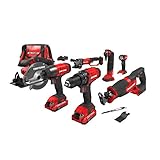


Core tool types at a glance
| Tool | Best for | Key stated traits | Limits |
|---|---|---|---|
| Drill/driver | Drilling and driving screws in wood, metal and plastic | Torque, chuck size, clutch settings, two speeds | Not ideal for stubborn fasteners |
| Impact driver | Long screws, deck work, assembling furniture | Hex quick-change chuck, high fastening torque | Less precise for small screws |
| Hammer drill | Masonry and concrete anchors | Hammer mode, larger chuck | Heavier |
| Circular saw (cordless) | Sheet goods, framing, shelves | Blade diameter, bevel range | Short run time on thick stock |
| Oscillating multi-tool | Flush cuts, trimming, scraping | Quick blade change | Slow for big cuts |
| Reciprocating saw | Demolition, pruning | Stroke length | Rough finish |
Choosing a battery platform first
Makers sell dozens of tools that share one battery type, so pick the system, then the tools. The main families include DeWalt 20V MAX and FLEXVOLT, Milwaukee M12 and M18, Makita 18V LXT and 12V max CXT, Bosch 12V and 18V, Ryobi 18V ONE+ and HP, and Craftsman V20. Independent reviewers such as Pro Tool Reviews and Tools in Action generally rate DeWalt, Milwaukee and Makita as strong professional choices, Ryobi and Craftsman as broad value choices for homeowners, and Bosch as a strong option for compact and precision work. The reviewers’ picks vary by year and model, so read the maker’s current range for the exact tool.
12V versus 18V and 20V
12V tools are smaller and lighter and handle electronics, furniture assembly and light drilling. 18V and 20V tools deliver more torque and run time and handle most general building tasks. Note that “20V MAX” is a marketing name for the peak voltage of an 18V nominal pack, so there is no performance gap between “18V” and “20V” labels on their own.
Specs that matter
Brushless motor
Makers and reviewers state that brushless motors run more efficiently and last longer than brushed motors. For regular use, brushless is the better long-term buy, while brushed tools suit light, occasional jobs.
Torque and speed
Torque is listed in inch-pounds or newton-meters. A compact driver is often enough for typical household drilling, while higher torque helps with large bits and long screws. Two-speed gearboxes balance control and speed.
Chuck and clutch
A 1/2 inch chuck on a drill/driver accepts a wider range of bits than a 3/8 inch chuck. A clutch with many settings protects screw heads and small fasteners, which is useful for PC and furniture assembly.
Battery capacity
Capacity is listed in amp-hours or watt-hours. Higher capacity gives longer run time but adds weight. Many users keep one small pack for light work and one larger pack for heavy tasks.
Ergonomics and lighting
A built-in LED helps in dark cabinets and under desks. Balance, grip texture and weight affect comfort during long jobs.
Budget tiers
| Tier | Typical buyer | What to expect | Trade-off |
|---|---|---|---|
| Budget | Renter or occasional user | Ryobi, Craftsman or entry-level kits with basic features | Brushed motors common, lower torque |
| Mid-range | Active DIY or modder | Brushless drivers, broader tool ranges, good warranty | Higher initial cost |
| Premium | Contractor or serious builder | DeWalt, Milwaukee, Makita pro lines, rugged tools | Cost, weight on some models |
Pick this if you…
| Situation | Choice |
|---|---|
| Build PCs and assemble desks | 12V compact driver with a fine clutch |
| Do general home repair and decks | 18V or 20V drill/driver plus impact driver combo |
| Need to drill concrete anchors | Hammer drill on the platform you own |
| Want to add tools slowly | Platform with a wide range and frequent bare-tool options |
| Work professionally | Pro-grade brushless tools with extended warranties |
Kit or bare tool
Combo kits bundle a drill/driver, an impact driver, batteries and a charger, and they usually cost less per tool than buying each separately. Bare tools make sense when you already own batteries. A kit with two batteries lets you keep working while one charges. Look at the charger rate as well, because a faster charger reduces downtime.
Common mistakes
- Mixing platforms and ending up with multiple chargers and incompatible packs.
- Buying maximum voltage when a compact 12V tool would do the job comfortably.
- Overlooking clutch settings. Overdriven screws strip and crack plastic and wood.
- Using worn or low-quality bits that reduce effective torque.
- Ignoring storage. Lithium-ion packs age faster when stored hot or fully drained.
Safety and battery care
Wear eye protection, and hearing protection with saws and impact tools. Secure the workpiece. Remove the battery before changing bits or blades. Use the charger the maker supplies and avoid charging damaged packs. If a battery swells, smells or overheats, stop use and contact the maker. Store packs in a cool, dry place away from flammable materials. For household wiring or hidden utilities behind walls, consult a licensed electrician before drilling.
Alternatives
- Corded drill: constant power, lower cost, but limited by the cord.
- Manual screwdriver set: precise for delicate electronics where power tools risk damage.
- Electric precision screwdriver: a small rechargeable unit made for PC and hobby work.
- Used tools from a platform you own: saves money if the tool is sound and the maker supports it.
Frequently Asked Questions
Which cordless tool brand is best?
There is no single winner. DeWalt, Milwaukee and Makita are widely regarded as strong professional systems, while Ryobi and Craftsman offer broad homeowner ranges, and Bosch is respected for compact tools. The best choice is the platform that has the tools you need and fits your budget.
Is 20V better than 18V?
Not by itself. The 20V figure is a peak voltage label and an 18V nominal pack is similar in practice. Compare torque, motor type and battery capacity rather than the headline voltage.
Do I need an impact driver and a drill?
Many people buy both because they complement each other. A drill/driver handles drilling and fine driving, while the impact driver speeds up long screws and tough fasteners. If you can buy only one, a drill/driver is more versatile.
How many batteries should I buy?
Two packs keep work moving while one charges. A compact pack and a larger pack give flexibility between weight and run time. Match packs to the tool maker’s compatibility list.
Are cordless tools strong enough for real projects?
For most home and hobby projects, yes. Brushless 18V and 20V tools handle framing, decking and furniture building. Very heavy continuous work, such as large demolition, still favors higher-capacity packs or corded and pneumatic tools.
How long do batteries last?
Lithium-ion packs are rated in charge cycles by their makers, and real life depends on heat, storage and load. Avoid leaving packs in a hot vehicle and avoid deep discharge. If a pack loses capacity quickly, replace it with a genuine pack from the platform.







Write Your Review
No reviews yet. Be the first to share your experience!