
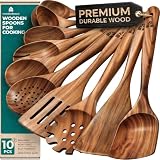
- Top Pick: Wooden Spoons for Cooking – 10 Pcs Non Toxic Teak Kitchen Utensils Set | Includes spatula, turner, ladle, skimmer, pasta server & salad fork; heat resistant, nonstick safe, easy to clean
- Best Value: Hefild Wooden Spoons for Cooking, 10-Piece Acacia Wood Cooking Utensil Set | Spoons and spatulas stir, mix, flip and serve; balanced handles offer control while staying gentle on nonstick cookware.
- Premium Choice: Wooden Utensil Set, 8 Pcs Teak Wooden Spoons for Cooking with Holder | Includes Spatula, Turner, Ladle, Skimmer, Spoon Rest & 6 Hooks – Sturdy, Non-Scratch, Easy to Clean
The best wooden utensils for most kitchens are hardwood spoons and spatulas in beech, maple, cherry or olive wood, with a smooth finish and a comfortable handle, while bamboo suits shoppers who want a lighter, harder and more affordable option. Pick based on what you cook: non-stick pans want smooth rounded edges, cast iron and stainless want a flat-edged spatula, and a stockpot wants a long handle. This guide covers wood types, shapes, care and the mistakes that make wood utensils crack.
As an Amazon Associate we earn from qualifying purchases at no extra cost to you.


At a Glance: Wood Types
| Material | Best for | Strength | Limit |
|---|---|---|---|
| Beech | All-round daily use | Dense, fine grain, widely used by makers such as Epicurean-style and European brands | Can darken or stain with turmeric and tomato |
| Maple | Durable, hard-wearing spatulas | Hard and smooth; common in American-made sets | Needs oiling to prevent drying |
| Cherry | Attractive hand-turned spoons | Fine grain, warm color, smooth feel | Slightly softer than maple |
| Olive wood | Serving and light cooking | Distinct grain and dense structure | Each piece varies; can crack if soaked |
| Teak | Moist environments | Natural oils resist water | Oils can leave a slight residue |
| Bamboo (technically a grass) | Budget and lightweight sets | Hard, sustainable, quick growing | Can splinter with rough use; glue in laminated pieces can fail |
Why Choose Wood at All?
Wood is gentle on non-stick and enameled cookware, so it will not scratch a coated surface the way metal can. It does not conduct heat, which keeps the handle comfortable while you stir a simmering sauce. It is quiet against a pot, and a good piece develops a patina with use. The drawbacks are real: wood absorbs liquids, can stain, and should not sit in water.
Shapes You Actually Need
Flat-edged spatula (saute paddle)
A flat front edge scrapes browned bits from stainless and cast iron. Many chefs use this as the main tool, and it works well on a flat-bottomed pan.
Round spoon
For stews, soups and sauces. A deeper bowl holds more liquid; a shallow bowl is better for stirring and tasting.
Slotted spoon or spurtle
Slotted spoons drain pasta and vegetables. A spurtle, a traditional Scottish stick, is good for porridge and prevents clumping.
Spoon with a corner
A spoon whose edge is angled reaches into the corner of a saucepan so that nothing scorches there. Reviewers often point to this design as a useful one for risotto and sauces.
Turner and fish spatula
A thin wooden turner can flip eggs and pancakes, although thin edges are more likely to chip than a thicker paddle.
Long-handled spoon
Useful for deep stockpots and canning pots, where a short handle brings your hand close to steam.
What to Look For
- Smooth sanding: rough surfaces trap food and can leave fibers. Run a hand over the head and handle.
- Even grain with no visible cracks, especially near the neck where the handle meets the head.
- Handle comfort: a rounded handle that is not too thin gives a better grip and reduces wrist fatigue.
- Food-safe finish: makers commonly use mineral oil or beeswax blends. Avoid finishes that are not stated as food safe.
- Single-piece construction rather than glued sections that can separate in the dishwasher or water.
- Hanging hole: helpful for drying in the open air.
Care: What the Makers Typically Advise
Most makers of wooden utensils state that the pieces should be hand washed, dried promptly and not left to soak. Dishwashers can warp and crack wood because of heat and prolonged moisture. Periodically rubbing the surface with food-grade mineral oil or a wood conditioner is a common step to prevent drying. Some makers give a specific interval, so follow the care card that comes with your set.
For hygiene, wash after each use with hot soapy water. Wood does have natural antimicrobial properties according to some food-science research, but it is still porous and should be kept clean, dry and free from deep cracks. Discard utensils that split or develop deep, persistent cracks that cannot be cleaned.
Do not use the same spoon for raw meat then ready food without washing it, and consider keeping a dedicated spoon for strong smells such as garlic and onion.
Budget Tiers
| Tier | What to expect | Trade-off |
|---|---|---|
| Budget | Bamboo or basic beech sets with several pieces | Less refined finish, handles may be thin |
| Mid-range | Solid hardwood from kitchenware brands, thoughtful shapes, better sanding | Best value for most households |
| Premium | Hand-turned or artisan pieces in cherry, olive wood or similar | Costly, and needs careful handling |
Pick X If You Want Y
| If you … | Choose |
|---|---|
| Cook mostly in non-stick pans | Smooth beech or maple with rounded edges |
| Use cast iron and stainless | A flat saute paddle in maple or beech |
| Want a decorative set for display | Olive wood or cherry in a crock |
| Need an inexpensive starter set | Bamboo, with the understanding that edges are less durable |
| Cook for a big family with large pots | Long-handled spoons and a spurtle |
| Care about sustainable materials | Bamboo or wood stated by the maker as responsibly sourced |
Common Mistakes
- Putting wood in the dishwasher, which is the top cause of cracking.
- Leaving a spoon resting across a hot pan or over a flame, which scorches it.
- Soaking in the sink overnight.
- Using unfinished utensils without oiling them, which lets them absorb stains and odors.
- Buying a large set when only three or four tools are used regularly.
Alternatives
If wood does not suit, silicone utensils tolerate high heat, go in the dishwasher and are gentle on coatings, though they feel softer and can retain odors. Nylon tools are budget friendly but can melt on a hot pan edge. Stainless steel is robust and ideal for uncoated cookware but scratches non-stick. A mix is common: wood for stirring and sauces, silicone for scraping bowls, and steel for high-heat searing.
Frequently Asked Questions
Which wood is best for cooking spoons?
Hard, tight-grained woods such as maple, beech and cherry are widely used because they resist cracking and stains. Olive wood is another popular choice with a striking grain. Avoid woods that are not stated as food safe.
Are bamboo utensils as good as hardwood?
Bamboo is hard and lightweight and can be a good budget choice. It can splinter if abused, and laminated pieces may separate over time. Hardwood is often thought of as more durable for daily use.
How do I stop wooden utensils from cracking?
Hand wash them, dry them well, avoid soaking and condition them with food-grade mineral oil from time to time. Keep them away from direct heat sources.
Can wooden spoons go in the dishwasher?
Most makers advise against it. High heat and long exposure to water can warp or split wood and strip its finish.
When should I replace a wooden spoon?
Replace it when it has deep cracks, rough splintering or a lasting odor that washing does not remove. Those areas can harbor food residue.
Do wooden utensils scratch non-stick pans?
Smooth wood is gentle on coatings, which is one of the main reasons people choose it. Keep edges smooth and avoid pieces with splinters.







Write Your Review
No reviews yet. Be the first to share your experience!