
The best 10 inch wet saw blade depends on your material: a continuous-rim diamond blade is the pick for porcelain, glass and fine ceramic because it gives the cleanest edge, while a segmented or turbo-rim blade is better for thick natural stone and concrete pavers where cutting speed and cooling matter more than finish. Check the arbor size and the maximum rpm on your saw before you buy any blade.
As an Amazon Associate we earn from qualifying purchases at no extra cost to you.

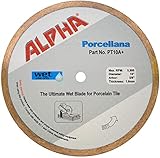


Blade types at a glance
| Blade type | Best for | Typical makers’ description | Limits |
|---|---|---|---|
| Continuous rim | Porcelain, glass, thin ceramic, polished edges | Smooth rim for minimal chipping | Slower on thick stone; needs water |
| Turbo rim (serrated continuous) | All-round tile, porcelain, some stone | Serrated edge for faster cuts with a clean finish | Edge slightly rougher than a pure continuous rim |
| Segmented rim | Brick, concrete, pavers, thick stone | Gaps between segments for cooling and debris removal | Chips fragile tile |
| Premium porcelain-specific blade | Dense, large-format porcelain | Higher diamond content and bond tuned for hard tile | Premium tier; wasteful on soft tile |
| General-purpose budget blade | Occasional DIY on ceramic wall tile | Standard diamond rim for basic work | Wears faster; may chip dense porcelain |
Compatibility checks
Diameter and arbor size
A 10 inch blade is common on tabletop and bridge wet saws. Most use a five-eighths inch arbor, but some saws use a different arbor or a diamond knockout adapter. The saw manual lists the correct bore and blade diameter. Do not force a blade onto a saw it does not match.
Maximum rpm
Every diamond blade has a maximum rpm stamped on it. Your saw must not exceed it. Check the blade marking and saw specifications before mounting.
Wet use only
Wet saw blades are made for cutting with water. Dry cutting overheats the rim and can damage the blade. Some blades are labeled for both wet and dry use, but a wet saw should always have its water supply running during cuts, as the saw manual describes.
Choosing by material
Porcelain and glass tile
Dense porcelain is hard on blades and prone to chipping. Continuous-rim or porcelain-specific blades with fine diamond grit are generally favored. Reviewers at tile-focused outlets such as Tile Setter’s guides and Pro Tool Reviews often recommend a slow, steady feed rate to cut dense tile.
Ceramic wall tile
Softer ceramic is easier to cut and works with most general-purpose blades. A continuous or turbo rim keeps edges clean.
Natural stone
Marble, granite and slate vary in hardness. A turbo rim or segmented blade intended for stone can cut faster and cool better. Granite and engineered quartz are harder and generally call for blades labeled for them by the maker.
Concrete pavers and brick
Segmented blades are made for abrasive, thick material. They leave a rougher edge, which is acceptable when the cut is hidden by joints or finished edges.
Brands to consider
- DeWalt: Offers 10 inch wet-cutting diamond blades for tile and masonry, described by the maker as suited to a range of materials.
- MK Diamond: Specialist maker of wet saw blades, including porcelain-focused and general tile blades.
- Diamond Products and Husqvarna: Professional-grade diamond blades for construction and tile pros.
- DEWALT, Bosch and Makita: Offer tile-cutting blades that match their own saws.
- Montolit and Rubi: Tile-tool specialists with premium porcelain and large-format blades.
- Lackmond and Norton Clipper: Established diamond blade makers with tile and stone lines.
- QEP and Ridgid: Budget to mid-range options suited to DIY use.
Product names are refreshed often, so confirm the current model name, rim type and rpm rating on the maker’s own page.
Pick by job
| Pick this if you… | Choose | Why |
|---|---|---|
| Cut dense porcelain for a bathroom floor | Porcelain-specific continuous rim blade | Fine edge and less chipping |
| Do mixed ceramic and porcelain tile | Turbo rim all-round blade | Balances speed and finish |
| Cut granite or engineered stone | Blade labeled for hard stone | Bond and diamond built for abrasion |
| Cut brick and pavers | Segmented masonry blade | Better cooling and aggressive cutting |
| Do a one-off DIY project | Budget general-purpose blade | Lower upfront cost for light use |
| Work on tile every week | Premium blade from a tile specialist | Longer life and consistent edge |
Budget tiers
Budget blades have a thinner diamond layer and a softer bond, so they wear faster and may chip hard tile. The mid-range balances rim height, diamond concentration and life for regular DIY use. The premium tier offers higher diamond content, tuned bonds, and often thinner kerfs for cleaner cuts in large-format porcelain. Because tile cutting is a repeated task, many reviewers note that a premium blade can cut cost per cut for frequent users, though a single-room DIYer may not need it.
Safety and technique
- Wear eye protection, hearing protection and a respirator rated for silica dust when cutting masonry or stone, following the saw and blade manuals.
- Keep the water reservoir filled and clean; sludge reduces cooling and blade life.
- Let the blade reach full speed before the cut and feed material slowly.
- Replace a cracked, warped or missing-segment blade immediately.
- Unplug the saw before changing blades.
Common mistakes
- Buying a segmented blade for fine porcelain and getting chipped edges.
- Ignoring the arbor size and rpm limits.
- Forcing the tile through the blade, which glazes the rim.
- Running the saw with a low water level.
- Using a thick standard blade on thin glass tile that needs a fine rim.
Alternatives
For a few simple cuts on soft ceramic, a manual snap cutter avoids water and dust. An angle grinder with a diamond blade handles notches and curves but produces more dust. For intricate cuts in porcelain, a tile nipper or a diamond hole saw may fit better than a wet saw.
Frequently Asked Questions
What is the best 10 inch blade for porcelain?
A continuous-rim blade or a blade labeled for porcelain by the maker generally gives the cleanest cut. Slow feeding and steady water flow help prevent chipping.
Can I use a 10 inch wet saw blade dry?
Only if the blade is labeled for dry use and your saw manual allows it. Wet saws are designed to cut with water, and dry cutting can overheat the blade.
How do I know the right arbor size?
Check your saw manual. Many 10 inch wet saws use a five-eighths inch arbor, but some require an adapter or a different size.
How long does a wet saw blade last?
Life depends on the material, feed rate and cooling. Hard porcelain wears blades faster than ceramic, and premium blades usually last longer than budget ones.
Why does my blade chip the tile?
Likely causes are the wrong rim type, a worn blade, a feed rate that is too fast or low water. Try a continuous-rim blade and slow the cut.
Is silica dust a concern with wet cutting?
Wet cutting reduces airborne dust but does not eliminate it. Follow the maker’s safety guidance, and consider a respirator and good ventilation, especially with stone or masonry.







Write Your Review
No reviews yet. Be the first to share your experience!