
- Top Pick: EVGA GeForce RTX 2080 Ti Black Edition Gaming, 11GB GDDR6, Dual HDB Fans & RGB LED Graphics Card 11G-P4-2281-KR (Renewed)
- Best Value: GIGABYTE GeForce RTX 2080 Ti Gaming OC 11GB Graphic Cards GV-N208TGAMING OC-11GC (Renewed)
- Premium Choice: GIGABYTE Radeon RX 7600 XT Gaming OC 16G Graphics Card, 3X WINDFORCE Fans 16GB 128-bit GDDR6, GV-R76XTGAMING OC-16GD Video Card (Renewed)
The RTX 2080 Ti is the faster gaming card, roughly 20-30% ahead of the RX 7600 XT in rasterized games and further ahead with ray tracing, so it is the better pick for raw performance if you can find a healthy used one for a similar price. The RX 7600 XT is the safer choice for buyers who want a newer card with warranty, lower power draw, 16 GB of VRAM, AV1 encoding and AMD’s FSR 4.1 upscaling, and who can accept lower frame rates.
This is a classic old-flagship versus new-midrange matchup. The 2080 Ti was a $999 halo card in 2018; the RX 7600 XT was a $329 1080p card in 2024. Today they often sit near each other in price, the 2080 Ti on the used market and the 7600 XT new or lightly used.
As an Amazon Associate we earn from qualifying purchases at no extra cost to you.

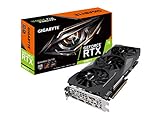

Head-to-Head Specs
| Spec | RTX 2080 Ti | RX 7600 XT |
|---|---|---|
| Architecture | Turing | RDNA 3.0 |
| Release date | 20 September 2018 | 8 January 2024 |
| Launch MSRP | $999 | $329 |
| Shaders / CUDA cores | 4352 | 2048 |
| Boost clock | 1545 MHz | 2755 MHz |
| Process | 12 nm | 6 nm |
| TDP | 250 W | 190 W |
| Memory | 11 GB GDDR6 | 16 GB GDDR6 |
| Bus width | 352-bit | 128-bit |
| Bandwidth | 616.0 GB/s | 288.0 GB/s |
| Cache | 5.5 MB L2 | 2 MB L2 + 32 MB L3 |
| Interface | PCIe 3.0 x16 | PCIe 4.0 x8 |
| Power connectors | 2x 8-pin | 1x 8-pin |
| Size | 267 mm, 2-slot | 204 mm, 2-slot |
| Outputs | 1x HDMI 2.0, 3x DP 1.4a, 1x USB Type-C | 1x HDMI 2.1a, 3x DP 2.1 |
The 2080 Ti has more than twice the memory bandwidth and a much wider chip. The RX 7600 XT counters with a 32 MB Infinity Cache, newer 6 nm silicon and 5 GB more memory. Its reference length of 204 mm also makes it far easier to fit into compact cases.
Gaming Performance
Published review data and multi-game aggregates consistently place the RTX 2080 Ti ahead. TechPowerUp’s relative performance charts put the 2080 Ti near RTX 3070 level, while the RX 7600 XT lands only modestly above the RX 7600, which is a full tier lower. Aggregated benchmark sources report the 2080 Ti roughly 23-35% faster, with the gap holding or widening at 1440p and 4K where its 352-bit bus helps. A fair summary is a 20-30% raster lead for the Nvidia card.
For orientation only, a modern AAA game that runs around 50-60 FPS on the RX 7600 XT at 1440p high settings often runs around 65-75 FPS on the 2080 Ti. Results vary with settings, CPU and game patches.
Ray tracing
Turing’s first-generation RT cores are old, but the 2080 Ti has 68 of them, and its RT performance remains ahead of the RX 7600 XT in most ray-traced games. RDNA 3’s ray accelerators improved over RDNA 2, but a 32-CU card cannot keep up with a big Turing chip once lighting effects get heavy.
Upscaling and frame generation
- RTX 2080 Ti: supports DLSS 4 Super Resolution with the transformer model, which gives very good image quality. No DLSS Frame Generation (RTX 40/50 only), but FSR 3 frame generation works in supported games.
- RX 7600 XT: received official FSR 4.1 upscaling in mid-2026 through AMD’s driver, for games with FSR 3.1 support. It also has FSR 3 frame generation and driver-level Fluid Motion Frames.
Both now have access to ML-based upscaling, which removes what used to be a major Nvidia advantage. DLSS is still supported in more games overall.
VRAM: 11 GB vs 16 GB
The RX 7600 XT’s 16 GB looks generous, but the card’s GPU is the limit long before memory in most games. The 2080 Ti’s 11 GB is still enough for 1440p high settings in the large majority of current titles.
| Resolution | Typical demand (high textures) | RTX 2080 Ti (11 GB) | RX 7600 XT (16 GB) |
|---|---|---|---|
| 1080p | about 6-9 GB | Comfortable | Comfortable |
| 1440p | about 8-11 GB | Usually fine | Comfortable, GPU-limited |
| 4K with upscaling | about 10-14 GB | Occasionally tight | Memory fine, GPU too slow for high settings |
Where the 16 GB matters is with high-resolution texture packs, mods, and local AI or content-creation workloads.
Power Draw and PSU Sizing
GPU TDP + CPU power + about 150 W headroom:
- RTX 2080 Ti + 105 W CPU: 250 + 105 + 150 = about 505 W, so a quality 600-650 W unit is recommended.
- RX 7600 XT + 105 W CPU: 190 + 105 + 150 = about 445 W, so 500-550 W is enough.
The 2080 Ti needs two 8-pin connectors and runs warmer. The RX 7600 XT needs one 8-pin. Over years of gaming the 60 W difference adds up on electricity bills and case temperatures.
Platform Fit: PCIe and Case Size
The 2080 Ti is a PCIe 3.0 x16 card, so it runs at full speed in any older board. The RX 7600 XT uses PCIe 4.0 x8; on a PCIe 3.0 motherboard it drops to x8 3.0 bandwidth, which costs a little on average. Its 16 GB buffer makes memory overflow rare, which limits the penalty. At 204 mm the RX 7600 XT fits small-form-factor cases that cannot take a 267 mm 2080 Ti.
Buying a Used RTX 2080 Ti in 2026
Used RTX 2080 Ti cards commonly sell for around $250-$330 depending on cooler and condition. Points to check:
- Ask for a stress-test screenshot or run one before paying; early 2080 Ti units had a known memory failure issue, though surviving cards are generally stable.
- Check fan noise and replace thermal paste if temperatures are high; many cards are six or more years old.
- Expect no remaining manufacturer warranty.
The RX 7600 XT, by contrast, still sells new in many markets and has typically been offered around its launch price or slightly below, with used units somewhat cheaper.
Value by the Numbers
Using the RX 7600 XT as 100 and the 2080 Ti as about 125, with a hypothetical used 2080 Ti at $290 and a 7600 XT at $300:
- RTX 2080 Ti: $290 / 125 = about $2.32 per performance point
- RX 7600 XT: $300 / 100 = about $3.00 per performance point
On pure frames per dollar the used 2080 Ti usually wins. The RX 7600 XT’s premium buys warranty, efficiency, newer outputs and more VRAM.
Pick by Resolution and Priorities
| Priority | Better choice |
|---|---|
| Highest FPS at 1440p for the money | RTX 2080 Ti (used) |
| Ray tracing at 1080p/1440p | RTX 2080 Ti |
| Warranty and peace of mind | RX 7600 XT |
| Small case or 550 W PSU | RX 7600 XT |
| Streaming with AV1 | RX 7600 XT |
| Texture mods, local AI with large models | RX 7600 XT (16 GB) |
| Older PCIe 3.0 motherboard | RTX 2080 Ti |
Software, Drivers and Long-Term Support
The RTX 2080 Ti remains on Nvidia’s main driver branch. It continues to receive game-ready drivers and DLSS improvements that apply to Turing, including the transformer-based upscaling model. Nvidia has ended support for much older GTX generations over time, so Turing will eventually follow, but for now it is fully supported. The card’s CUDA support also keeps it useful for Blender, video effects and AI tools that favor Nvidia hardware.
The RX 7600 XT is on AMD’s main RDNA 3 and RDNA 4 driver branch, which receives new features first. Official FSR 4.1 support is the clearest example: it reached RX 7000 cards in mid-2026, while older Radeon generations wait longer or miss out. The 7600 XT also supports hardware AV1 encoding, DisplayPort 2.1 and HDMI 2.1a, which make it a better match for newer high-refresh monitors and streaming setups.
For buyers planning to keep a card for four or more years, the newer architecture and warranty of the 7600 XT count for more than its lower frame rates suggest. For buyers chasing maximum frames today on a budget, the used 2080 Ti remains the stronger performer.
Frequently Asked Questions
Is the RTX 2080 Ti faster than the RX 7600 XT?
Yes. Published reviews and benchmark aggregates place it roughly 20-30% ahead in rasterized games. The lead is similar or larger with ray tracing enabled.
Does the RTX 2080 Ti support DLSS 4?
It supports DLSS 4 Super Resolution, including the transformer model. It does not support DLSS Frame Generation or Multi Frame Generation, which require RTX 40 and RTX 50 cards respectively.
Is the RX 7600 XT’s 16 GB better than 11 GB?
Only in specific cases such as texture mods, very high texture settings, or AI workloads. In most games the RX 7600 XT runs out of GPU power before it uses all 16 GB. The 2080 Ti’s 11 GB is still adequate at 1440p.
What PSU does an RTX 2080 Ti need?
A quality 600-650 W power supply with two 8-pin PCIe cables is recommended. The card is rated at 250 W. Older or low-quality units may struggle with its power spikes.
Is a used RTX 2080 Ti risky?
Any six-year-old card carries some risk, and there is no warranty left. Testing the card under load and checking temperatures before buying reduces that risk. Many surviving units still run reliably.
Ready to decide? Our #1 pick for 2026 is the Architecture.
Live price & availability on Amazon.









Write Your Review
No reviews yet. Be the first to share your experience!