
- Top Pick: KOTIN Gaming PC, Ryzen 7 9800X3D, RTX 5070 Ti 16GB, 32GB DDR5, 1T SSD
- Best Value: ZOTAC MEK Gaming PC Desktop, Ryzen 7 9700X, NVIDIA GeForce RTX 5070 Ti 16GB
- Premium Choice: GIGABYTE GeForce RTX 5070 Ti Gaming OC 16G Graphics Card, 16GB 256-bit GDDR7, PCIe 5.0, WINDFORCE Cooling System, GV-N507TGAMING OC-16GD Video Card


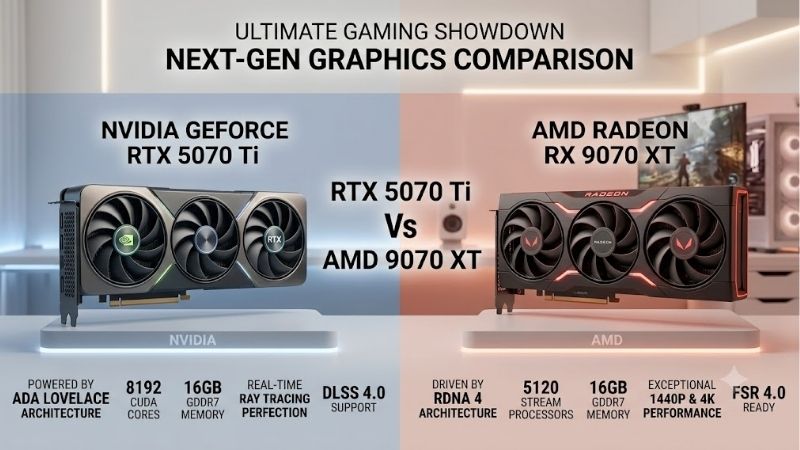
RTX 5070 Ti vs AMD 9070 XT is the ultimate upper mid-range graphics card matchup for PC gamers seeking elite 1440p and 4K performance in 2026. Choosing between NVIDIA’s AI-driven architecture and AMD’s high-value rasterization muscle requires analyzing specs, real-world frame rates, pricing, and current market dynamics.
Architectural Specs, Features, and Market Supply Trends
Comparing modern upper mid-range graphics cards requires looking past surface marketing names to analyze hardware execution units, memory subsystems, and broader semiconductor market conditions. The architectural divergence between NVIDIA Blackwell and AMD RDNA 4 defines how these two GPUs process modern rendering workloads.
As an Amazon Associate we earn from qualifying purchases at no extra cost to you.


Architecture, Core Counts, and Technical Specifications
The core structural distinction between these two GPUs originates in their underlying microarchitecture. The NVIDIA GeForce RTX 5070 Ti leverages the Blackwell architecture built on a custom TSMC 4N process node. It features 8,960 CUDA cores, 280 Tensor cores, and 70 RT cores. Engineered to push neural rendering and real-time path tracing, Blackwell introduces next-generation streaming multiprocessors with enhanced execution efficiency and double the FP32 throughput compared to prior generations.
Conversely, the AMD Radeon RX 9070 XT utilizes the RDNA 4 architecture built on advanced TSMC process technology. Packing 64 Compute Units, 128 AI Accelerators, and 64 2nd-Gen Ray Tracing Accelerators, AMD focuses heavily on massive raw compute density and refined spatial execution pipelines. Clock speeds on the RX 9070 XT routinely boost above 2.8 GHz, yielding phenomenal floating-point calculation performance that translates directly into high traditional rasterized frame rates.
VRAM Allocation, Memory Bus Width, and Bandwidth
Memory configurations play an increasingly critical role in modern game performance as high-resolution textures and AI frame generation demand higher VRAM allocations. The RTX 5070 Ti comes equipped with 16GB of GDDR7 memory operating across a 256-bit memory bus interface. Utilizing ultra-fast GDDR7 memory technology allows NVIDIA to achieve memory bandwidth exceeding 800 GB/s. This massive memory throughput prevents texture bottlenecking during complex path-traced rendering scenes at 4K resolution.
AMD equips the Radeon RX 9070 XT with 16GB of high-speed VRAM across a wide 256-bit memory bus, augmented by AMD’s 3rd-Gen Infinity Cache. While AMD utilizes fast GDDR6/GDDR6X modules, the addition of a 64MB Infinity Cache dramatically increases effective bandwidth while reducing latencies for on-die cache hits. Both graphics cards comfortably satisfy the heavy VRAM requirements of 2026 AAA games, ensuring long-term hardware longevity without micro-stuttering caused by video memory constraints.
Check the latest price on Amazon:
- Gigabyte Geforce Rtx 5070 Ti Gaming Oc 16gb
- Gigabyte Geforce Rtx 5060 Ti Windforce Oc
- Rx 7700 Xt Vs Rtx 5070
- Zapfixers Gpu Repair
Semiconductor Supply Allocations and Component Inflation Risks in 2026
Evaluating hardware buying decisions in 2026 requires understanding macro macroeconomic trends across the PC gaming industry. A major market shift occurred when regulatory bodies authorized NVIDIA to export high-capacity H200 AI chips to select enterprise clients in international markets. Because enterprise AI accelerators command significantly higher profit margins than consumer hardware, semiconductor foundries like TSMC are allocating substantial wafer capacity and advanced packaging lines toward enterprise AI silicon rather than consumer graphics dies.
This reallocation creates ripple effects across retail GPU inventory channels, limiting supply yields for consumer chips like the RTX 5070 Ti. Furthermore, supply chain data across 2026 highlights sustained inflation across memory modules, power delivery components, and finished gaming laptops. As manufacturing costs rise across the board, retail GPU prices face persistent upward pressure. Gamers looking to build or upgrade a gaming rig face financial risks by waiting for price cuts, making an early purchase a sensible hedge against future price increases.
$$Check the latest price on Amazon for RTX 5070 Ti Graphics Cards$$
| Hardware Specification | NVIDIA GeForce RTX 5070 Ti | AMD Radeon RX 9070 XT |
|---|---|---|
| Architecture | Blackwell (TSMC 4N) | RDNA 4 (TSMC Advanced) |
| Stream Cores / Units | 8,960 CUDA Cores | 64 Compute Units (4,096 Shaders) |
| Boost Clock Speed | ~2.55 GHz | ~2.85 GHz |
| VRAM Capacity | 16GB GDDR7 | 16GB GDDR6 / GDDR6X |
| Memory Bus Width | 256-bit | 256-bit |
| Cache Architecture | 64MB L2 Cache | 64MB Infinity Cache |
| Total Board Power (TBP) | 285W | 300W |
| Recommended PSU | 750W | 750W – 800W |
| Primary Upscaling AI | DLSS 4 / DLSS 3.5 Suite | FSR 4 / HYPR-RX |
The Quick Verdict: If you prioritize maximum rasterized frame rates per dollar and traditional gaming performance, the AMD Radeon RX 9070 XT delivers incredible value. However, if you want uncompromised ray tracing performance, superior power efficiency, and access to industry-leading DLSS 4 AI frame interpolation, the NVIDIA GeForce RTX 5070 Ti takes the top spot.
$$Check current Amazon deals on AMD Radeon RX 9070 XT Graphics Cards$$
Real-World Gaming Performance, Ray Tracing, and Ecosystems
Moving from synthetic specifications to practical gameplay scenarios demonstrates how these upper mid-range GPUs perform in real-world environments. Testing modern game engines reveals distinct advantages for each graphics card depending on visual settings and display resolutions.
1440p and 4K Rasterization Benchmarks
In standard rasterized gaming without ray tracing enabled, the AMD Radeon RX 9070 XT demonstrates exceptional strength. At 1440p Quad HD resolution, the RX 9070 XT routinely matches or surpasses the RTX 5070 Ti in traditional titles like Call of Duty: Warzone, Far Cry 7, and Starfield. High clock speeds and optimized Infinity Cache allow the AMD card to push ultra-high frame rates that fully saturate 180Hz and 240Hz gaming monitors.
When scaling up to 4K Ultra HD resolution, the performance delta between both cards narrows into a fierce neck-and-neck battle. The RTX 5070 Ti leverages its ultra-fast GDDR7 memory bandwidth to process high-resolution asset pipelines seamlessly, maintaining averages around 75 to 90 FPS in demanding 4K titles like Cyberpunk 2077 and Black Myth: Wukong. The RX 9070 XT remains competitive, holding strong 4K frame rates and proving that both GPUs are fully capable 4K gaming solutions.
Ray Tracing, Neural Rendering, and Upscaling Technologies
Ray tracing performance remains the single largest differentiator in this GPU comparison. The RTX 5070 Ti integrates 5th-Gen Tensor Cores and 4th-Gen RT Cores, allowing it to handle full path tracing and heavy lighting calculations with minimal performance loss. Utilizing NVIDIA’s DLSS 4 feature set, which includes Multi-Frame Generation and Ray Reconstruction, the RTX 5070 Ti multiplies frame output while enhancing image clarity.
AMD has made significant structural gains with its RDNA 4 Ray Tracing Accelerators, dramatically reducing the performance penalty seen in older Radeon generations. The RX 9070 XT handles heavy ray-traced reflections and shadows far better than its predecessors. However, in full path-traced titles, the RTX 5070 Ti maintains a clear 25% to 35% performance advantage. Furthermore, while AMD’s FSR 4 upscaling technology offers impressive open-source spatial upscaling, NVIDIA’s proprietary AI tensor pipeline still provides cleaner temporal stability and fewer visual artifacts in fast-moving scenes.
Power Efficiency, Thermal Performance, and System Requirements
Power draw and thermal output are important considerations when selecting a graphics card for your desktop PC build. The RTX 5070 Ti operates at a rated Total Board Power (TBP) of 285W. Thanks to the architectural efficiency of Blackwell, the GPU delivers remarkable performance-per-watt metrics. Under heavy gaming loads, custom dual-fan and triple-fan partner cards keep core temperatures near 65°C while running quietly. Most PC builders can comfortably power an RTX 5070 Ti system using a standard 750W power supply.
The AMD Radeon RX 9070 XT features a slightly higher TBP rating of 300W. While it requires slightly more power under full load, board partners supply robust cooling solutions that keep junction temperatures well within safe operational limits. AMD continues to utilize standard dual 8-pin PCIe power connectors on most custom models, avoiding the need for dedicated 12VHPWR adapter cables required by some ATX 3.0 power supply standards.
Practical Value Analysis, Pros & Cons, and Final Recommendations
Making the final buying choice between these two powerful graphics cards requires balancing raw frame rates against long-term features, driver ecosystems, and total budget limits.
RTX 5070 Ti vs AMD 9070 XT Pros and Cons Analysis
Every graphics card design involves trade-offs between physical footprint, architectural features, power consumption, and price point. Below is a detailed evaluation of the strengths and weaknesses inherent to the RTX 5070 Ti vs AMD 9070 XT comparison.
- NVIDIA GeForce RTX 5070 Ti Pros:
- Unmatched Ray Tracing & Path Tracing: Leading hardware acceleration for advanced lighting, shadows, and path-traced rendering.
- DLSS 4 & AI Feature Suite: Access to cutting-edge AI frame interpolation, Super Resolution, and Ray Reconstruction.
- GDDR7 Memory Speed: High memory bandwidth ensures smooth asset streaming at 4K resolution.
- Content Creation Dominance: Hardware acceleration in Blender, Premiere Pro, and DaVinci Resolve via NVENC encoders.
- NVIDIA GeForce RTX 5070 Ti Cons:
- Higher Price Point: Demands a premium initial investment compared to AMD’s price-to-performance options.
- Power Cable Requirements: Many models require 12VHPWR power adapters or native ATX 3.0 power supplies.
- AMD Radeon RX 9070 XT Pros:
- Excellent Price-to-Performance: Delivers high rasterization performance per dollar in modern AAA titles.
- 16GB VRAM & Infinity Cache: Generous memory buffer with fast cache architecture for 1440p and 4K gaming.
- Standard PCIe Power Connectors: Uses standard 8-pin PCIe power cables, simplifying upgrades for older PSUs.
- Open-Source Ecosystem: Broad support for AMD FidelityFX features across PC and console ports.
- AMD Radeon RX 9070 XT Cons:
- Ray Tracing Deficit: Lags behind Blackwell architecture in intense path-traced game titles.
- Higher Power Consumption: Slightly higher board power draw under peak gaming workloads.
The Alternative GPU Option for Balanced Budgets
If neither card perfectly fits your budget or system requirements, a compelling middle-ground alternative is the standard NVIDIA GeForce RTX 5070 (non-Ti) or the AMD Radeon RX 9070. Operating just below these top-tier offerings, the non-Ti RTX 5070 provides full access to Blackwell AI features and DLSS 4 frame generation at a lower price point and a modest 220W power draw.
Alternatively, looking at prior-generation hardware like the AMD Radeon RX 7900 XT offers another viable path for budget-focused builders. The RX 7900 XT features a massive 20GB VRAM buffer and a wide 320-bit memory bus, making it an attractive option for high-VRAM production workloads and native 4K gaming if found on clearance sales.
Final Verdict and Persona-Based Buying Guidance
Selecting the best graphics card ultimately comes down to matching hardware capabilities with your gaming priorities and display hardware.
Who Should Buy the AMD Radeon RX 9070 XT?
- Pure Rasterization Gamers: Players who focus on competitive high-FPS online shooters at 1440p without enabling heavy ray tracing.
- Value-Focused PC Builders: System builders looking to maximize frame rates per dollar invested in raw GPU hardware.
- Upgraders Keeping Existing PSUs: Users upgrading older systems who prefer standard 8-pin PCIe power connections without custom adapters.
Who Should Buy the NVIDIA GeForce RTX 5070 Ti?
- Ray Tracing & Graphics Enthusiasts: Gamers who want to play visual showcases like Cyberpunk 2077 with maxed path tracing, high frame rates, and DLSS 4 enabled.
- 4K Gaming & Future-Proofing Buyers: Gamers pairing their GPU with a 4K OLED monitor who need ultra-fast GDDR7 bandwidth.
- Content Creators & Streamers: Users who perform 3D rendering, video editing, or high-bitrate live streaming using NVIDIA CUDA and NVENC acceleration.
$$Check Amazon today for the best deals on RTX 5070 Ti and RX 9070 XT GPUs$$
Conclusion: Which Graphics Card Should You Choose?
When summarizing the RTX 5070 Ti vs AMD 9070 XT comparison, both GPUs deliver outstanding performance for high-end PC gaming in 2026. The AMD Radeon RX 9070 XT stands out as a high-value rasterization powerhouse that delivers incredible frame rates for traditional titles. However, the NVIDIA GeForce RTX 5070 Ti represents the more complete, future-ready package thanks to its superior ray tracing hardware, ultra-fast GDDR7 memory, and cutting-edge DLSS 4 AI suite. Considering ongoing semiconductor allocations toward AI chips and rising PC component costs, securing your upper mid-range GPU upgrade today ensures an elite gaming experience for years to come. Check Amazon today to compare current prices and complete your dream PC build!
Frequently Asked Questions
Which card is faster for 1440p gaming?
In pure rasterization the two trade blows, with the RX 9070 XT often matching or slightly beating the RTX 5070 Ti in titles that favor RDNA 4, while the NVIDIA card pulls ahead in engines tuned for its architecture. Once ray tracing is enabled the gap widens clearly in NVIDIA favor, frequently by twenty to thirty percent in heavy path-traced or full RT workloads.
Is 16GB of VRAM enough on both cards for the next few years?
Both ship with 16GB, though the RTX 5070 Ti uses faster GDDR7 on a 256-bit bus while the RX 9070 XT uses GDDR6 on the same bus width. Sixteen gigabytes comfortably covers maxed 1440p textures, and handles 4K with high settings in almost every current title. It is the memory capacity most reviewers consider the sensible minimum for a card intended to last through this console generation.
What power supply do I need for either card?
The RTX 5070 Ti draws around 300W and the RX 9070 XT around 304W board power, so a quality 750W unit is the sensible baseline for a mainstream CPU, and 850W is safer for a high-core-count Ryzen 9 or Core i9 with several drives and fans. The NVIDIA card uses a 12V-2×6 connector, usually via an adapter; most Radeon models use two or three standard 8-pin PCIe cables.
How do DLSS 4 and FSR 4 compare in practice?
DLSS 4 with its transformer model generally holds a small but visible edge in image stability, especially on fine detail like foliage and wires, and NVIDIA multi frame generation can push far higher frame counts on high refresh monitors. FSR 4 closed most of the historic quality gap on RDNA 4 hardware and looks genuinely competitive, but it is supported in fewer games than DLSS at present.
Which is the better buy at real street prices?
If the Radeon sells meaningfully below the GeForce, it is the stronger raw-frames-per-dollar choice for high refresh 1440p rasterized play. If the two sit within about fifty dollars of each other, the RTX 5070 Ti is easier to recommend because you gain stronger ray tracing, better productivity and AI application support, NVENC encoding for streaming, and broader upscaling adoption across games.

Write Your Review
No reviews yet. Be the first to share your experience!