
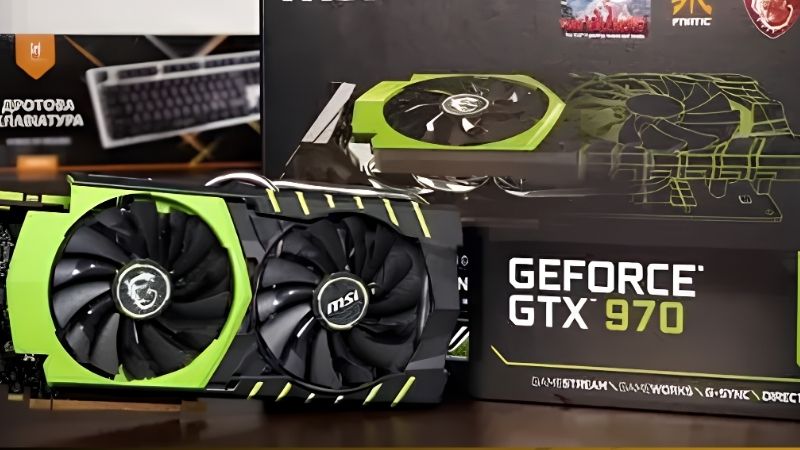
Nvidia GTX 970 drivers reached the end of the road in October 2025, and if you are searching for one now it is worth knowing exactly what that means before you download anything. The card is not broken. It will not stop working. But Nvidia shipped its final Game Ready driver for Maxwell that month, and everything since has been security patches only. This covers which version you actually want, why installing the newest thing you find is now the wrong move, and what an eleven-year-old card is genuinely worth keeping.
What Happened to GTX 970 Driver Support
Nvidia gave this card an unusually long run, and then ended it clearly. Understanding the shape of that ending saves you from chasing updates that do not exist.
The October 2026 Cutoff
Nvidia announced that after a final Game Ready Driver release in October 2025, GeForce GPUs based on Maxwell, Pascal, and Volta architectures would transition to quarterly security updates for the next three years — through October 2028.
The GTX 970 is Maxwell. It uses the GM204 die, launched in September 2014 at $329, and it sits squarely in that group alongside the GTX 980 and the rest of the 900 series.
Nvidia’s framing was that support reached up to eleven years for these cards, well beyond industry norms. That is a fair claim. The GTX 900 series debuted in 2014, and hardware receiving optimisation work a decade later is genuinely unusual.
| Architecture | Cards | Status in 2026 |
|---|---|---|
| Maxwell | GTX 700 / 900 series | Security only, to Oct 2028 |
| Pascal | GTX 10 series | Security only, to Oct 2028 |
| Volta | Titan V | Security only, to Oct 2028 |
| Turing | GTX 16 / RTX 20 | Full Game Ready support |
| Ampere and newer | RTX 30 / 40 / 50 | Full Game Ready support |
What “Security Updates Only” Actually Means
Be precise about this, because it is narrower and less alarming than it sounds. You stop receiving new game profiles, driver-level optimisations for new titles, and new features. You continue receiving fixes for security vulnerabilities.
Display drivers run in kernel mode, so those security patches are not theoretical — they matter. But nothing about your card’s performance in the games you already play changes on the day support ends.
What changes is the future. A title released in 2027 will have received no driver-side optimisation for Maxwell, and modern engines lean on that work more than they used to.
The 580/581 Branch Is Your Last Full-Feature Driver
The practical detail: the 580/581 driver family was the last full-feature branch for Maxwell, Pascal, and Volta. That is the version you want.
On Linux this became operational rather than theoretical. The 590 driver arrived in December 2025, and community testing found a number of Pascal and Maxwell cards no longer enumerating correctly with it. Distributions adapted — Arch moved to 590 as default while providing an nvidia-580xx-dkms path for older hardware.
So the instruction is unusual for a driver article: do not install the newest driver you can find. Find the last 580-series release for your platform, install that, and stop.
Installing and Keeping the Right Driver
The mechanics are the same as any Nvidia card. The difference is that you are now pinning a version rather than chasing one, and Windows will fight you about it.
The Clean Install Path
Create a restore point first. Then disconnect from the network before uninstalling the old driver — this stops Windows Update from racing you to install its own version into the gap.
Run the installer, choose Custom (Advanced), tick Perform a clean installation. On a card this old, the clean install matters more than usual: a machine that has been running since 2014 may be carrying eight years of layered driver remnants.
Note that the Nvidia Control Panel is being retired in favour of the Nvidia App. Much of the advice you will find for a card this old references Control Panel menu paths that no longer exist. If a guide tells you to open Manage 3D Settings from the Control Panel, translate rather than assuming your install is broken.
Stopping Windows From Replacing It
This is the part that matters more now than it used to. Once you have pinned a 580-series driver, Windows Update will happily install something else over it.
On Windows 11 Pro, defer driver updates through Group Policy. On Home editions, the “Show or hide updates” troubleshooter is the practical workaround — clumsy but functional.
There is a Windows 10 wrinkle worth knowing. Nvidia extended Windows 10 Game Ready driver support to October 2026 — but that extension was announced for RTX GPUs. If you are running a GTX 970 on Windows 10, you are outside both the architecture extension and, shortly, the operating system’s own support window.
The 3.5GB Issue, and Whether It Still Matters
Worth addressing since it defines this card’s reputation. The GTX 970 was advertised with 4GB of VRAM. In practice it has 3.5GB on a fast partition and 0.5GB on a substantially slower one — a segmentation Nvidia did not disclose at launch, which led to a class action and a settlement paying affected buyers.
The practical effect: when a game exceeds 3.5GB, performance does not degrade gracefully. It falls off a cliff, because the last half-gigabyte is served at a fraction of the bandwidth.
In 2026 this matters less than it did, for a depressing reason. Modern titles exceed 4GB at 1080p high settings routinely, so you are past the cliff regardless of where it sits. The 3.5GB boundary was a scandal when 4GB was adequate. Now the card is memory-limited at 4GB and the internal split is academic.
Pros and Cons of Keeping a GTX 970 in 2026
There is a real case for keeping this card and a real case for not, and which applies depends entirely on what you run rather than on any driver decision.
What Still Works
Esports at 1080p. CS2, Valorant, League, Rocket League, Dota — the 970 still delivers playable frame rates in all of them, and the driver situation does not change that. If this is what you play, nothing is broken and nothing needs fixing.
Older libraries. Anything from before roughly 2019 runs well. A decade of games exists that this card handles comfortably.
And it is paid for. In a market where component prices have continued climbing, a card that works and costs nothing has more appeal than it did three years ago.
What Does Not
4GB is the hard wall, and it is not fixable. Modern titles at 1080p high routinely exceed it, and the symptom is not a lower average frame rate — it is severe stutter as assets swap over the PCIe bus.
The feature gap is larger than the performance gap. No DLSS in any form, no ray tracing, no frame generation. Games are increasingly designed assuming upscaling is available, with performance targets set on that basis. You are running at native resolution in a world tuned for reconstruction.
And the upscaling workarounds mostly do not reach you. FSR 1, 2, and 3 are hardware-agnostic and work. But Intel’s XeSS DP4a path — the fallback that gives Pascal owners something — relies on instructions Maxwell does not have. When AMD brought FSR 4.1 to older cards in May 2026, it reached RX 6000 and 7000. Nothing in that wave reaches a 2014 Nvidia card.
The Honest Verdict
| Your situation | Verdict |
|---|---|
| Esports and older titles at 1080p | Keep it. Pin 580, ignore the noise |
| Modern AAA, stuttering | 4GB is the cause. No driver fixes it |
| Want DLSS or ray tracing | Hardware cannot. Upgrade or accept |
| Running Linux | Pin 580xx. Avoid the 590 branch |
| On Windows 10 | You are outside the RTX extension |
If You Are Considering an Upgrade
Driver support ending is the signal, not the cause. If the stutter section above described your evenings, the useful question is timing — and the market has a clearer answer than it did a year ago.
Prices Flattened, But They Have Not Fallen
Component pricing has continued trending upward, memory foremost. The positive news is real but weak: the steep climb through late 2025 has flattened, and Framework has reported a stretch of relative stability while still warning that volatility remains. New supply is opening — OEMs can source DDR5 from Chinese suppliers such as CXMT, and Micron is building two fabs in Idaho — but neither produces until 2027–2028.
Translated for someone on a 970: waiting is not being rewarded. Prices stopped rising sharply, they have not dropped, and the supply that would drop them is three years out. The cards available now are approximately the cards available in 2028, at approximately these prices.
It has also become more selective. At CES 2026, board partners reported the RTX 5070 Ti and RTX 5060 Ti 16GB as end of life while Nvidia disputed the claim; Nvidia’s allocation has visibly shifted toward 8GB parts. What that means for you is that the tiers still in normal supply are the ones at the bottom — which is where you were shopping anyway.
Where the Money Goes Furthest
The RTX 5060 class has normalised best. The RTX 5060 carries a $299 MSRP and has traded near $339 as of July 2026 — the tightest MSRP-to-street gap anywhere in the lineup.
For a 970 owner the jump is not incremental. You go from 1,664 CUDA cores to 3,840, from a segmented 4GB to a clean 8GB of GDDR7, and from no upscaling at all to DLSS 4.5 with Multi Frame Generation. The feature gain alone exceeds the raw performance gain, and DLSS 5 arrives this autumn on RTX 50 hardware.
Check your power supply first. A GTX 970 draws 145W on two 6-pin connectors; an RTX 5060 wants around 550W of quality supply and a proper 8-pin. On a machine of that vintage, the PSU is likely as old as the card and capacitors age. Budget for it, or the upgrade stalls on the bench. If your system can take it, it is worth comparing current listings across the RTX 5060 and 5060 Ti tiers — they are the two closest to list price and the two Nvidia is still clearly making.
See More:
- Nvidia beta
- Nvidia CUDA 11.8
- Check CUDA version
- Nvidia GPU for gaming
- PNY GeForce RTX 5080 16GB OC review
Final Verdict on Nvidia GTX 970 Drivers
Nvidia GTX 970 drivers ended with a final Game Ready release in October 2025, and the card now receives quarterly security updates through October 2028. The version you want is the last 580-series build — that was the final full-feature branch for Maxwell, and on Linux the 590 driver actively broke enumeration on some cards in this family. This is the rare case where installing the newest driver you can find is the wrong move.
Pin it, tick clean install, and defer Windows Update so it stays pinned. Then be honest about what you have: an eleven-year-old card with 4GB — 3.5GB of it usable at full speed — and no path to DLSS, ray tracing, or frame generation, permanently. If you play esports and older titles, that is entirely fine and you should ignore the noise. If modern releases are stuttering, no driver is coming to fix it, and the market has stopped rewarding patience.
Frequently Asked Questions
Is the GTX 970 still receiving driver updates?
Not in the usual sense. Maxwell has been moved to a legacy branch, which means Nvidia continues to publish security fixes for a defined support window but no longer adds new game optimisations, features, or performance work. The final feature bearing Game Ready driver for the 970 has already shipped, and nothing new is coming.
What does legacy status mean for playing new games?
New titles will still launch in most cases, because the driver still implements the DirectX and Vulkan features Maxwell supports. What you lose is per-game tuning and the fixes that normally follow a rough launch. Some newer engines also require feature levels Maxwell lacks entirely, and those games will refuse to start rather than run slowly.
Does the 3.5GB memory issue still matter?
Yes. The 970 has 4GB total but only 3.5GB runs at full speed, with the last 512MB on a much slower path. Modern games routinely exceed 3.5GB even at 1080p medium, so you will encounter frame time spikes that no driver version can fix. It is the single biggest practical limitation of the card today.
Which driver version should I install now?
Use the latest release from the legacy branch listed for Maxwell on the Nvidia driver page or the driver archive. There is no benefit to running an older version unless you have a specific application compatibility need, and the newest legacy build contains the accumulated security fixes.
Is it worth upgrading, and to what?
If you play anything released in the last few years, yes. Even a used RTX 3050 or a new RTX 5050 gives you a larger memory buffer, DLSS, current driver support, and lower power draw. The 970 draws around 145W to 165W, so almost any modern replacement will also run cooler and quieter in the same case.
As an Amazon Associate we earn from qualifying purchases at no extra cost to you.


Ready to decide? Our #1 pick for 2026 is the Maxwell.
Live price & availability on Amazon.







Write Your Review
No reviews yet. Be the first to share your experience!