
NVIDIA BlueField 4 is the kind of hardware most people never see but that quietly shapes the data centers powering modern AI. If you are researching it, you are almost certainly an engineer or decision-maker who needs a clear, technical read on what a DPU does, where BlueField-4 fits, and whether it belongs in your infrastructure. This review lays out the role, the real-world workloads, and the market context so you can evaluate it accurately rather than from marketing alone.
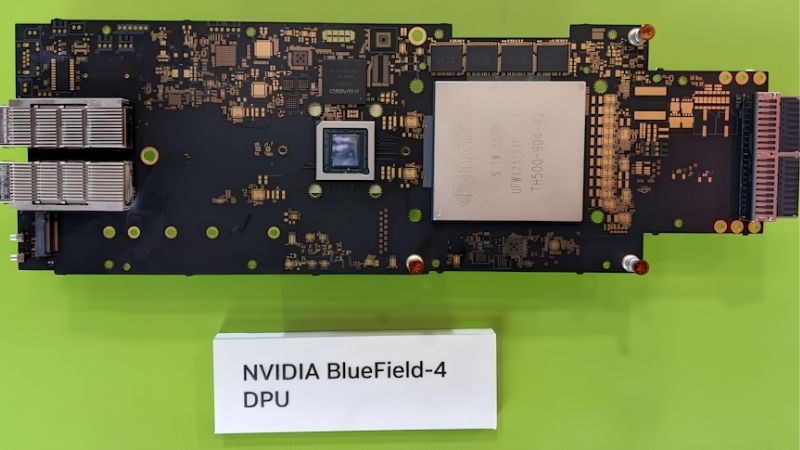
What the NVIDIA BlueField-4 DPU Actually Is
BlueField-4 is a data processing unit, or DPU, a class of hardware distinct from both CPUs and GPUs. Its job is to offload and accelerate the infrastructure tasks that would otherwise consume a server’s main processor, and understanding that division of labor is the key to grasping why data centers deploy it.
The Role of a Data Processing Unit
A DPU sits on the network edge of a server and takes over the work of moving, securing, and managing data. Networking, storage handling, and security functions that traditionally ran on the CPU are instead handled by the DPU, freeing the main processor to focus on the application workload it was bought for.
This matters most at scale. In a large data center running thousands of servers, the overhead of infrastructure tasks adds up enormously, and offloading it to dedicated hardware recovers a meaningful share of expensive CPU capacity for productive work.
The practical framing is that a DPU is an efficiency and isolation device. It keeps infrastructure functions separate from the application, which improves both performance and security in ways that are hard to achieve when everything runs on the same processor.
Another way to picture it is as a dedicated computer for the network and infrastructure layer, sitting in front of the server’s main system. It runs its own operating environment and handles its own tasks independently, which is what allows it to enforce policy and move data even when the host processor is fully loaded or, in some designs, compromised. That independence is a core part of the security argument for the whole category.
BlueField-4 Architecture and Capabilities
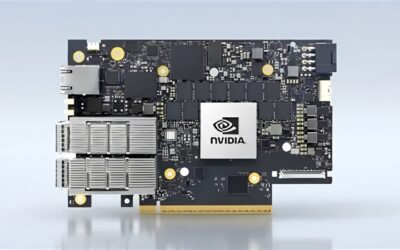
BlueField-4 represents the next generation in NVIDIA’s DPU line, building on the established BlueField family with more onboard compute, faster networking, and expanded acceleration for infrastructure workloads. The design goal is consistent across generations: move more of the data-center’s plumbing off the CPU and onto purpose-built silicon.
The defining characteristics of a modern DPU are its integrated networking, programmable acceleration engines, and onboard processing cores. Together these let the device handle complex data-path tasks at line rate, which is exactly what large-scale AI and cloud infrastructure demands.
For an AI data center in particular, the interconnect and data-movement capabilities matter enormously, because feeding accelerators with data efficiently is often the bottleneck. A more capable DPU generation directly addresses that constraint.
BlueField-4 vs Traditional NIC and CPU Offload
The natural comparison is against a traditional network interface card paired with CPU-based processing. A standard NIC moves packets but leaves the heavy lifting of security, storage, and network virtualization to the CPU, which consumes cycles that could serve applications.
BlueField-4 collapses that split by handling those functions itself. The result is lower CPU overhead, better isolation between infrastructure and workload, and consistent performance that does not degrade when the main processor is busy.
The honest read is that a DPU is not a drop-in upgrade for every server. It is a strategic component for environments where infrastructure overhead, security isolation, and scale justify the investment, which is a different calculus from simply buying a faster network card.
NVIDIA BlueField-4 in Real Data-Center Workloads
The value of BlueField-4 shows up in how it changes the economics and security of large deployments rather than in any single benchmark. Understanding the workloads it targets clarifies whether it fits your environment or is overkill for it.
Networking, Storage, and Security Offload
The core workloads a DPU accelerates are software-defined networking, storage virtualization, and security enforcement. By running these directly on the DPU, a data center keeps them off the CPU and enforces them at the network edge before traffic ever reaches the application.
Security is a particularly compelling use case. Because the DPU sits between the network and the host, it can enforce isolation and inspect traffic independently of the software running on the server, which creates a stronger security boundary than host-based approaches alone.
The practical benefit is measurable efficiency and a cleaner security model. Recovering CPU cycles and enforcing policy at the edge are the two outcomes that most often justify a DPU deployment at scale.
Storage offload deserves a specific mention because it is often underappreciated. Modern data centers rely heavily on networked and software-defined storage, and the work of managing that storage traffic can consume significant CPU resources. Handling it on the DPU instead keeps storage performance consistent and predictable, which matters enormously for the data-hungry workloads that AI training represents.
BlueField-4 and AI Infrastructure
The rise of large-scale AI is the biggest driver behind advanced DPUs. Training and serving large models requires moving enormous volumes of data between storage, accelerators, and the network, and doing that efficiently is where a capable DPU earns its place.
In an AI factory, the environment where thousands of accelerators work together, the DPU handles the data movement and networking that keeps those accelerators fed. Without efficient data handling, expensive compute sits idle waiting for data, so the DPU is a force multiplier for the whole system.
This forward-looking role is why BlueField-4 is positioned as AI-infrastructure hardware rather than a general server component. It is designed for the scale and data intensity that modern AI deployments demand.
The economics reinforce the point. Accelerators are the most expensive resource in an AI data center, so any hardware that keeps them busy rather than idle pays for itself quickly at scale. By ensuring data flows to the accelerators efficiently and securely, a capable DPU protects the return on a massive compute investment, which is exactly the kind of calculation that justifies deploying BlueField-4 across a large fleet.
Who Deploys BlueField-4 and Why
BlueField-4 is aimed at hyperscalers, cloud providers, large enterprises, and organizations building AI infrastructure at scale. For these operators, the CPU savings, security isolation, and data-movement efficiency translate into real cost and performance advantages across thousands of servers.
It is not a component for a small business server, a homelab, or a single workstation. The value only materializes at the scale where infrastructure overhead is significant and security isolation is a priority, which is a specific and demanding profile.
The honest filter is scale and mission. If you are running data-center-class infrastructure with heavy networking, storage, and security demands, BlueField-4 is relevant; if you are not, it is far more capability than your environment can use, and simpler hardware will serve you better and cost far less.
BlueField-4, AI Demand, and the 2026 Landscape
Evaluating BlueField-4 in isolation misses the wider context, because the same AI boom driving demand for accelerators is what makes advanced DPUs necessary. A little market perspective explains both the urgency and the strategy behind this class of hardware.
The H200-to-China News and What It Signals
A significant recent development is that the United States has permitted NVIDIA to sell the H200, one of its most powerful AI chips, to China. That decision underscores how central NVIDIA’s full data-center stack, from accelerators to DPUs, has become to the global AI supply chain.
For anyone evaluating BlueField-4, the signal is that NVIDIA is building an integrated infrastructure platform, and the DPU is a deliberate piece of that whole. The company’s networking and data-movement hardware is designed to work hand in hand with its accelerators, which is a strategic argument for the platform as a system.
It also reflects sustained, intense global demand for AI infrastructure at every layer. When the appetite for accelerators is this strong, the supporting hardware that keeps them efficient, including DPUs like BlueField-4, becomes equally important to the operators building these systems.
Pros and Cons of the BlueField-4 Approach
The advantages are clear: significant CPU offload, stronger security isolation, efficient data movement for AI workloads, and integration with NVIDIA’s broader infrastructure platform. For large-scale operators, these benefits compound across a fleet.
The drawbacks are equally real. The value depends entirely on scale, the technology adds complexity to deploy and manage, and it is unnecessary for smaller environments. It is a specialized strategic investment, not a universal upgrade.
The balanced verdict is that BlueField-4 is the right tool for data-center-scale AI and cloud infrastructure and the wrong one for everyone below that threshold. Matching the hardware to genuine scale is what determines whether it pays off.
It is also worth noting that a DPU is part of a platform decision, not an isolated purchase. Adopting BlueField-4 tends to make the most sense for organizations already building around NVIDIA’s networking and accelerated-computing stack, where the pieces are designed to work together. For a shop running heterogeneous infrastructure, the integration benefits are smaller, which is another reason the technology rewards commitment to the broader ecosystem rather than piecemeal adoption.
Accessible Ways to Explore This Ecosystem
Most readers researching BlueField-4 will not be deploying it themselves, but many want to understand and work within NVIDIA’s accelerated-computing ecosystem. The good news is that the same CUDA platform and AI tooling that run in these data centers are accessible on far more modest hardware.
For learning, prototyping, and local AI experimentation, a capable consumer or prosumer GPU with a large memory buffer puts you on the same software platform at an individual’s budget. It is the practical entry point for building skills relevant to this ecosystem.
If you want hands-on experience with NVIDIA’s AI platform without data-center hardware, comparing current high-VRAM GPU options through the link below is the realistic starting point. It is the accessible on-ramp to the same ecosystem BlueField-4 serves at scale.
See More:
- NVIDIA GeForce Game Ready Driver
- NVIDIA CUDA Toolkit Archive
- Gigabyte GeForce RTX 5070 Windforce OC
- AMD Radeon RX 9070 XT vs NVIDIA GeForce RTX 5070
- PNY GeForce RTX 5070 Ti Triple Fan
Conclusion
NVIDIA BlueField-4 is a strategic data-center DPU that offloads networking, storage, and security from the CPU while accelerating the data movement that modern AI infrastructure depends on, but it is aimed squarely at operators working at hyperscale. If you run data-center-class infrastructure, it is a compelling piece of NVIDIA’s integrated platform; if you do not, it is more capability than your environment can use. For readers who want to work within the same ecosystem that NVIDIA BlueField-4 supports, checking current high-VRAM GPU options through the link below is the accessible next step.
Frequently Asked Questions
What is a DPU and how is it different from a GPU?
A data processing unit offloads infrastructure work from the host CPU, handling networking, storage virtualisation, and security in dedicated silicon. Where a GPU accelerates compute, a DPU accelerates the plumbing around it, freeing CPU cores that would otherwise be consumed by packet processing and encryption.
What is BlueField-4 built for?
It targets large-scale AI infrastructure, where the volume of east-west traffic between accelerators overwhelms conventional host networking. It combines high-throughput networking with an integrated Arm-based processing complex so that data movement, isolation between tenants, and storage access happen without stealing CPU cycles from training or inference jobs.
Is this something I can buy for a home PC?
No. BlueField products are data center components sold through server OEMs and cloud providers as part of full system designs. They require specific server platforms, management software, and networking fabrics. There is no consumer equivalent, and the hardware would provide no benefit in a desktop.
How does it relate to NVLink and ConnectX?
They solve different layers of the same problem. NVLink handles high-bandwidth communication between GPUs inside a node, ConnectX provides the network interface, and BlueField adds a programmable processing layer on top of that interface for infrastructure services. Together they form NVIDIA’s rack-scale networking stack.
Why does NVIDIA invest so heavily in networking?
Because at cluster scale, moving data becomes the bottleneck rather than raw compute. Once thousands of accelerators train a single model, interconnect bandwidth and latency determine real throughput. Owning the networking layer, largely through the Mellanox acquisition, lets NVIDIA sell complete systems rather than individual chips.
As an Amazon Associate we earn from qualifying purchases at no extra cost to you.









Write Your Review
No reviews yet. Be the first to share your experience!