
4070 vs 5080 is the comparison thousands of PC builders are running in 2026, because it frames the real question behind every GPU upgrade: do you pay roughly $549 for proven mid-range efficiency, or roughly $999+ for next-generation headroom? The two cards sit two performance tiers and one full architecture apart, yet both remain top sellers on Amazon. This head-to-head puts hard numbers on that gap — CUDA cores, bandwidth, watts, and frames — then folds in current market news that materially changes the buy-now-or-wait calculus.
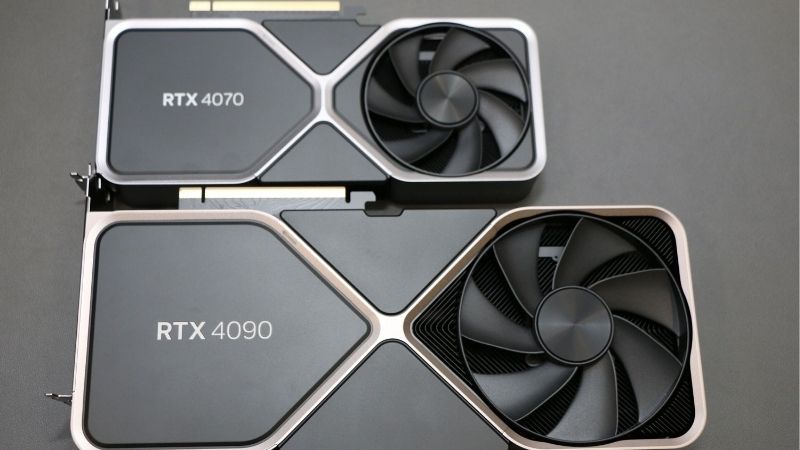
RTX 4070 vs 5080: Quick Verdict and Spec Comparison
If you only read one section, make it this one. We compress the entire verdict into a few lines, then back it with the full specification table so you can verify every claim yourself before clicking through to check live pricing.
The Quick Verdict for Busy Buyers
The RTX 5080 wins on raw performance, and it is not close: roughly 55-70% faster at 4K, with 16GB of GDDR7 memory, DLSS 4 Multi Frame Generation, and nearly double the memory bandwidth. It is the card for 4K high-refresh gaming and serious creative or AI workloads.
The RTX 4070 wins on efficiency and value: 200W total power, no PSU upgrade for most builds, and excellent 1440p performance at roughly 55% of the 5080’s street price. If you game at 1440p and your monitor tops out at 144-165Hz, the 4070 delivers the experience you will actually perceive. Ready to decide already? Check the current Amazon price on whichever card matches your resolution — both fluctuate weekly.
For context on how far apart these products really sit: Nvidia positions the 4070 as its mainstream 1440p card and the 5080 as the enthusiast 4K tier, separated by one full architecture generation and nearly double the silicon budget. Comparing them is still fair, because real buyers compare across tiers whenever budgets stretch — the question is whether the extra $450 buys experiences you will actually use.
RTX 4070 vs RTX 5080 Comparison Table
The table below isolates the specifications that drive real-world results. Note the bandwidth row in particular — it explains most of the 4K performance gap.
| Specification | RTX 4070 | RTX 5080 |
|---|---|---|
| Architecture | Ada Lovelace | Blackwell |
| CUDA Cores | 5,888 | 10,752 |
| VRAM | 12GB GDDR6X | 16GB GDDR7 |
| Memory Bus | 192-bit | 256-bit |
| Memory Bandwidth | 504 GB/s | 960 GB/s |
| Boost Clock | 2,475 MHz | 2,617 MHz |
| Total Graphics Power | 200W | 360W |
| Frame Generation | DLSS 3 (single) | DLSS 4 (multi, up to 4x) |
| Launch MSRP | $599 (now ~$549) | $999 |
| Recommended PSU | 650W | 850W |
Price-to-Performance: What Each Dollar Actually Buys
Divide average 4K benchmark results by street price and the math gets interesting. The RTX 5080 produces roughly 65% more frames at 4K but costs roughly 80-85% more, so its cost per frame is slightly worse — a normal premium for flagship-tier hardware. At 1440p, the gap narrows further because the 4070 is rarely the bottleneck there.
The inversion happens with DLSS 4. In supported titles, Multi Frame Generation lets the 5080 output 3-4x its base frame rate, a multiplier the 4070’s single-frame generation cannot match. In that software-boosted scenario, the 5080’s effective cost per displayed frame actually undercuts the 4070. Your verdict therefore depends on whether your game library supports DLSS 4 — a list that keeps growing monthly.
4070 vs 5080 Deep Dive: Performance, Features, and Power
Specifications predict performance, but architecture decides it. This section compares the two cards criterion by criterion — gaming throughput, AI feature sets, and the power and thermal realities of fitting each card into an actual build.
Gaming Performance at 1440p and 4K
At 1440p, the RTX 4070 averages 90-120 FPS in modern AAA titles at high settings and exceeds 200 FPS in esports games. The RTX 5080 pushes those same AAA numbers to 150-190 FPS — measurable, but largely invisible unless you own a 240Hz panel. At this resolution, the 4070 is the rational choice for most people.
At 4K, the hierarchy flips decisively. The 4070 manages 45-60 FPS in demanding titles, frequently needing DLSS Quality mode to stay smooth, while its 192-bit bus becomes a hard ceiling in bandwidth-heavy scenes. The 5080 sustains 80-110 FPS natively in the same workloads, and its 960 GB/s of GDDR7 bandwidth keeps 1% lows far steadier. With ray tracing enabled, the gap widens to 70-90% in path-traced titles like Cyberpunk 2077 and Alan Wake 2.
Frame-time data tells the same story with more nuance. The 5080’s 1% lows at 4K typically hold above 60 FPS even in scenes where the 4070 dips into the high 20s, which is the difference between consistent smoothness and visible hitching. If your library leans toward open-world titles with heavy asset streaming — the genre where bandwidth and VRAM pressure peak simultaneously — that consistency gap is worth more than the headline averages suggest.
DLSS 4, AI Features, and Future-Proofing
Blackwell’s headline technology is DLSS 4 with Multi Frame Generation, which generates up to three AI frames per rendered frame using a new transformer-based model. The visual result is path-traced 4K gameplay at frame rates that were physically impossible two generations ago. The transformer upscaler also improves image stability — less ghosting, sharper distant detail — and that part does benefit 40-series cards, but the multi-frame multiplier remains 50-series exclusive.
The 5080 also carries 5th-generation Tensor cores rated for substantially higher AI throughput, which matters beyond games: local LLM inference, Stable Diffusion, and video upscaling workloads run 1.7-2.2x faster than on the 4070 in community benchmarks. If you are experimenting with on-device AI at all, the 16GB of VRAM is the difference between models fitting or not fitting in memory. The 4070’s 12GB handles today’s games, but it is already the minimum comfortable figure for 2026 releases at max textures.
There is also a longevity argument hiding in the feature gap. Nvidia historically backports software refinements selectively, and each new DLSS revision since 2020 has reserved its headline capability for the newest silicon. Buying the 5080 today means buying into the architecture Nvidia will optimize for through at least 2028, while the 4070 enters the maintenance phase of its software life. For owners who upgrade every two generations rather than every cycle, that support runway has real dollar value.
Power, Thermals, and Real Build Compatibility
The RTX 4070 is one of the easiest high-performance cards to integrate ever shipped: 200W, a single power connector on many models, dual-slot coolers around 240-270mm, and quiet operation on a 650W PSU. It drops into nearly any mid-tower built in the last eight years. For upgraders, that means zero hidden costs.
The RTX 5080 demands respect: 360W TGP, a 12V-2×6 connector (adapter included, but a modern ATX 3.1 PSU is the clean solution), 850W recommended supply, and coolers commonly 300-330mm long at 2.5-3.5 slots. Budget an extra $100-150 for a PSU upgrade if yours predates 2022, and verify case clearance before ordering. Thermally, both run cool for their class — partner models hold 65-75°C under load — but the 5080 exhausts nearly double the heat into your room, a genuine comfort factor in small spaces.
Acoustics follow the same physics: partner 4070 models routinely idle fan-stopped and stay under 36 dBA gaming, while 5080 coolers, though excellent, work harder to move 360W of heat. If your PC shares a desk with a microphone or sits in a bedroom, that gap is audible — and it is the kind of daily-life detail spec sheets never disclose but owners mention constantly in reviews.
Pricing Trends, Market News, and the Smart Alternative
A comparison frozen in spec sheets misses the variable that changes fastest: price. Two current news items are actively reshaping GPU pricing in 2026, and they affect these two cards unequally. There is also a third card that splits the difference for buyers who find both options imperfect.
How the H200 China Approval Affects GeForce Prices
The US government has authorized Nvidia to sell the H200 — one of its most powerful AI chips — to China. Strategically, this reopens a multi-billion-dollar market for Nvidia’s data-center division, and Nvidia responds to demand signals by allocating wafer starts, GDDR7/HBM memory contracts, and advanced packaging capacity toward its highest-margin products. AI accelerators outearn GeForce cards several times over per wafer.
For consumers, the historical pattern is consistent: when data-center demand surges, GeForce supply tightens within one to two quarters, street prices drift above MSRP, and the newest cards — like the RTX 5080, which shares GDDR7 supply chains with data-center products — feel it first. The RTX 4070, built on mature GDDR6X with established supply, is more insulated. If you are leaning 5080, this is a concrete argument against waiting for a sale that may never materialize.
Component Price Inflation Is Squeezing Both Cards Upward
The second force is broader: laptop and PC component prices are trending upward industry-wide, led by memory. DRAM and graphics memory contract prices have climbed as AI build-outs absorb fab capacity, and VRAM is among the largest cost items on any GPU’s bill of materials. Board partners have already passed increases through on several SKUs.
The practical read: today’s prices on both cards are more likely a floor than a ceiling for the next two quarters. Buyers who waited out previous shortage cycles in 2020-2021 remember paying 40-80% over MSRP at the peak. Nobody can promise a repeat, but the inputs — surging AI demand, constrained memory supply, reopened China exports — rhyme. Whichever side of this comparison you land on, current Amazon pricing is worth locking in rather than betting against.
The Alternative: RTX 5070 Ti for the Undecided Middle
If the 4070 feels short on headroom and the 5080 feels heavy on price, the RTX 5070 Ti at $749 MSRP is the engineered compromise: 8,960 CUDA cores, 16GB of GDDR7, 896 GB/s bandwidth, full DLSS 4 Multi Frame Generation, and a 300W power budget that most 750W PSUs handle.
In benchmarks it lands 35-45% ahead of the RTX 4070 at 4K while trailing the 5080 by 15-20% — yet it keeps the entire Blackwell feature set, including the AI capabilities the 4070 lacks. For 4K/60-100 gamers and creators who want VRAM headroom without flagship pricing, it is arguably the best value of the three. It is worth a price check on Amazon alongside the other two before you commit either way.
One compatibility note for the 5070 Ti: at 300W with a 12V-2×6 connector, it occupies the middle ground on power requirements too. Owners of recent 750W ATX 3.0 supplies can install it without any PSU change, which keeps total upgrade cost meaningfully below the 5080 path while preserving most of the Blackwell experience. In Amazon reviews, that “no hidden costs at near-flagship performance” combination is the most cited reason buyers chose it over both cards in this comparison.
Recommended Products

ASUS
ASUS Dual GeForce RTX 4060 Ti V2 OC Edition 8GB GDDR6 SFF Compatible with Axial-tech Fan/DUAL-RTX4060TI-O8G-V2 (Renewed)

GIGABYTE
GIGABYTE GeForce RTX 4060 Ti WINDFORCE OC 8G Graphics Card, 2X WINDFORCE Fans, 8GB 128-bit GDDR6, GV-N406TWF2OC-8GD Video Card (Renewed)

ZOTAC
ZOTAC Gaming GeForce RTX 4060 Ti 16GB AMP DLSS 3 16GB GDDR6 128-bit 18 Gbps PCIE 4.0 Compact Gaming Graphics Card, IceStorm 2.0 Advanced Cooling, Spectra RGB Lighting, ZT-D40620F-10M
As an Amazon Associate we earn from qualifying purchases. Product prices and availability are accurate as of the date/time indicated.
Final Verdict: Who Should Buy Which in the 4070 vs 5080 Battle
The 4070 vs 5080 decision resolves cleanly once you name your resolution and budget. Buy the RTX 4070 if you game at 1440p, value efficiency and drop-in compatibility, and want the lowest total upgrade cost — it remains a superb card that most monitors cannot outrun. Buy the RTX 5080 if you game at 4K, own or plan a high-refresh panel, run AI or creative workloads, and want DLSS 4 headroom that will carry you through 2028. And if you sit between those profiles, the RTX 5070 Ti deserves a hard look. With the H200 export approval tightening Nvidia’s consumer supply and component prices climbing, the smart move is the same in all three cases: check today’s Amazon price on your pick and buy while current inventory lasts.
Frequently Asked Questions
Is the newer card worth double the money?
That depends entirely on your display. If you game at 1080p or 1440p on a sixty to 144Hz panel, the 4070 already delivers high settings and the extra spend adds frames you cannot use. If you run 4K or a high refresh 1440p display with ray tracing, the 5080 changes what is playable.
How different are the two cards on paper?
Very. The 4070 offers twelve gigabytes of GDDR6X on a 192-bit bus at around two hundred watts, while the 5080 brings sixteen gigabytes of GDDR7 on 256-bit at roughly three hundred and sixty watts, with far more shader and RT hardware. The performance difference is around double in most titles.
What upgrade costs beyond the card should I budget for?
A power supply if yours is under 850 watts or lacks a native 12V-2×6 connector, and possibly a case if your current one cannot accommodate a card over 320mm long and three slots thick. Buyers often forget these and end up spending more than the sticker price suggested.
Will my processor bottleneck the faster card?
At 4K, rarely. At 1440p and especially 1080p, an older or mid range processor can absolutely hold back a card of this class, meaning you pay for performance you never see. If your processor is several generations old, upgrading it alongside the GPU is the better balanced approach.
What about resale and longevity?
The 5080 has a longer runway, thanks to its larger and faster memory and support for the newest frame generation features, and it will hold value better over the next few years. The 4070 remains a capable 1440p card but its twelve gigabytes will constrain it sooner as texture budgets grow.

Write Your Review
No reviews yet. Be the first to share your experience!