
- Top Pick: ASUS TUF Gaming GeForce RTX 5070 12GB GDDR7 OC EditionGaming Graphics Card
- Best Value: ASUS Dual GeForce RTX 4070 Super EVO OC Edition 12GB GDDR6X (PCIe 4.0, 12GB GDDR6X, DLSS 3, HDMI 2.1a, DisplayPort 1.4a, 2.5-Slot Design, Axial-tech Fan Design, 0dB Technology), 3 Year Warranty
- Premium Choice: GIGABYTE GeForce RTX 4070 Super WINDFORCE OC 12G Graphics Card, 3X WINDFORCE Fans, 12GB 192-bit GDDR6X, GV-N407SWF3OC-12GD Video Card
Top Rtx 5070 Rtx 4070 Super Picks for 2026
Here are our current top rtx 5070 rtx 4070 super picks, compared on real Amazon owner reviews, price, and features. Live prices update below.


RTX 5070 vs RTX 4070 Super is the matchup that dominates every mid-range upgrade thread in 2026, and for good reason. One card is Nvidia’s fresh Blackwell mainstream pick; the other is the late-Ada value champion that refuses to retire. Both carry 12GB of memory on a 192-bit bus, both target the same 1440p gamer, and both sit within a $60 window at launch pricing. So the real question is not which one is “better” on paper, but which one gives you more frames, more longevity, and more value for the money you are about to spend this month.
As an Amazon Associate we earn from qualifying purchases at no extra cost to you. Product prices and availability are accurate as of the date shown and are subject to change.


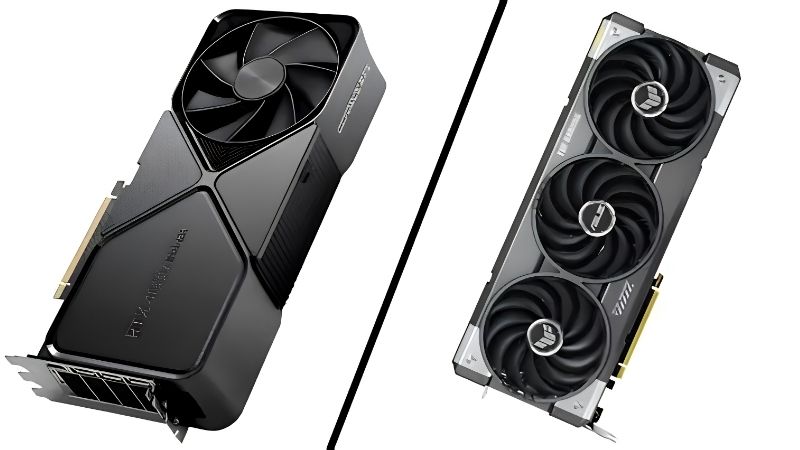
The Quick Verdict: RTX 5070 vs RTX 4070 Super
If you want the one-line answer: the RTX 5070 is the better buy for most new builds because of DLSS 4 Multi Frame Generation and GDDR7 bandwidth, while the RTX 4070 Super remains the smarter pick if you find it discounted or you distrust frame-generated numbers. The two trade blows depending on whether you weight raw raster or AI-assisted performance.
The Fast Answer for Buyers
For a brand-new 1440p system bought at or near MSRP, the RTX 5070 ($549) edges out the RTX 4070 Super ($599) on price and feature set. You pay less and gain the newer DLSS 4 stack, which matters more every quarter as supported titles grow.
If you spot a 4070 Super on sale below $500, the equation flips and the older card becomes the value king. Ready to lock in today’s price before the next stock swing? Check the current listing and grab whichever card is cheaper this week.
A useful rule of thumb: weigh the price difference against the feature gap. At MSRP you are paying $50 less for the newer card, so the 5070 is the default. Only when the 4070 Super drops $100 or more below the 5070 does its extra raster muscle justify giving up DLSS 4.
Where the RTX 5070 Pulls Ahead
The RTX 5070 wins on memory technology and AI features. Its GDDR7 modules push roughly 672 GB/s of bandwidth versus about 504 GB/s on the 4070 Super’s GDDR6X, and that gap widens the higher you push resolution and texture settings.
It also unlocks DLSS 4 with Multi Frame Generation, a Blackwell-exclusive that can multiply rendered frames in supported games. In titles that implement it well, the 5070 can post frame counts the 4070 Super simply cannot reach.
Where the RTX 4070 Super Holds Its Ground
The RTX 4070 Super answers with raw shader muscle: 7168 CUDA cores against the 5070’s 6144. In native, non-upscaled raster workloads, that extra hardware keeps the older card surprisingly competitive, often within a handful of frames.
It is also the proven, mature product. Two years of driver refinement, broad cooler availability, and a deep secondhand market make it a low-risk pick for buyers who care more about stability than the newest acronyms.
For builders who never enable frame generation and judge a card on native output alone, the 4070 Super is arguably the more honest performer. What you see on the benchmark chart is what you get, with no asterisk about AI-inserted frames.
Specs Head-to-Head: RTX 5070 vs RTX 4070 Super
Before the feature debate, it helps to see the core numbers side by side. The table below strips out marketing language and shows only the figures that change real performance, power planning, and budget.
| Spec | RTX 5070 | RTX 4070 Super |
|---|---|---|
| Architecture | Blackwell | Ada Lovelace |
| CUDA Cores | 6144 | 7168 |
| VRAM | 12GB GDDR7 | 12GB GDDR6X |
| Memory Bus | 192-bit | 192-bit |
| Bandwidth | ~672 GB/s | ~504 GB/s |
| Total Graphics Power | 250W | 220W |
| Recommended PSU | 650W | 650W |
| DLSS | DLSS 4 (Multi Frame Gen) | DLSS 3.5 |
| Launch MSRP | $549 | $599 |
CUDA Cores and Architecture
On core count alone the 4070 Super looks stronger, with about 14% more CUDA cores. But raw counts across two different architectures are not directly comparable, because Blackwell’s per-core throughput and clock behavior differ from Ada.
In practice this means the 5070 closes most of the core-count gap through architectural efficiency, then overtakes the 4070 Super once DLSS 4 enters the picture. Judge these two by delivered frames, not by spec-sheet core totals.
A concrete way to think about it: the 4070 Super’s core lead is largest in old, non-upscaled engines, while the 5070’s architectural and bandwidth gains compound in newer titles built around AI upscaling and ray tracing. Your game library decides which trait pays off more.
VRAM and Memory Bandwidth
Both cards ship 12GB, which is the single most debated number in this matchup. For 1440p in 2026 it is adequate for the vast majority of titles, but a handful of heavily modded or path-traced games will brush against that ceiling.
Here the 5070’s GDDR7 advantage is the deciding factor. Higher bandwidth feeds the cores faster at high settings, so the newer card ages more gracefully as texture budgets keep climbing.
If your workload includes content creation or high-resolution texture mods, treat the bandwidth gap as the tiebreaker. For pure esports and lighter titles, both cards have memory to spare and you will rarely feel the difference.
Power Draw and PSU Requirements
The RTX 5070 draws up to 250W versus 220W on the 4070 Super, a 30W difference that rarely changes your PSU choice. Both comfortably run on a quality 650W unit, and both use the 12VHPWR connector via adapter or native cable.
Practically, confirm your case clears a roughly 2.5-slot cooler and that you have the right power connectors before checkout. Neither card is a furnace, but the 5070’s slightly higher draw is worth noting for small-form-factor or older builds.
Deep Dive Face-Off: Performance, Features, and Value
Specs set expectations; gameplay settles arguments. This section compares the two by the criteria buyers actually feel — frame rates, exclusive features, and the trade-offs each card forces you to accept.
1440p and 4K Gaming Performance
At native 1440p, expect the two cards to land within a small margin of each other across most modern titles, with the 4070 Super occasionally nudging ahead in pure raster scenes and the 5070 leading in ray-traced ones.
Turn on upscaling and the picture changes. With DLSS Quality enabled the gap narrows further; add Frame Generation and the 5070 can post substantially higher numbers in supported games. At 4K, both are best treated as upscaling-dependent cards rather than native 4K performers.
As a rough field guide at 1440p high settings, both cards typically sit in the 80-120 fps band in modern raster titles, dropping into the 45-70 fps range with heavy ray tracing before upscaling. That is why the DLSS tier you unlock, not the native delta, usually decides the smoother experience.
DLSS 4, Frame Generation, and Future Headroom
This is the 5070’s strongest argument. DLSS 4 with Multi Frame Generation is a Blackwell-exclusive feature, and Nvidia continues to expand title support and refine its transformer-based upscaling model through driver updates.
That ongoing optimization is the “future headroom” worth paying for. A card that keeps gaining performance from software updates protects your investment in a way the 4070 Super, capped at DLSS 3.5, cannot fully match.
There is a caveat worth stating plainly: frame-generated numbers are not identical to native frames, and a minority of players notice latency or artifacts. If you fall in that camp, value the 5070’s native and bandwidth gains over its frame-gen headline, and the comparison tightens again.
Pros and Cons at a Glance
No card is perfect, and the RTX 5070 vs RTX 4070 Super decision comes down to which compromises you can live with. Here is the honest balance sheet for each.
RTX 5070 — Pros: lower MSRP, GDDR7 bandwidth, DLSS 4 Multi Frame Gen, ongoing driver optimization. Cons: fewer CUDA cores, 30W higher draw, frame-gen gains vary by title.
RTX 4070 Super — Pros: more CUDA cores, mature drivers, wide availability, strong used market. Cons: higher MSRP, slower GDDR6X, locked to DLSS 3.5, end-of-life product line.
How 2026 Market Forces Reshape This Matchup
A GPU comparison in 2026 is incomplete without the market context, because timing and street pricing can outweigh a 5% performance gap. Two news threads in particular are bending the RTX 5070 vs RTX 4070 Super decision right now.
Rising Component Prices and Buy-Now Timing
Laptop and PC-component prices have been trending upward, and the consensus is they will keep climbing. For GPUs that means today’s listed price may be the best you see for a while, which raises the cost of waiting.
If you already need a card, this favors buying sooner rather than hunting for a dip that may not come. When you do pull the trigger, compare both cards’ live prices and take whichever is cheaper at that moment.
The practical risk is asymmetric. If prices rise as expected, waiting costs you money and you still need the GPU; if they happen to fall, you lose very little by having bought a card you were going to use anyway. For most buyers that math points toward acting now.
The H200-to-China Decision and Nvidia’s Silicon Priorities
The U.S. recently allowed Nvidia to sell its powerful H200 AI chips to China. The H200 is a data-center part, not a GeForce card, so it does not directly change 5070 or 4070 Super performance.
The indirect signal matters, though. Heavier demand for Nvidia’s most profitable silicon can pull wafer allocation and engineering focus toward AI accelerators, which historically tightens consumer GPU supply and keeps prices firm. That reinforces the buy-now logic above.
The Alternative If Both Feel Too Expensive
If neither card fits your budget, the standard RTX 4070 (non-Super) is the obvious step down, trading some performance for a lower price while keeping the same 12GB buffer and DLSS support.
On the other end, buyers who can stretch a little may prefer the RTX 5070 Ti for meaningfully more headroom at higher resolutions. Either way, it is worth checking current prices on all three before you commit.
Think of it as a price ladder: the 4070 below, the 5070 and 4070 Super in the middle, and the 5070 Ti above. Your budget and target resolution decide the rung, and a quick price check often reveals that the gaps between them are smaller than expected.
Frequently Asked Questions
Quick answers to the questions buyers most often ask about the RTX 5070 versus the RTX 4070 Super.
Is the RTX 5070 faster than the RTX 4070 Super?
In raw rasterization they are very close, often trading the lead from one title to the next.
The 5070’s practical edge comes from DLSS 4 Multi Frame Generation in supported games.
Do both cards support DLSS 4?
The 5070 supports DLSS 4 with Multi Frame Generation as a Blackwell card.
The 4070 Super supports DLSS 3 Frame Generation but not the newer Multi Frame Generation.
Which card is the better value?
The 5070 generally offers stronger value thanks to its pricing and modern feature set.
A discounted 4070 Super can still be compelling if you find it meaningfully cheaper.
Conclusion
Final verdict: in the RTX 5070 vs RTX 4070 Super battle, the RTX 5070 is the recommended choice for most 2026 builders thanks to its lower MSRP, GDDR7 memory, and DLSS 4 future-proofing — buy it if you want the newest feature set at the better price. The RTX 4070 Super is the pick for bargain hunters who find it discounted or who prioritize raw raster and a proven, mature driver stack. With component prices set to keep rising, the most expensive option is waiting too long — compare today’s listings and secure whichever card matches your priorities and budget while stock and pricing are still in your favor.










Write Your Review
No reviews yet. Be the first to share your experience!