
- Top Pick: Lian Li V100-ATX Mid-Tower PC Case-Black-V100RX
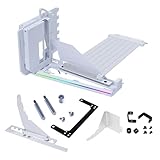
- Best Value: LIAN LI 4 Slots Vertical GPU Kit (VG4v4), PCIe 5.0 Riser, 4-Slot, White
- Premium Choice: HAVN HS 420 VGPU Dual-Chamber Mid Tower ATX PC Case White | PCIe 5.0 Vertical GPU Kit, 11x 140mm Fan Slots & 2X 420mm Radiator Support, SimpliCable Cable Management, Tempered Glass, PWM Fan Hub
Choosing a graphics card is not only a question of performance. The card must physically fit inside your case, clear the front fans or radiator, leave room for power cables, and occupy the correct number of expansion slots. The most important specifications are GPU length, height, thickness, and power-connector clearance.
The Short Answer
Measure the case’s maximum GPU clearance, then compare it with the graphics card’s published dimensions. As a practical rule, choose a card at least 10 to 15 mm (0.4 to 0.6 inches) shorter than the case’s stated maximum. That extra space helps with front fans, radiator fittings, airflow, and power cables.
As an Amazon Associate we earn from qualifying purchases at no extra cost to you. Product prices and availability are accurate as of the date shown and are subject to change.



Most modern mid-tower cases support graphics cards between 300 and 400 mm (11.8 and 15.7 inches) long. Compact micro-ATX cases commonly support 280 to 340 mm (11.0 to 13.4 inches). Thickness is just as important: a card advertised as 2.5, 3, or 4 slots may block neighboring expansion slots and interfere with a vertical GPU mount.
Also check the case manufacturer’s measurement with the exact front configuration you plan to use. A case may accept a 400 mm card with no front radiator, but only a 360 mm card after installing a 360 or 420 mm radiator.
Standard Sizes
There is no single universal GPU size. Board partners produce different versions of the same GPU, and factory-overclocked models often use larger heatsinks. The following ranges are useful for shopping, but the manufacturer’s individual card dimensions should always take priority.
| GPU category | Typical length | Typical height | Typical thickness | Best fit |
|---|---|---|---|---|
| Low-profile | 6.7–8.3 in (17–21 cm) | 2.7–3.0 in (6.9–7.6 cm) | 0.6–1.5 slots; 0.5–1.2 in (1.3–3.0 cm) | Small-form-factor and office PCs |
| Compact full-height | 7.1–9.8 in (18–25 cm) | 4.0–4.5 in (10.2–11.4 cm) | 2–2.5 slots; 1.4–2.0 in (3.6–5.1 cm) | Mini-ITX and compact micro-ATX cases |
| Standard dual-fan | 9.4–12.6 in (24–32 cm) | 4.3–5.1 in (10.9–13.0 cm) | 2–3 slots; 1.4–2.4 in (3.6–6.1 cm) | Most mid-tower systems |
| Large triple-fan | 11.8–14.2 in (30–36 cm) | 4.7–5.7 in (12.0–14.5 cm) | 3–4 slots; 2.4–3.5 in (6.1–8.9 cm) | Airflow-focused mid-towers and full towers |
| Oversized flagship | 13.4–15.7 in (34–40 cm) | 5.1–6.3 in (13.0–16.0 cm) | 3.5–4.5 slots; 2.8–4.0 in (7.1–10.2 cm) | Large ATX cases with open front clearance |
A full-height graphics card uses a standard rear bracket that is approximately 4.38 inches (11.1 cm) tall, while the cooler extends above the bracket. A card’s listed thickness describes how many rear expansion slots it covers, but the heatsink can also overhang the motherboard. Leave at least one additional slot of breathing room when possible.
For example, the RUIX OV502 Pro M-ATX case is listed with support for a 340 mm (13.4 inch) GPU. That is enough for many triple-fan cards, but a 330 mm card with a thick front power connector may be a safer choice than a card that is exactly 340 mm long. At the other end of the range, larger dual-chamber cases such as the HAVN HS 420 VGPU are designed around high-end components and include support for a vertical GPU arrangement. Its listed price is $329.99, compared with about $59.99 for the compact RUIX case, so case size and construction can significantly affect cost.
How to Measure Your Space
- Find the case’s GPU clearance specification. Look in the case manual or product specifications for “maximum GPU length,” “graphics card clearance,” or “VGA length.” Do not rely on the case’s external depth.
- Measure from the rear expansion brackets to the nearest obstruction. This may be a front fan, radiator, drive cage, power-supply shroud, or internal bracket. Measure in millimeters for better accuracy.
- Account for front cooling hardware. Subtract the depth of front fans, usually 25 mm (1 inch), plus the thickness of a radiator, commonly 27 to 38 mm (1.1 to 1.5 inches). A front radiator and fan assembly can consume about 52 to 65 mm (2.0 to 2.6 inches).
- Measure vertical clearance. Compare the GPU height with the distance from the motherboard’s PCIe slot to the side panel. Allow extra room if the card uses side-mounted power connectors. A 12V-2×6 or similar connector may need roughly 35 to 40 mm (1.4 to 1.6 inches) of cable-bending space.
- Measure thickness at the PCIe slot. Count the card’s slot width and compare it with the open slots in the case. A 4-slot card can block three additional slots even when the motherboard has enough PCIe connectors.
- Check the motherboard and PSU area. Confirm that the lower edge of the card will not collide with a bottom fan, cable grommet, drive cage, or power-supply shroud. Verify that the power supply has the required connectors and enough output; a high-end card may call for a 750 to 1,000 watt PSU, depending on the complete system.
- Plan for support. Heavy triple-fan cards can weigh approximately 1.5 to 3 kg (3.3 to 6.6 pounds). Use the included support bracket or an adjustable anti-sag stand, especially in a vertical or horizontal mount.
By Room or Use Case
Small desk or bedroom PC
Prioritize a short, quiet card between 180 and 280 mm (7.1 and 11.0 inches) and no more than 2.5 slots thick. A compact card leaves room for airflow and is easier to install in a narrow desk compartment. Measure the case’s external depth too, because a large rear exhaust area and adequate side-panel ventilation matter in a confined room.
General gaming workstation
A conventional ATX mid-tower is the easiest choice. Look for at least 330 mm (13.0 inches) of GPU clearance without a front radiator, or 280 to 300 mm (11.0 to 11.8 inches) with a front-mounted liquid cooler. The Lian Li V100-ATX Mid-Tower PC Case-Black-V100RX, listed at $74.99, represents the type of affordable ATX case buyers often consider; confirm its current internal clearance before choosing a specific graphics card.
Showcase or vertical GPU build
Vertical mounting can improve presentation, but it introduces new measurements. Check the vertical bracket’s supported slot width, riser length, distance from the glass, and airflow gap. The LIAN LI 4 Slots Vertical GPU Kit, VG4v4, is listed at $74.99 and supports a four-slot configuration with a PCIe 5.0 riser. A vertical card should generally have at least 25 to 35 mm (1.0 to 1.4 inches) between its fans and the glass panel.
Large creator or enthusiast system
Choose a dual-chamber or full-size ATX case when using a 360 or 420 mm radiator, multiple storage drives, or a very thick GPU. The HAVN HS 420 VGPU lists support for 11 140 mm fan positions and two 420 mm radiators, making it suited to elaborate cooling layouts. The extra space also simplifies cable routing, but it does not eliminate the need to check the graphics card’s exact length and thickness.
Common Sizing Mistakes
- Confusing case depth with GPU clearance: The useful measurement runs from the PCIe brackets to the first internal obstruction, not from the rear panel to the front glass.
- Ignoring the radiator: A front-mounted radiator can reduce available GPU length by more than 2 inches (5 cm).
- Checking length only: A card can fit front to back and still hit the side panel, bottom fans, or power cables.
- Forgetting the connector bend: Never force a power cable sharply against the side panel. Use the card maker’s recommended clearance.
- Assuming every model of a GPU is the same: Compare the exact brand and model number, including its listed length, height, and slot width.
- Overlooking vertical mounting: A case that accepts a long horizontal card may not have enough glass-panel clearance for a thick vertical model.
FAQ
How much smaller should my GPU be than the case clearance?
Aim for at least 10 to 15 mm (0.4 to 0.6 inches) of spare length. Increase that margin when using a front radiator, a drive cage, or a card with an unusual power-connector location.
Will a 3-slot GPU fit in a 2-slot case?
No. A three-slot card needs three usable expansion slots and matching side-panel clearance. It may also block neighboring motherboard slots, so check both the case and the motherboard layout.
Is a longer GPU always faster?
No. Length usually reflects the cooler, fan count, and circuit-board design rather than performance by itself. A shorter card can use the same GPU chip and deliver similar performance, although temperatures and noise may differ.
What GPU size is safest for a new case?
For the broadest compatibility, choose an ATX mid-tower with at least 330 mm (13.0 inches) of clearance, three or more expansion slots, and strong front-to-back airflow. That covers many standard and large cards while leaving room for future upgrades in 2026.






Write Your Review
No reviews yet. Be the first to share your experience!