
- Top Pick: GIGABYTE GeForce RTX 5080 Gaming OC 16G Graphics Card, WINDFORCE Cooling System, 16GB 256-bit GDDR7, GV-N5080GAMING OC-16GD Video Card
- Best Value: ASUS TUF Gaming NVIDIA GeForce RTX 4080 Super OC Edition Gaming Graphics Card (PCIe 4.0, 16GB GDDR6X, HDMI 2.1a, DisplayPort 1.4a), 3 Year Warranty
- Premium Choice: Gigabyte GeForce RTX 4080 Super WINDFORCE V2 Graphics Card – 2550MHz Core, 16GB GDDR6X 23000MHz 256-bit Memory, PCI-E 4.0, 3X DP 1.4, 1x HDMI 2.1a, NVIDIA DLSS 3.5, GV-N408SWF3V2-16GD
Top Rtx 5080 4080 Super Same Picks for 2026
Here are our current top rtx 5080 4080 super same picks, compared on real Amazon owner reviews, price, and features. Live prices update below.
- Top Rtx 5080 4080 Super Same Picks for 2026
- RTX 5080 vs 4080 Super: Quick Verdict and Specifications
- Deep Dive Face-Off: Performance, Power, and Features
- The 2026 Market: Why Both Cards Resist Discounts
- Final Verdict: Who Should Buy Which Card?
- Conclusion
- Related Guides
- Frequently Asked Questions
- Related Articles

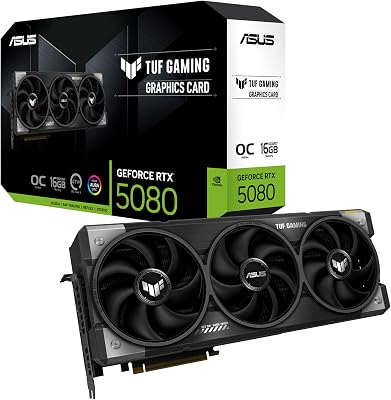

Dropped $25.01

Save $100.00


RTX 5080 vs 4080 Super is the rare GPU matchup where the sticker prices are identical and everything else is not. Both cards launched at $999 — the 4080 Super in January 2024 as Ada Lovelace’s value-corrected near-flagship, the 5080 a year later as Blackwell’s second-in-command — and both carry 16GB of memory aimed at the same 4K and high-refresh-1440p buyer. The differences live in bandwidth, frame generation, and the used-market discount that is the 4080 Super’s only remaining argument. This comparison quantifies all three, then tells you exactly which card your money should buy in 2026.
As an Amazon Associate we earn from qualifying purchases at no extra cost to you. Product prices and availability are accurate as of the date shown and are subject to change.


RTX 5080 vs 4080 Super: Quick Verdict and Specifications
One generation and twelve months separate these cards, and the spec sheet shows Nvidia spending that year almost entirely on the memory subsystem. Here is the short answer, the numbers behind it, and the trade-offs on each side.
The Quick Verdict for Busy Buyers
The RTX 5080 wins for anyone buying new: it is roughly 10 to 15 percent faster in raster, substantially stronger in ray tracing, and exclusively equipped with DLSS 4 Multi Frame Generation — at the same $999 MSRP the 4080 Super carried. New-for-new, there is no decision to make.
The 4080 Super’s case lives entirely on the used market, where clean examples trade around $750 to $820. At the bottom of that band it becomes genuinely interesting value — about 90 percent of the 5080 experience for 75 percent of the money. Check both prices on Amazon before deciding; the spread between them is the entire comparison.
Specification Comparison Table
The table makes the generational priorities obvious: similar core counts, radically different memory bandwidth.
| Specification | RTX 4080 Super | RTX 5080 |
|---|---|---|
| Architecture | Ada Lovelace (2024) | Blackwell (2025) |
| CUDA Cores | 10,240 | 10,752 |
| VRAM | 16GB GDDR6X | 16GB GDDR7 |
| Memory Bandwidth | 736 GB/s | 960 GB/s |
| Board Power | 320W | 360W |
| DLSS Support | DLSS 3 (Frame Generation) | DLSS 4 (Multi Frame Generation) |
| Launch Price | $999 | $999 |
A 5 percent core-count increase producing a double-digit performance gap is the bandwidth line at work: GDDR7’s 30 percent advantage feeds the same-sized engine far better, especially at 4K.
Pros and Cons of Each Card
An honest RTX 5080 vs 4080 Super breakdown keeps both columns full, because the older card remains excellent hardware whose only sin is a successor.
RTX 4080 Super pros: 90 percent of the newer card’s raster at a meaningful used discount; identical 16GB capacity; slightly lower 320W draw; famously oversized coolers run cool and quiet; proven, mature platform. Cons: permanently excluded from DLSS 4 Multi Frame Generation; 736 GB/s of bandwidth trails at 4K; no warranty used; its price floor sits uncomfortably close to the 5080’s MSRP.
RTX 5080 pros: faster everywhere, with the gap widest in ray tracing and bandwidth-bound 4K scenes; DLSS 4 and the full Blackwell software stack; GDDR7 headroom that ages well; new-card warranty and resale value. Cons: street prices drift above $999 when supply tightens; 360W wants an 850W power supply; generational raster gain is modest by historical standards.
Deep Dive Face-Off: Performance, Power, and Features
Ten to fifteen percent is the headline, but it distributes unevenly — negligible in some workloads, decisive in others. These four sections map exactly where each card earns or loses its price.
4K and High-Refresh 1440p Gaming
At 4K high settings, the 4080 Super delivers 75 to 100 fps in demanding AAA titles; the 5080 lands at 90 to 120 fps in the same suite. Both are excellent — the practical difference is whether a 4K 120Hz display is fully saturated natively or needs upscaling help to get there, and the 5080’s bandwidth advantage stretches widest precisely here, in the resolution both cards were built for. One-percent lows tell the same story more loudly: in bandwidth-bound open-world scenes, the newer card’s frame times stay flat where the 4080 Super shows brief, measurable spikes.
At 1440p the raster gap compresses toward single digits as CPU limits intrude, and both cards exceed 150 fps in nearly everything a modern engine produces. Pair either with anything less than a current top-tier processor and the difference between them disappears entirely into the CPU ceiling. High-refresh competitive players will notice the 5080’s edge only on 240Hz-plus panels; everyone else will not.
Frame generation rewrites the comparison in supported titles: the 4080 Super’s DLSS 3 doubles presented frames, while the 5080’s Multi Frame Generation can quadruple them — translating to 40 to 70 percent higher on-screen frame rates for the newer card with Reflex managing latency on both.
Ray Tracing and Path-Traced Workloads
Hybrid ray-traced titles show a 15 to 20 percent gap favoring Blackwell’s fourth-generation RT cores — larger than the raster difference and visible in minimum frame rates more than averages. Both cards are fully capable here; one simply works less hard.
Path tracing separates them decisively. In fully path-traced showcases, the 5080 with DLSS 4 sustains presented frame rates the 4080 Super cannot approach with DLSS 3’s single-frame generation — the difference between comfortably above 100 fps and hovering near playable. Buyers who care about the most demanding lighting tech have their answer in this section alone. And the catalog of path-traced titles keeps growing — what reads as a niche advantage today compounds with every major release that ships the technology.
Power, Thermals, and System Fit
Practical requirements are close: 320W against 360W, both on the 12V-2×6 connector, both happiest on a quality 850W ATX 3.0/3.1 power supply — the 4080 Super tolerates a strong 750W unit with less margin. Seat the connector fully on either card and avoid sharp bends near the plug.
Thermally both are overbuilt: the 4080 Super inherited coolers designed for a hotter card and runs famously quiet, while 5080 partner designs manage their extra 40W with similar composure. Sizes are comparable — plan for 300 to 340mm of clearance and 2.5 to 3.5 slots either way, verify case fit before ordering rather than after, and budget an anti-sag bracket for either card’s considerable weight.
Idle and media power slightly favor the newer card, a minor but permanent line item for always-on systems. For creators, both cards carry dual AV1-capable encoders, though the 5080’s newer generation delivers measurably better quality per bitrate for streaming and export work.
Value per Frame: The Cost Math
With 2026 prices, the arithmetic is clean. The 5080 at $999 averaging 105 fps across a 4K suite costs about $9.51 per frame. A used 4080 Super at $780 averaging 92 fps costs $8.48 per frame — roughly 11 percent cheaper per unit of performance, before counting features.
Ownership math narrows that edge: the 5080’s warranty, DLSS 4 headroom, and stronger resale trajectory are worth real money across a four-to-five-year horizon, while the used card carries secondhand risk and an earlier feature ceiling. At $780 the older card still defends itself; at $850 it does not.
The decision rule that falls out: buy the used 4080 Super below $800 with a return window, and buy the 5080 in every other scenario — including the common one where used listings creep within $150 of new MSRP.
The 2026 Market: Why Both Cards Resist Discounts
This comparison’s price spread — the variable that decides it — is itself being shaped by two current industry forces. Understanding them explains both the 5080’s scarce MSRP stock and the 4080 Super’s stubborn used values.
The H200 China Approval and High-End Supply
The United States has approved Nvidia selling the H200 — among its most powerful AI accelerators — to China, unleashing data-center orders that compete directly with high-end GeForce production for memory, packaging, and wafer allocation. Nvidia’s allocation follows margin, and nothing in the consumer stack out-margins data center.
The 5080 sits close enough to that silicon to feel the squeeze first: MSRP windows shorten, third-party listings drift upward, and the $999 price this comparison assumes becomes a target rather than a given. Previous AI demand waves ran exactly this script: lengthening restock gaps, third-party premiums, and bundles replacing bare-card listings — early signs worth watching on any retailer page.
Rising Component Prices Anchor the Used Side
Meanwhile, laptop and PC component prices are climbing industry-wide, led by the memory costs that feed every graphics card’s bill of materials. As new-card prices firm, used equivalents reprice upward in sympathy — which is why 4080 Super listings have traded flat for consecutive quarters instead of sliding toward $700 as normal depreciation would predict.
For this matchup, the consequence is direct: the used discount that justifies the older card is more likely to shrink than grow from here.
Buy Now or Wait?
If the performance tier fits your build today, buy today. A 5080 at $999 or a 4080 Super under $800 with returns are both fair 2026 prices carrying more upside risk than downside.
Set Amazon alerts on both, anchor on those numbers, and execute on whichever triggers first — in this segment, readiness has outperformed patience for two straight years.
Final Verdict: Who Should Buy Which Card?
The recommendation splits on one variable — where you buy — with a clean rule for each side and an alternative for buyers this tier does not quite fit.
Who Should Buy the RTX 4080 Super
Buy a used 4080 Super if you find one under $800 with a return window, you game primarily in raster and hybrid ray tracing rather than path-traced showcases, and the $200 saved matters to your build. At that price it remains one of the used market’s most complete cards.
Test promptly: stress the GPU, verify all outputs, and confirm the model — Ada-era naming confusion makes listing verification non-negotiable. Check the power connector area in listing photos too; a clean, unstressed plug is part of what the fair band pays for.
Who Should Buy the RTX 5080
Buy the 5080 in every other case: buying new, wanting DLSS 4 and path-tracing headroom, valuing warranty and resale, or simply finding used prices within $150 of MSRP — where the older card’s case evaporates.
It is the recommendation for most readers of this comparison. Track Amazon stock and move when $999 listings appear; they rarely last the week.
The Alternative: RTX 5070 Ti
If $999 overshoots your monitor’s needs, the RTX 5070 Ti at $749 delivers roughly 85 percent of the 5080’s performance with the same 16GB of GDDR7 and full DLSS 4 support — the value line of the entire high end.
For 1440p builds without 4K plans, it quietly beats both cards in this comparison; price it on Amazon before committing either way.
See More:
- Nvidia Reflex low latency
- RTX 4070 vs 5060 Ti
- Zephyr RTX 4070
- RTX 3080 Ti price
- Nvidia RTX 2060 Super
Conclusion
The RTX 5080 vs 4080 Super matchup resolves into one clean rule: new money buys the 5080 — 10 to 15 percent faster, dramatically stronger in path tracing, and DLSS 4-equipped at the same $999 the older card launched at — while used money buys the 4080 Super only below $800 with recourse. The 30 percent bandwidth gap and Multi Frame Generation exclusivity are the levers behind every number above. With the H200 export approval squeezing high-end supply and component prices propping up used values, the spread deciding this comparison is shrinking, not growing. Settle your side of the RTX 5080 vs 4080 Super question, check both cards’ live Amazon prices, and buy while your number still exists.
Frequently Asked Questions
What is the best rtx 5080 4080 super in 2026?
The best rtx 5080 4080 super depends on your budget and how you plan to use it. The options compared above are our top-rated picks based on real customer ratings, build quality, and overall value — start with the highest-rated model that fits your budget.
How much should I expect to spend on a rtx 5080 4080 super?
Prices vary by brand and features. Budget options cover the essentials, while mid-range and premium models add durability, performance, and extra features. Compare the prices in the list above to find the best value for your needs.
What should I look for when buying a rtx 5080 4080 super?
Focus on what matters most for your use case — build quality, compatibility, performance, warranty, and verified customer reviews. Every pick above is selected to balance these factors.
Are budget rtx 5080 4080 super options worth it?
Yes. For most people a well-reviewed budget or mid-range rtx 5080 4080 super delivers excellent value. You only need to spend more if you specifically require premium materials or top-tier performance.
How did we choose these rtx 5080 4080 super picks?
We compare current Amazon ratings, review counts, key features, and price to surface the options with the best real-world value. The list is refreshed as ratings and availability change.










Write Your Review
No reviews yet. Be the first to share your experience!