
- Top Pick: Nvidia GeForce GTX 1080 8GB FE Founders Edition GDDR5X Video Graphics Card (Renewed)
- Best Value: MSI Gaming GeForce GTX 1080 8GB GDDR5X SLI DirectX 12 VR Ready Graphics Card (GTX 1080 ARMOR 8G OC) (Renewed)
- Premium Choice: Sapphire Technology Pulse AMD Radeon RX 6600 XT Gaming Graphics Card with 8GB GDDR6, AMD RDNA 2 (11309-03-20G) (Renewed)
The RX 6600 XT is the better gaming card. It’s generally around 20-30% faster than the GTX 1080 at 1080p, uses less power, is physically smaller, and supports ray tracing and current AMD drivers. The GTX 1080 still makes sense in two situations: as a very cheap used card for older and esports titles, or in a PCIe 3.0 system where the 6600 XT’s x8 link and narrow memory bus give up some of its lead. Most buyers should choose the 6600 XT, especially for 1080p high-refresh gaming.
As an Amazon Associate we earn from qualifying purchases at no extra cost to you.

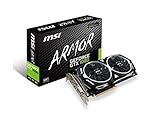


Two Generations Apart
NVIDIA released the GTX 1080 in May 2016 at $599 as its Pascal flagship. It was a 4K-capable card for its time, with a 256-bit GDDR5X memory bus. AMD’s RX 6600 XT arrived in July 2021 at $379, built on RDNA 2 and explicitly aimed at 1080p. AMD used a narrow 128-bit bus and offset it with a 32 MB Infinity Cache and very high clocks. The result is a card that beats the old flagship at 1080p while drawing less power, but whose advantage narrows as resolution rises and the cache becomes less effective.
Specifications
| Specification | GeForce GTX 1080 | Radeon RX 6600 XT |
|---|---|---|
| Architecture / process | Pascal, 16 nm | RDNA 2.0, 7 nm |
| Release date | 27 May 2016 | 30 July 2021 |
| Launch MSRP | $599 | $379 |
| Shaders | 2,560 CUDA cores | 2,048 stream processors |
| Boost clock | 1,733 MHz | 2,589 MHz |
| Memory | 8 GB GDDR5X | 8 GB GDDR6 |
| Bus / bandwidth | 256-bit / 320 GB/s | 128-bit / 256.0 GB/s |
| Cache | 2 MB L2 | 2 MB L2 + 32 MB Infinity Cache |
| TDP | 180 W | 160 W |
| Power connector | 1x 8-pin | 1x 8-pin |
| Interface | PCIe 3.0 x16 | PCIe 4.0 x8 |
| Length / slots | 267 mm / 2-slot | 190 mm / 2-slot |
| Outputs | DisplayPort 1.4, HDMI 2.0b, DL-DVI | 1x HDMI, 2x DisplayPort |
Gaming Performance by Resolution
1080p
TechSpot’s RX 6600 XT review, Hardware Unboxed’s testing in written form, placed the card at about RX 5700 XT and RTX 3060 level at 1080p, a tier that runs clearly ahead of the GTX 1080 in modern games. Combining that with long-standing review data that places the 5700 XT and RTX 3060 well above the 1080, the 6600 XT typically leads by roughly 20-30% at 1080p in current titles. Some aggregate benchmark sites show a smaller lead, around 5-15%, mostly because they weight older games where Pascal remains strong. The gap is largest in newer DX12 and Vulkan games built for modern architectures.
1440p
At 1440p the 32 MB Infinity Cache catches fewer memory accesses, and the 1080’s 256-bit bus helps it more. The 6600 XT’s lead shrinks to something more like 10-20% in most games. Both cards are acceptable for 1440p at medium settings. Neither is a strong 1440p ultra card in 2026.
As a rough guide, a modern AAA game at 1080p high might run around 60-80 fps on the 6600 XT and 50-65 fps on the GTX 1080, and both clear 144 fps in many esports titles. Actual numbers depend on the specific game, settings, CPU and driver version.
Ray Tracing, Upscaling and Frame Generation
- Ray tracing: The 6600 XT has first-generation RDNA 2 ray accelerators. RT is usable only at 1080p with low settings and upscaling, but it lets the card run games that require RT hardware. The GTX 1080 has no RT hardware.
- Upscaling: The 6600 XT supports FSR 2 and FSR 3 and XeSS in DP4a mode. The GTX 1080 can also use FSR and XeSS DP4a, but not DLSS, because Pascal lacks Tensor cores. Neither card supports FSR 4, which targets RDNA 4.
- Frame generation: The 6600 XT supports FSR 3 frame generation in games and AMD Fluid Motion Frames at the driver level. The GTX 1080 can use FSR 3 frame generation only in games that implement it. It has no driver-level equivalent.
Driver Support in 2026
NVIDIA ended Game Ready driver updates for Pascal cards after the 580 driver branch in late 2025, with security updates scheduled to continue into 2028. The GTX 1080 will still run games but won’t get new per-game optimizations. AMD moved RDNA 2 to a maintenance-focused driver track at the same time, but said it will continue to deliver game-specific fixes as needed. In practical terms, the 6600 XT has the more active support path.
Power, PSU, Size and Connectivity
PSU sizing
- GTX 1080: 180 W + 95 W (mainstream 6-core CPU) + 150 W headroom = 425 W, so a quality 450-550 W unit.
- RX 6600 XT: 160 W + 95 W + 150 W = 405 W, so a quality 450-500 W unit.
Both use a single 8-pin connector, so cable requirements are the same.
Case fit
The 6600 XT’s 190 mm reference length is a big advantage for compact builds. Many partner cards are short single- or dual-fan designs that fit mini-ITX cases. The GTX 1080’s 267 mm reference length needs a typical mid-tower or a larger ITX case.
PCIe link
The RX 6600 XT uses PCIe 4.0 x8. On a PCIe 3.0 board it runs at 3.0 x8, which reviews have shown costs a few percent in most games and more in memory-heavy titles once VRAM fills. The GTX 1080’s full x16 link isn’t affected. Owners of older Intel platforms or AMD B450 boards should expect the 6600 XT’s lead to be a little smaller than review charts on modern platforms suggest.
Outputs
The GTX 1080 includes a dual-link DVI port, useful for older monitors. The 6600 XT drops DVI but has more modern display support. Check your monitor’s inputs before choosing.
Cost per Frame
At launch MSRP, with the GTX 1080 at 100 and the RX 6600 XT at about 125 on a 1080p index, the 1080 cost $5.99 per point and the 6600 XT about $3.03 per point. That shows roughly how much five years of progress improved value.
Used prices tell a more practical story. A used GTX 1080 usually sells for around $80-$120, and a used RX 6600 XT typically for about $150-$190. At midpoints, the 1080 is about $1.00 per index point and the 6600 XT about $1.36. The GTX 1080 delivers more frames per dollar on paper, while the 6600 XT costs more for better efficiency, features, driver support and a newer card that has generally seen less wear.
Decision Table
| Budget / use case | Pick | Why |
|---|---|---|
| Under $100, esports and older games | GTX 1080 (used) | Best raster per dollar in this pair |
| 1080p high-refresh in new AAA games | RX 6600 XT | Roughly 20-30% faster at 1080p |
| Mini-ITX or compact case | RX 6600 XT | 190 mm reference length |
| Games requiring RT hardware | RX 6600 XT | The GTX 1080 can’t run them |
| Older PCIe 3.0 board, DVI monitor | GTX 1080 | Full x16 link and DVI output |
| Around $200-$250 new | Neither | RX 9060 XT 8GB or Arc B580-class cards are stronger |
Frequently Asked Questions
Is the RX 6600 XT faster than the GTX 1080?
Yes, in most modern games. Review data that places the 6600 XT at about RX 5700 XT and RTX 3060 level suggests a lead of roughly 20-30% at 1080p, shrinking to about 10-20% at 1440p. Older games favor the GTX 1080 more.
Does the RX 6600 XT lose performance on PCIe 3.0?
Slightly. It uses an x8 link, so a PCIe 3.0 board halves its available bandwidth. Most games lose only a few percent, but memory-heavy titles can lose more once the 8 GB of VRAM is full.
Can the GTX 1080 use FSR frame generation?
It can use FSR 3 frame generation in games that implement it, since FSR doesn’t require vendor-specific hardware. It can’t use AMD Fluid Motion Frames, which is a Radeon driver feature, or DLSS, which needs RTX Tensor cores.
What PSU do I need for the RX 6600 XT?
A quality 450-500 W unit with one 8-pin PCIe connector is enough for a typical gaming system. Stronger CPUs may call for 550 W for extra headroom.
Is 8 GB enough on either card in 2026?
At 1080p with high, not ultra, textures, 8 GB still works in most games. Some new releases need texture settings lowered to avoid stutter. Both cards have the same 8 GB, so VRAM doesn’t separate them.
Which card runs cooler and quieter?
The RX 6600 XT usually does, thanks to its lower 160 W TDP and more efficient 7 nm design. Actual noise depends on the specific cooler, and an old GTX 1080 can run quieter after fresh thermal paste and clean fans.
Ready to decide? Our #1 pick for 2026 is the Architecture / process.
Live price & availability on Amazon.










Write Your Review
No reviews yet. Be the first to share your experience!