
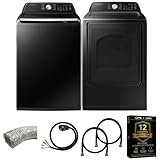
- Top Pick: Samsung Smart 4.7 Cu Ft Top Load Washer & 7.4 Cu Ft Electric Dryer, Sensor Stops Overdrying, Low Vibration Quiet Wash, WaterJet w/Power Cords, Hoses, Vent Duct, 1 Year CPS Protection Bundle (Black)
- Best Value: Samsung WA44A320KIT1 White Top Load High-Efficiency Smart Washer and Dryer Pair 4.5 Cu Ft Washer 7.4 Cu Ft Electric Dr
- Premium Choice: GE Unitized Spacemaker® 2.3 Cu. Ft. Washer and 4.4 Cu. Ft. Electric Dryer Laundry Center, 24-Inch, White – GUD24ESSMWW
For most households, a Whirlpool front-load washer paired with a matching dryer offers the best balance of capacity and efficiency, while a top-load pair with an agitator-free impeller suits buyers who prefer easier loading and a lower-cost tier. Which pair is right depends mainly on space, drum size, fuel type for the dryer and how much laundry you run per week.
Model numbers change by retailer and by year, so this guide focuses on Whirlpool’s current product families and the specs the maker publishes, rather than a single SKU. Always match the washer and dryer model families and confirm the exact model on the maker’s page and your retailer’s listing before you buy.
As an Amazon Associate we earn from qualifying purchases at no extra cost to you.


Whirlpool Laundry Lines at a Glance
| Line | Type | Best for | Typical features the maker lists | Limits |
|---|---|---|---|---|
| Front-load washer (mid and upper tiers) | Front load, stackable with matching dryer | Large families, efficiency, gentler on clothes | Large capacity drum, steam options on some models, Load and Go dispensers on some | Door gasket needs care to limit odour; bending to load unless on pedestals |
| Top-load washer with removable agitator | Top load | Heavily soiled loads, familiar operation | Deep Water Wash and agitator cleaning action on some | Lower capacity per footprint, rougher on delicates |
| Top-load washer with impeller (agitator-free) | Top load | Larger loads, bulky bedding | Low-profile impeller, large drum | Can tangle on some loads; slightly longer cycles |
| Electric dryer, matching pair | Electric 240 V | Homes with a 240 V outlet | Large drum, sensor dry, steam refresh on some | Needs correct outlet and vent |
| Gas dryer, matching pair | Gas | Homes with gas line | Same drum size options, usually quicker drying | Needs gas connection and professional hookup |
| Laundry centre / stacked units | Stacked | Closets and small spaces | Single footprint, wash-and-dry in one column | Fixed pairing, fewer choices |
Outlets such as Consumer Reports, Wirecutter and Reviewed have covered Whirlpool’s laundry range over the years and generally describe it as solid value, with some models rated higher than others. Individual results depend on the model, so look at the model-specific review, not the brand average.
How to Choose a Whirlpool Pair
Front load or top load
Front-load washers typically use less water and spin faster, which pulls out more moisture and shortens dryer time. They need a door seal wiped regularly and left open between loads. Top-load models are easier on the back, load mid-cycle and tend to cost less. Agitator versions scrub more aggressively, while impeller versions are gentler and hold more.
Capacity
Makers list drum capacity in cubic feet. Larger drums handle comforters and big family loads in one go. A very large drum used for tiny loads wastes water and energy, so match it to your habits. The dryer should have a capacity at least as large as the washer, ideally larger, so clothes can tumble freely. Whirlpool normally pairs washers and dryers of matching size within a line.
Dryer fuel and venting
Electric dryers need a dedicated 240 V outlet of the correct type. Gas dryers need a gas line and exhaust venting installed correctly. Both need proper venting to the outside and a clean lint path; poor venting is a known fire hazard and slows drying. If you are unsure about your home’s wiring, gas supply or venting, hire a licensed electrician or installer.
Dimensions and clearances
Measure the space and the path to it: doorways, stairs, corners. Allow clearance behind for hoses and vent, usually a few inches, and check the door swing direction, which many front-load washers let you reverse. Stackable pairs need the correct stacking kit from the maker.
Features that matter
- Sanitize and steam cycles: useful for allergy-prone households; the maker describes the cycle behaviour on each model page.
- Sensor dry: stops the cycle when clothes are dry, saving energy and fabric wear.
- Smart connectivity: available on some models, lets you start or monitor cycles by app. Optional for most buyers.
- Energy and water ratings: check for ENERGY STAR certification on the specific model, because not every model carries it.
- Quiet operation: matters in apartments or when laundry is near bedrooms.
Pick This If…
| Pick this if… | Choose | Reason |
|---|---|---|
| You have a large family and bulky bedding | Large-capacity front-load pair | Fewer loads, faster spin extraction |
| You want the lowest entry cost | Basic top-load with matching electric dryer | Simple controls, fewer parts |
| You have a closet or tight space | Stacked front-load pair or laundry centre | Single footprint |
| You have back or mobility concerns | Top-load, or front-load on pedestals | Easier loading height |
| You have gas at home | Gas dryer paired with a matching washer | Often quicker drying, check installation needs |
| You like app control | Smart-enabled models in the upper tiers | Remote start and notices |
Budget Tiers
Budget: basic top-load washers and simple electric dryers with fewer cycles. Good for singles and couples with moderate loads.
Mid-range: front-load washers with larger drums and more cycles, and sensor-dry dryers. Most buyers land here.
Premium: large front-load pairs with steam, extra sanitising options, smart features and pedestal compatibility.
Alternatives to Consider
- Maytag, owned by the same company, emphasises durability and often shares platforms with Whirlpool.
- LG and Samsung are common front-load rivals with strong feature sets and smart features.
- GE and Speed Queen appeal to buyers who prioritise simplicity and long service life.
- Washer-dryer combos in a single drum suit apartments but dry more slowly than a separate dryer.
Common Mistakes
- Buying without measuring delivery paths and venting clearance.
- Ignoring the dryer’s fuel type and outlet.
- Choosing the biggest drum without checking the dryer can match it.
- Skipping a stacking kit or pedestal when planning a stacked or raised set.
- Forgetting maintenance: wipe the front-load gasket, clean the lint filter every load and inspect the vent hose regularly.
Frequently Asked Questions
Should I buy the washer and dryer as a matched pair?
A matched pair looks consistent, ensures drum sizes line up and often simplifies stacking. You can mix models if dimensions and fuel type work, but check the stacking kit compatibility if you plan to stack.
Are Whirlpool front-load washers prone to odour?
Front-load washers of any brand can develop odour if the door is kept closed and the gasket stays damp. Leaving the door ajar, wiping the seal and running the maker’s clean-washer cycle as the manual directs helps.
Do I need a gas or electric dryer?
It depends on the connections in your home. Electric needs a suitable 240 V outlet, gas needs a gas line. Ask a licensed electrician or installer if you are unsure what your laundry area supports.
How big a washer do I need?
Smaller households do well with moderate capacities, while families and people who wash comforters benefit from a large drum. Compare the maker’s cubic-foot figures within the same type, since front and top-load figures are measured differently.
How long should a washer and dryer last?
Appliance lifespans vary with use and care. Regular cleaning, level installation and correct loading all help, and the maker’s warranty terms on each model state the coverage you actually get.







Write Your Review
No reviews yet. Be the first to share your experience!