
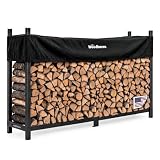
- Top Pick: Woodhaven 8-Foot Raised Firewood Rack Black w/ Cover, 1/2 Cord|Made in USA | Heavy-duty steel w/ lifetime structural warranty; elevated for airflow; cover keeps top wood dry while exposed wood seasons
- Best Value: VIVOHOME 4 ft Heavy Duty Firewood Rack Outdoor with Cover, Black | Fire Wood Storage Rack, Log Holder and Cover Combo Set with Zipper
- Premium Choice: VEVOR 12.7FT Outdoor Firewood Rack with Cover, Firewood Holder for 3/4 Cord | Heavy Duty Wood Storage with Half-Covered for Porches Gardens Patios Yards Log Steel Frame UV Protection
The best outdoor firewood rack keeps wood off the ground, holds the volume you actually burn and has a cover or roof that sheds rain while leaving the sides open to airflow. A steel frame with a powder-coated or galvanised finish suits most backyards, and the size you need depends on whether you keep a day’s supply or a full season’s.
As an Amazon Associate we earn from qualifying purchases at no extra cost to you.


Start With How Much Wood You Store
Firewood is often sold by the cord, which is commonly defined as a stacked pile four feet high, four feet wide and eight feet long. Most buyers store a fraction of that on a rack, so look at the rack’s stated capacity and dimensions. A small rack by the door is handy for a few days of burning, while a long, multi-bay rack handles a half cord or more. Makers state capacities differently, so compare dimensions and not only names.
At a Glance
| Style | Example makers | Best for | Limits |
|---|---|---|---|
| Open tubular steel rack | Panacea, Amagabeli, Sunnydaze | Everyday backyard storage | Needs a cover in wet climates |
| Rack with roof | Landmann, Pleasant Hearth style units | Rainy regions | Heavier, costlier |
| Adjustable-length bracket kit | Various | Custom lengths along a wall | You supply the wood and need a level base |
| Log hoop or round holder | Various | Decorative, small volume | Low capacity |
| Shed or lean-to | Various | Large seasonal supply | Takes space; needs assembly |
Open Steel Racks
Steel racks from makers such as Panacea, Amagabeli and Sunnydaze are the common choice. They raise the stack off the ground, which helps airflow and reduces rot. Makers describe finishes such as powder coat or black paint, and some sell matching covers. Check the stated load rating and the dimensions, and assemble on level ground. Reviewers often point out that thin tubing can bow under heavy stacks, so a higher stated capacity and welded joints are worth noting.
Covered and Roofed Racks
In rainy or snowy places, a roof or a fitted cover helps the top layer stay dry. Some racks come with a cover, while others sell it separately. A cover should leave the sides open, because a fully wrapped stack traps moisture and slows seasoning. A good cover reaches only part-way down the sides, with strap or clip fixings to resist wind.
Material and Finish
- Powder-coated steel: Common, durable if the coating stays intact.
- Galvanised steel: Resists rust and fits wet climates.
- Stainless steel: Rust-resistant, usually at a higher tier.
- Wood frames: Attractive but can rot if the legs sit in damp ground.
Placement and Seasoning
Seasoned wood burns cleaner. Many extension services say wood should be split and dried for six months to a year or more, depending on species, until moisture content is about 20 percent or lower. A moisture meter can confirm this. Stack with the bark side up where practical, leave gaps between rows and place the rack in sun and wind.
Keep stacks away from the walls of your house and from other structures. Wood piles can harbour insects such as termites and carpenter ants, and a pile against a building also creates a fire hazard. Local rules and fire authorities may specify distances, so follow them.
Pick X If You Want Y
| Pick this | If you |
|---|---|
| Small open steel rack | need a day or two of supply near the fire pit or door |
| Large multi-bay rack with cover | store a half cord or more in a wet region |
| Rack with built-in roof | prefer no separate cover |
| Adjustable bracket kit | want a rack that fits a long wall |
| Galvanised or stainless frame | live in a humid or coastal area |
Budget Tiers
Budget: A basic tubular steel rack with a separate cover.
Mid-range: A larger powder-coated rack with a fitted cover and welded joints.
Premium: A roofed or galvanised system, or a purpose-built shed.
Assembly and Safety Notes
- Build on level, firm ground or pavers, as the stated load rating assumes a stable base.
- Do not overload beyond the maker’s rating.
- Wear gloves when handling wood, since splinters and insects are common.
- Keep stacks low enough that they cannot tip onto children or pets.
- Keep wood away from fire pits, grills and heat sources, and from the building wall.
- Bring in only what you will burn soon, and inspect it for insects first.
Common Mistakes
- Buying by looks and ignoring capacity.
- Wrapping the entire stack in a tarp, trapping moisture.
- Placing the rack directly against the house.
- Burning wood that has not seasoned long enough.
- Ignoring wind, so covers blow off.
- Assembling on soft, uneven ground.
Alternatives
- Pallet racks: A lower-cost homemade option, though condition and treatment of pallets vary.
- Lean-to shed: For a full season of wood.
- Indoor log holders: For carrying wood into the house.
- Kiln-dried bundles: Where storage space is limited.
Sizing and Layout Tips
Measure the space before you buy, including room to walk around the stack and to reach the wood in winter when snow lies on the ground. A rack placed near the door saves trips, while the main store can sit farther from the house. Many owners keep a small rack close to the fire pit or entrance and refill it from a larger one. Heavy wood such as oak weighs more than softwood of the same volume, so check the load rating against the species you burn.
When stacking, put the largest pieces at the bottom and ends, keep the stack tight enough to stay stable and leave small gaps for air. Rotate so the oldest wood is used first. If your rack uses adjustable brackets, set them level and keep the stack height below the rack uprights. In windy areas, anchor lighter racks or use covers with fixings, so the stack does not tip or lose its cover in a storm.
Frequently Asked Questions
How big should my firewood rack be?
Match it to how much you burn. A cord is commonly four by four by eight feet when stacked, so a half cord needs about half that volume. Check the rack’s stated dimensions and capacity.
Should I cover the whole stack?
No. Cover the top to shed rain, but leave the sides open for airflow. A fully wrapped stack holds moisture.
How far should a rack be from the house?
Keep it away from the walls, since wood piles attract insects and can be a fire risk. Follow local guidance on distance.
Can a rack sit on grass?
Yes, but pavers, gravel or a pad give a more stable and drier base. Soft ground can let legs sink.
How long should firewood season?
Many sources say six months to a year or longer depending on species, until moisture is around 20 percent or lower. A moisture meter helps confirm.
Will steel racks rust?
Coatings help, but scratches can allow rust. Galvanised or stainless options resist it better. Touch up damaged paint when it occurs.







Write Your Review
No reviews yet. Be the first to share your experience!