
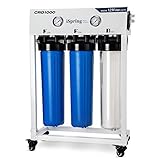
- Top Pick: iSpring CRO1000 4-Stage Tankless Commercial Reverse Osmosis Water Filtration System, for House, Restaurant, Small Business, and Light Industrial Use,1000 GPD High Flow, Upgraded Size Filters
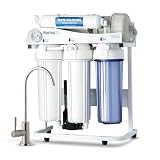
- Best Value: iSpring RCS5T Commercial Tankless Reverse Osmosis RO Water Filter System with 1.5:1 Pure to Drain Ratio, Pressure Gauge
- Premium Choice: AquaTru Pro Model 1 Compact Commercial Water Purification System | 5-Stage Reverse Osmosis (RO) | Hot & Cold Dispenser with Hands-Free Sensors | Filters Certified by IAPMO to NSF Standards
Best Commercial RO Water Purifiers in 2026
The best commercial RO water purifier for most cafés, offices, restaurants, and small food businesses is a 600–1,000 GPD low-energy system with a 2:1 or better product-to-waste ratio, a high-rejection membrane, carbon pretreatment, pressure monitoring, and a storage tank sized for peak demand rather than average demand.
- Best Commercial RO Water Purifiers in 2026
- Commercial RO systems compared
- Best choices by operating situation
- Daily output: size for peak demand, not the daily average
- Filtration stages and membrane life
- Recovery rate and wastewater costs
- Water pressure and pump requirements
- Installation requirements that are easy to overlook
- Maintenance schedule and operating checks
- Final buying recommendation
For a compact operation, a 600 GPD system such as the Pentair Everpure MRS-600HE is a sensible starting point. A busy restaurant, catering kitchen, or refill station should consider a 1,000 GPD class system such as the Pentair Everpure MRS-1000HE. The correct choice depends less on the headline gallon-per-day number than on your incoming water pressure, peak-hour demand, hardness, chlorine level, and willingness to maintain pretreatment.
As an Amazon Associate we earn from qualifying purchases at no extra cost to you.


Commercial RO systems compared
| System class | Typical daily output | Typical recovery | Best fit | Main limitation |
|---|---|---|---|---|
| Compact commercial RO | 300–600 gallons | 25–40% | Small cafés, offices, salons, light food service | Limited peak-hour capacity |
| Low-energy 600 GPD RO | 500–700 gallons | 40–50% | Restaurants, coffee shops, moderate beverage production | Needs reliable pressure and good pretreatment |
| Low-energy 1,000 GPD RO | 800–1,200 gallons | 40–50% | Busy kitchens, catering, small bottling operations | Higher installation and maintenance cost |
| High-output multi-membrane RO | 2,000–10,000+ gallons | 50–75% | Hotels, factories, laundries, large food production | Requires engineering, pumps, controls, and pretreatment |
Published capacity is normally based on a particular water temperature, pressure, and dissolved-solids level. Cold water, fouled filters, low pressure, or high total dissolved solids can reduce real production substantially. Treat the rating as a design reference, not a guaranteed flow rate under every condition.
Best choices by operating situation
| Your situation | Recommended specification | Why |
|---|---|---|
| Up to 150 gallons per day, mostly intermittent use | 300–600 GPD, storage tank, 3–5 filtration stages | The tank handles short demand spikes without oversizing the membrane |
| 150–500 gallons per day, regular beverage service | 600 GPD low-energy RO, 40% or higher recovery | Balances output, wastewater, and replacement costs |
| More than 500 gallons per day or concentrated lunch peaks | 1,000 GPD or larger, booster pump, adequate storage | Provides recovery time between demand surges |
| Very hard water or high silica | Softener or antiscalant pretreatment before RO | Protects the membrane from scale and premature flow loss |
| Chlorinated municipal water | Carbon block or catalytic carbon before the membrane | Chlorine can damage thin-film composite membranes |
| Private well water | Iron, manganese, sediment, and bacteria testing first | RO is not a substitute for well-water treatment |
Daily output: size for peak demand, not the daily average
Estimate demand by adding every use that needs RO water: drinking water, coffee machines, ice makers, cooking, steam equipment, bottle filling, and cleaning where purified water is required. Then identify the busiest two- to four-hour period.
For example, suppose a café uses 240 gallons per day, but 90 gallons are needed during a three-hour lunch period. A 600 GPD membrane produces approximately 25 gallons per hour under its rated conditions. In three hours it can make about 75 gallons, leaving a 15-gallon shortfall. A 40- to 60-gallon storage tank can cover that gap, provided it is full before the rush.
This is why a 600 GPD system with storage can outperform a nominally larger tankless unit for intermittent demand. Conversely, a bottling line drawing water continuously may need a larger membrane and pump rather than merely a bigger tank.
Filtration stages and membrane life
A typical commercial system uses four functional treatment stages:
- Sediment filtration: Removes sand, rust, and suspended particles that would clog carbon filters and reduce membrane flow.
- Carbon filtration: Removes chlorine and many organic compounds. Use a carbon stage rated for the actual flow, not just a small residential cartridge.
- Reverse osmosis membrane: Reduces dissolved salts, many metals, nitrate, and other contaminants. Rejection varies by contaminant and operating conditions.
- Post-treatment: A polishing carbon filter, remineralizer, ultraviolet unit, or ozone-compatible finishing stage may be used depending on the application.
Hardness is one of the biggest threats to membrane life. If feed water contains substantial hardness, a softener or properly controlled antiscalant system may be necessary. Chlorine exposure, iron fouling, biofouling, and incorrect recovery can also shorten membrane life.
A well-maintained commercial membrane commonly lasts about two to five years, but replacement may be needed sooner when feed water is difficult or pretreatment is neglected. Cartridges usually require more frequent replacement: sediment and carbon filters are often changed every three to twelve months, based on pressure drop, chlorine breakthrough, and gallons treated.
Recovery rate and wastewater costs
Recovery is the percentage of feed water converted into purified product water. At 40% recovery, every 100 gallons entering the system produces 40 gallons of RO water and 60 gallons of concentrate. At 50% recovery, the same 100 gallons produces 50 gallons and sends 50 gallons to drain.
Consider a business making 300 gallons of RO water daily:
- At 25% recovery: 1,200 gallons of feed water are required and 900 gallons become concentrate.
- At 40% recovery: 750 gallons are required and 450 gallons become concentrate.
- At 50% recovery: 600 gallons are required and 300 gallons become concentrate.
A higher recovery rate reduces water and sewer expense, but it concentrates more minerals on the membrane surface. Do not increase recovery simply by restricting the drain flow. The system must be designed for that recovery using suitable membrane area, pressure, pretreatment, and controls.
Water pressure and pump requirements
Many commercial RO systems perform best with approximately 60–100 PSI at the membrane inlet, although the exact requirement depends on the membrane and system design. Municipal pressure that appears adequate at a faucet may fall sharply when several fixtures operate at once.
If pressure is below the required range, production falls, rejection may worsen, and the system may run continuously. A booster pump with a pressure switch and low-pressure shutoff is usually preferable to simply installing a restrictive flow control. Confirm that the building supply, electrical circuit, and plumbing can support the pump.
Measure pressure dynamically: open the nearby fixtures that normally operate during the busiest period, then check the pressure at the RO inlet. Static pressure alone can give a misleading result.
Installation requirements that are easy to overlook
- Drain connection: The concentrate line needs an air gap or an approved drain connection to prevent backflow contamination.
- Storage: Use a food-grade tank with enough usable volume for peak demand. A tank’s nominal capacity is larger than its usable drawdown.
- Floor space: Leave access above and beside cartridges, membranes, valves, and electrical controls.
- Power: Pumped systems may require a dedicated grounded outlet. Check voltage and amperage before ordering.
- Plumbing: Commercial systems generally need a properly sized feed line, shutoff valve, product-water line, and drain line.
- Sanitation: Tanks and product lines must be sanitized on a schedule appropriate to the business and local health requirements.
- Water testing: Test total dissolved solids, hardness, iron, manganese, pH, chlorine, and—where relevant—silica and microbiological quality.
Maintenance schedule and operating checks
Check inlet and outlet pressure, product flow, concentrate flow, and total dissolved solids at least monthly in a busy operation. A rising TDS reading after the membrane can indicate rejection loss, a damaged seal, scaling, or a membrane nearing the end of its service life.
Replace sediment and carbon filters when their pressure drop becomes excessive or when chlorine is detected after the carbon stage. Sanitize the storage tank and product plumbing during scheduled service. Inspect tubing, fittings, float valves, and automatic shutoff components for leaks. Keep a log of readings so gradual performance loss is visible before it interrupts production.
Final buying recommendation
Choose a 600 GPD low-energy commercial RO system when demand is moderate and intermittent, especially when a storage tank can cover peak periods. Choose a 1,000 GPD system when demand regularly exceeds 500 gallons per day or when several appliances draw water simultaneously. For high-hardness, well-water, or industrial applications, select the pretreatment first and the membrane system second.
The best commercial RO water purifier is therefore not the unit with the largest advertised output. It is the system whose membrane capacity, recovery rate, pressure controls, storage, pretreatment, and service access match the water chemistry and the business’s busiest operating hours.
Ready to decide? Our #1 pick for 2026 is the Compact commercial RO.
Live price & availability on Amazon.




Write Your Review
No reviews yet. Be the first to share your experience!