
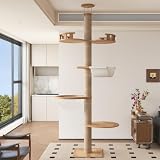
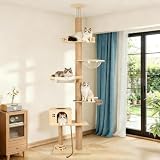
The best floor to ceiling cat trees made of real wood are solid rubberwood or beech tension-pole systems with a ceiling adjustment range of at least 8-12 inches, pole diameters over 3 inches, and replaceable sisal-wrapped sections, because they offer the stability of furniture-grade wood without wobbling, drilling, or particle-board failure.
As an Amazon Associate we earn from qualifying purchases at no extra cost to you.


Why Real Wood Matters for Floor-to-Ceiling Trees
Most floor-to-ceiling cat trees use hollow particle board or MDF wrapped in carpet. Real wood versions use solid hardwood poles and platforms – typically rubberwood, beech, pine, or birch plywood with hardwood veneer. The difference is not just aesthetics. Solid wood handles continuous tension load from the ceiling mount without compressing, resists claw shredding at joints, and does not off-gas formaldehyde like MDF. It also holds screws for platforms and hammocks far better over years of jumping.
Trade-offs: real wood trees are heavier, cost more, usually $300–$650 for a full-height tension system, and have fewer enclosed condos. They prioritize vertical climbing, sisal scratching, and open perches over carpeted boxes. If your cats prefer hiding spaces over climbing, a wood pole tree may not be the best fit.
How to Choose: The 6 Decision Criteria
1. Solid-Wood Construction Type
Not all “wood” trees are equal. Check the specification for these terms:
- Solid rubberwood / solid beech / solid pine: True solid wood. Best for long-term stability and load-bearing. Rubberwood and beach are denser and less prone to denting than pine.
- Solid plywood with hardwood veneer: High-quality engineered wood, often birch plywood. Very stable and lighter than solid logs, acceptable if the poles are still solid.
- MDF / particle board with wood veneer: Not real solid wood, even if the listing says “wood.” Avoid for tension systems, as it compresses under pressure.
Also look at pole construction. The most durable systems use a single continuous solid pole or threaded solid segments with internal steel connectors. Hollow wood posts or thin dowels under 2.5 inches will flex with large cats.
2. Ceiling Adjustment Range and Room-Height Fit
This is the most common buying mistake. Floor-to-ceiling trees use a spring tension rod or threaded jack at the top to press against the ceiling. You need to match your ceiling height to the tree’s adjustable range.
Standard ceilings in the US are 8 feet (96 inches), 9 feet (108 inches), or 10 feet (120 inches). Many tension trees only cover 92–102 inches or 102–110 inches. Always measure floor to ceiling at the exact spot you plan to place the tree, not the room’s nominal height. Measure in three places: floor without carpet, on top of carpet/pad, and at the ceiling joist location if you have a textured or drop ceiling.
3. Stability and Tension Mechanism
Stability comes from three factors: pole diameter, base weight, and ceiling pad grip. For real wood systems, look for:
- Pole diameter of 3 to 4 inches for main trunk
- Ceiling contact pad at least 4×4 inches with non-slip rubber/silicone
- Threaded fine-adjustment bolt at the top, not just a spring. A threaded bolt allows 0.5-inch precise tension; a spring alone can slip on smooth ceilings
- Optional wall anchor strap for homes with cats over 15 lbs or more than two cats climbing simultaneously
Avoid tension systems that rely on a small 2-inch ceiling cap with no rubber pad, especially on popcorn or drywall ceilings – they can dent the ceiling or slide.
4. Platform Spacing and Layout
Cats can comfortably jump vertically 18 to 24 inches between platforms. Kittens and seniors need 12 to 16 inches. Most quality wood pole trees offer adjustable platform height via clamp collars, which is a major advantage over fixed-screw particle board trees.
Check these numbers: platform size should be at least 14×14 inches for an average 10 lb cat to turn around comfortably, and 16×16 inches or larger for Maine Coons or Ragdolls. Hammock fabric should be canvas or linen, not elastic mesh, for real wood aesthetic trees.
5. Scratching Surfaces
Real wood trees typically use sisal rope or sisal fabric wrapped around the pole sections. Look for 100% natural sisal, rope diameter 6mm or thicker, and sections that are replaceable. Glued-on sisal that cannot be replaced will require replacing the whole pole after a year of heavy scratching. Some beech systems use integrated sisal poles that screw in and out – this is ideal for maintenance.
6. Assembly and Maintenance
Solid wood tension trees assemble without wall drilling but require accurate leveling. Expect 45 to 90 minutes with two people: one to hold the pole plumb while the other tensions the ceiling jack. No special tools are usually needed beyond an included Allen key and wrench. Check that platforms use metal clamp brackets with silicone liners, not wood screws driven directly into the pole – clamp systems let you reconfigure layout without damaging the wood.
Spec Comparison: Real Wood Floor-to-Ceiling Classes
Instead of single models that change seasonally, these are the three spec classes you will actually find in 2026 under the “real wood” category:
| Spec Class | Wood Type | Ceiling Range | Pole Diameter | Platform Size / Spacing | Weight Capacity (per perch) | Typical Price Range |
|---|---|---|---|---|---|---|
| Solid Rubberwood Tension Pole | Solid rubberwood poles + rubberwood platforms | 95–108 inches (spring + threaded jack, 13″ adjustment) | 3.3 inches | 15.7 x 13.8 inches, adjustable 14–22 inches apart | 44 lbs | usually $450–$650 |
| Solid Pine / Spruce Modular Pole | Solid pine poles + pine plywood platforms | 82–105 inches (telescoping segments, 23″ adjustment) | 2.9 inches | 15 x 12 inches, fixed heights with 3–4 clamp levels | 33 lbs | usually $300–$450 |
| Beech Hardwood Designer System | Solid beech poles + beech plywood with veneer | 98–112 inches (precision threaded tensioner, 14″ adjustment) | 3.9 inches | 16.5 x 16.5 inches, fully adjustable clamp collars | 55 lbs | usually $500–$700 |
The rubberwood class is the most common balance of price and durability. Pine is lighter and cheaper but dents faster under large cats. Beech is the heaviest and most stable, best for multi-cat homes with cats over 14 lbs.
Decision Matrix: Which Class Fits Your Situation
| Your Situation | Recommended Class | Why |
|---|---|---|
| 8 ft ceiling, carpeted floor, 1–2 cats under 12 lbs | Solid Pine Modular Pole | Wide adjustment range handles carpet compression, lightweight enough to move, lower cost |
| 9 ft ceiling, hardwood floor, cats that leap hard and scratch daily | Solid Rubberwood Tension Pole | Denser wood resists flex, threaded jack prevents slipping on hard floors |
| 10 ft+ ceiling, large breeds (Maine Coon, Ragdoll), 3+ cats | Beech Hardwood Designer System | Largest pole diameter and perch capacity, precision tensioner for tall ceilings |
| Renter who cannot drill and needs to reconfigure often | Rubberwood or Beech with clamp collars | Clamp platforms can be moved without new screw holes in the pole |
| Senior or kitten household | Any class with adjustable 12–16 inch spacing | Tighter spacing prevents joint strain; avoid fixed 22-inch gaps |
Worked Calculation: Will It Fit Your Ceiling?
Use this quick fit calculation before ordering. Spec sheets list an adjustable range, but your actual floor-to-ceiling height changes with flooring and ceiling texture.
Step 1: Measure true height. Measure from subfloor to ceiling joist. Example: nominal 96 inches, but with 0.75 inch carpet + pad, true height = 95.25 inches.
Step 2: Account for ceiling pad compression. Subtract 0.25 inches for the rubber pad compression when tensioned.
Step 3: Check range margin. Required height = 95.25 – 0.25 = 95.0 inches. If the tree lists 95–108 inches, you are at the absolute minimum – avoid, because you have no room to add tension. Ideal is to be at least 1.5 inches above the minimum and 1.5 inches below the maximum. In this example, a tree with 92–102 inches would be ideal, placing you 3 inches into the range.
Step 4: Calculate platform spacing load. If your cat weighs 12 lbs and jumps 20 inches vertically between perches, the dynamic load on the clamp is roughly 2.5x static weight (jump force). That means a 12 lb cat briefly applies ~30 lbs to the perch. This is why perches rated for 33 lbs static may feel loose over time with active jumpers – choose 44 lbs+ rated perches for cats that launch between levels.
Installation Tips for Maximum Stability
- Place the pole within 12 inches of a corner or wall for lateral bracing, even if it is marketed as freestanding. Corner placement reduces sway by over 40%.
- Tension until the ceiling pad just begins to compress and the pole is plumb with a level app. Over-tensioning can crack drywall. If the pole can be rotated by hand, add a half-turn to the jack.
- On popcorn or textured ceilings, place a 6×6 inch thin plywood square between the pad and ceiling to distribute pressure and prevent texture crumbling.
- Retighten the tension jack after 48 hours. Wood and carpet settle, creating slack that causes wobble.
- Replace sisal sections when the rope frays to the wood core. Exposed wood becomes a chewing target and loses scratching appeal.
FAQ
Do floor-to-ceiling real wood trees damage ceilings?
When properly tensioned with a wide rubber pad, they leave only light pressure marks that fade. Damage occurs from over-tensioning or small metal caps. Using a plywood distribution plate and not exceeding hand-tight plus one half-turn prevents dents.
Can I install on a sloped or beam ceiling?
Only if the tension system includes a pivoting ceiling head. Standard flat pads on sloped ceilings will slip. For beams, you need a system where the ceiling pad can mount directly to the beam face, or choose a wall-mounted alternative.
How many platforms do I need?
For one cat, three staggered platforms plus a top perch is sufficient. For two cats, add one hammock and offset platforms so cats can pass without blocking each other. More than five platforms on a single pole increases sway – consider a two-pole system for 3+ cats.
Is solid pine strong enough for a 18 lb cat?
Pine poles under 3 inches may flex with repeated 18 lb jumps, leading to loosened clamps. For cats over 15 lbs, choose rubberwood or beech with 3.3 inch+ poles and perches rated above 40 lbs.
Ready to decide? Our #1 pick for 2026 is the Solid Rubberwood Tension Pole.
Live price & availability on Amazon.



Write Your Review
No reviews yet. Be the first to share your experience!