
Best car leather conditioners: quick picks
For most modern car interiors, the best car leather conditioners are water-based, pH-balanced products labeled safe for automotive leather and suitable for coated finishes. A cleaner-and-conditioner such as 303 Leather 3-in-1 is a practical maintenance choice; Leather Honey Leather Conditioner suits people seeking a longer-lasting, richer treatment for compatible leather, but it is not the default pick for every modern, coated seat. If your seats are synthetic, perforated, or explicitly “do not condition,” use the vehicle maker’s recommended cleaner and skip conditioner.
That distinction matters: many contemporary seats have a protective topcoat, so conditioner cannot soak into the leather beneath it as it might with unfinished hide. A heavy or oily product may instead sit on the coating, leaving shine, tackiness, or residue. Always check the owner’s manual and the product label, then test on a concealed area.
As an Amazon Associate we earn from qualifying purchases at no extra cost to you.
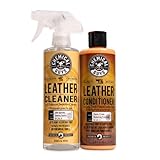


How the leading options differ
| Product or product class | Best fit | Finish and residue | Drying guidance | Key caution |
|---|---|---|---|---|
| 303 Leather 3-in-1 | Routine care when you want cleaning and conditioning in one step | Typically a low-sheen finish when applied sparingly and buffed | Allow about 20–30 minutes before use; follow the label | Confirm compatibility with the vehicle’s finish; avoid oversaturating perforations |
| Leather Honey Leather Conditioner | Compatible leather that needs a richer, more substantial treatment | Can leave a noticeably richer feel if too much is applied | Allow several hours, or longer if the surface still feels tacky | Not ideal as a universal choice for modern coated or synthetic seats |
| Automotive leather cleaner, no conditioner | Coated, synthetic, or perforated seats whose maker advises against conditioning | Usually the lowest-risk route to a clean, factory-like feel | Let the surface air-dry fully before sitting on it | Choose a product labeled for the exact material; “leather” on a bottle does not guarantee vinyl compatibility |
| Dedicated leather protector | Reducing transfer from clothing and everyday grime on compatible finishes | Should dry without an oily film when used as directed | Use the label’s cure time; keep the seat unused until dry | A protector is not a substitute for cleaning or a repair product |
Drying times above are practical planning windows, not guaranteed cure times: temperature, humidity, application amount, and seat material all affect them. The product label and vehicle manual take priority.
Choose by seat material and use case
| Your situation | Safer choice | Why |
|---|---|---|
| Modern, smooth seat with a factory coating | Gentle automotive leather cleaner; add a compatible protector only if recommended | The coating limits absorption, so excess conditioner can remain on the surface |
| Perforated or ventilated seat | Low-moisture cleaner applied to a cloth, not sprayed into the seat | Liquid and residue can enter holes and potentially reach ventilation components |
| Vinyl, leatherette, or synthetic upholstery | Cleaner explicitly labeled safe for that synthetic material | Leather conditioner may leave a film without benefiting the surface |
| Uncoated or older leather, confirmed by the maker | A compatible conditioner, applied in a thin layer | More absorbent leather may benefit from conditioning, but still needs a patch test |
| Light-colored seats or strong sensitivity to scent | Low-residue, low- or fragrance-free cleaner/protector | Less chance of visible transfer, lingering odor, or dye pickup |
What matters beyond the product label
Protection versus a “soft” feel
Conditioning is not the same as protecting. A conditioner may change feel or appearance, while a protector is intended to help limit staining or transfer. Neither restores cracked coating, fixes peeling, or reverses dye damage. On coated seats, preserving the existing finish with gentle cleaning is often more useful than trying to make the surface feel unusually soft.
Finish and residue
A clean automotive seat generally looks matte or softly satin, not wet or greasy. If a product leaves your fingertips slick after the stated drying period, too much may have been applied or the formula may not suit that finish. Buff gently with a clean, dry microfiber cloth. Avoid aggressive rubbing, which can burnish or abrade the coating.
Drying time and scent
Plan around the actual seat, not just the bottle: a thin application on a warm, dry day will usually clear sooner than a heavy application in a cool, humid cabin. Strong fragrance can linger in a closed car, so fragrance-free or lightly scented products are preferable if you are sensitive to odors. Open doors or windows while working, and do not use heat to force-dry upholstery.
A careful application method
- Identify the material. Check the manual or ask the vehicle maker whether the seat is coated leather, synthetic upholstery, or a combination. Do not assume every panel is the same material.
- Remove loose grit first. Vacuum with a soft brush attachment. This reduces the risk of scratching the surface while wiping.
- Patch-test. Apply a small amount to a hidden area and let it dry completely. Check for darkening, gloss, discoloration, tackiness, or an unwanted scent before treating a visible panel.
- Apply sparingly to a cloth. Work in small sections with light pressure. For perforations, do not spray directly onto the seat or push liquid into the holes.
- Remove excess and let the seat dry. Use a second clean microfiber cloth if the surface feels slick. Keep the seat clear until it is dry to the touch and any label-specified cure time has passed.
For routine upkeep, clean when soil is visible rather than layering conditioner on a schedule. Repeated product buildup can make a seat feel greasy even when each individual application seems small.
How much product is enough?
Use the smallest amount that spreads into a thin, even film. For a rough planning example, suppose a 16-ounce bottle is used at 0.25 ounce per front seat: that is 16 ÷ (0.25 × 2) = 32 treatments for both front seats. Actual use varies with the applicator, seat size, and whether the product is concentrated. The useful takeaway is not to saturate upholstery; a damp applicator is usually easier to control than a wet one.
Bottom line
For most newer vehicles, start with the owner’s recommended cleaner and preserve the factory finish rather than chasing a glossy, heavily conditioned look. Choose 303 Leather 3-in-1 only when its label matches your seat material and the vehicle maker permits conditioning. Consider Leather Honey for compatible, more absorbent leather—not as an automatic choice for coated, perforated, or synthetic upholstery. In every case, a patch test, light application, and complete drying are more dependable than any product promise.
Ready to decide? Our #1 pick for 2026 is the 303 Leather 3-in-1.
Live price & availability on Amazon.








Write Your Review
No reviews yet. Be the first to share your experience!