
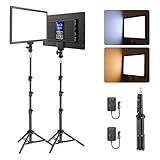
- Top Pick: Neewer 2 Packs Dimmable Bi Color 480 LED Video Light Kit, 3200~5600K CRI 96+ LED Panel with U Bracket, 75 inches Tripod Light Stand for YouTube Recording Studio Photography Streaming Key Lighting
- Best Value: NEEWER Basics 13" LED Video Light Panel, 2 Pack with Tripod Stands, NL-192B
- Premium Choice: NEEWER 13" LED Video Light Panel Kit with Tripod Stand, 2 Pack, NL-192AI
The best bi-color LED panels in 2026 are the Litepanels Gemini 2×1 Soft for large, soft studio sources, the Aputure Nova P300c when you also want RGB control and effects, and the amaran P60x for affordable streaming or small-location work.
- Best bi-color LED panels at a glance
- 1. Litepanels Gemini 2×1 Soft: best for a polished studio look
- 2. Aputure Nova P300c: best for flexible production
- 3. amaran P60x: best value for streaming and small spaces
- 4. Litepanels Gemini 1×1 Soft: best portable professional panel
- How the important specifications affect real results
- Which panel should you buy?
- Final buying advice
As an Amazon Associate we earn from qualifying purchases at no extra cost to you.



Best bi-color LED panels at a glance
| Panel | Best for | Color-temperature range | Power class | Color performance | Power options |
|---|---|---|---|---|---|
| Litepanels Gemini 2×1 Soft | Large studios and interviews | Approximately 2,700–6,000K | Roughly 300W | High CRI/TLCI; broadcast-oriented consistency | AC power and professional battery inputs, depending on configuration |
| Aputure Nova P300c | Studio, commercial, and location production | Approximately 2,000–10,000K | 300W class | High CRI/TLCI with RGBWW color control | AC power and 48V battery operation with suitable accessories |
| amaran P60x | Streaming, talking heads, and compact crews | Approximately 2,500–7,500K | 60W | High CRI/TLCI for its price class | AC adapter or compatible V-mount-style battery solution |
| Litepanels Gemini 1×1 Soft | Portable interviews and news production | Approximately 2,700–6,000K | 150W class | Consistent, broadcast-friendly white light | AC and professional battery power |
These are different tools rather than direct substitutes. A 2×1 panel produces a much larger apparent source than a compact 1×1 or 2×1-foot class panel, so it can create softer facial shadows from the same distance. A smaller panel may have similar electrical efficiency but still look harder because its emitting surface is smaller.
1. Litepanels Gemini 2×1 Soft: best for a polished studio look
The Gemini 2×1 Soft is the strongest choice when the priority is broad, flattering illumination with minimal setup time. Its large diffusion surface is well suited to interviews, corporate video, television, and studio livestreams. It can often be placed close to a subject without producing the narrow, visibly directional look associated with small LED fixtures.
Its bi-color range is aimed at common daylight and tungsten workflows rather than extreme creative color. That is an advantage for productions where repeatable skin tones matter more than RGB effects. The light is also designed for professional control systems, making it easier to match several fixtures across a set.
The main limitation is size. A 2×1 panel needs a strong stand, a wider case, and more transport space than a compact fixture. It is also more expensive than entry-level panels, usually falling in the professional market rather than the budget category. Choose it when the panel will live in a studio or travel as part of a serious interview kit.
2. Aputure Nova P300c: best for flexible production
The Aputure Nova P300c is technically more than a conventional bi-color panel: its RGBWW engine provides tunable white light plus a broad range of color modes. For a buyer comparing the best bi-color LED panels, that makes it useful when a single fixture must cover daylight, tungsten, colored backgrounds, practical-light matching, and in-camera effects.
Its 300W-class output places it well above compact streaming panels. With the included or optional diffusion approach, it can serve as a key light for a medium-sized interview area, an overhead source, or a bounced fill. The trade-off is that diffusion costs output. Removing diffusion increases intensity but produces less flattering shadows, so the fixture is best treated as a powerful source that can be shaped rather than as a permanently soft light.
The P300c supports local controls and professional remote-control workflows, including app-based operation and DMX-oriented setups. That matters when the light is mounted overhead or positioned behind a set. It is also a good choice for location work where a production may need to recreate a look across different rooms and times of day.
3. amaran P60x: best value for streaming and small spaces
The amaran P60x is the practical pick for a desk studio, creator room, small interview setup, or compact two-light kit. Its 60W output is enough for a close key light, especially when the subject is only 0.6–1 meter from the panel and the included softbox is used. It is not a replacement for a 300W panel when lighting a group or pushing light through a large diffusion frame.
The P60x offers a useful bi-color range, onboard controls, app control, and a softbox/grid combination in many kits. The grid is particularly valuable for streaming: it reduces spill onto a nearby wall and helps maintain contrast behind the subject. Without the grid, the softbox gives a broader beam but may flatten a small room by illuminating everything around it.
Its lower power also simplifies heat management and battery use. That makes it easier to mount on a lighter stand, although a sandbag is still advisable. The main compromises are lower output, less robust professional connectivity than cinema-oriented fixtures, and a smaller diffusion face.
4. Litepanels Gemini 1×1 Soft: best portable professional panel
The Gemini 1×1 Soft occupies the middle ground between compact creator lights and large studio panels. It is easier to transport than a 2×1, while its larger surface and professional construction make it more suitable for broadcast, documentary, and corporate production than many budget panels.
Choose the 1×1 when the light must fit through narrow locations, travel in a smaller case, or mount on a stand without the footprint of a 2×1. It is particularly useful as a key, fill, or backlight in a three-point lighting kit. For a large group, however, one 1×1 will not provide the same wrapping coverage as a 2×1 source.
How the important specifications affect real results
Output and diffusion
Compare output only with the same color temperature, beam angle, distance, and diffusion installed. A panel rated for high output may appear less bright after a softbox, grid, or heavy front diffuser removes one or more stops of light. As a practical rule, doubling the distance from the subject reduces illuminance to roughly one quarter. Moving a 60W panel from 1 meter to 2 meters therefore costs far more than its wattage suggests.
For a solo talking-head setup, place a 60W panel about 0.7–1 meter away and expose at a moderate aperture. For a two-person interview or a larger set, a 150W–300W panel gives more room to move the fixture back while keeping the same exposure and softness.
Color temperature
A range around 2,700–6,500K covers most practical interiors, warm household lamps, and daylight windows. A wider range, such as approximately 2,000–10,000K, is helpful for stylized looks and unusual ambient conditions, but the extremes may not deliver the same output or color quality as the middle of the range.
For mixed lighting, measure or identify the dominant source before setting the panel. Start at 3,200K for tungsten fixtures and 5,600K for daylight. If the background is lit by a window and the subject is too blue, do not automatically lower the panel to 3,200K; first determine whether the window, the camera white balance, or a reflective surface is causing the mismatch.
Color accuracy
High CRI and TLCI scores are useful screening metrics, but they do not guarantee identical skin tones between brands. For multi-camera work, matching the same model and firmware across key and fill positions is often more predictable than mixing several highly rated fixtures. Also check green-magenta adjustment. A panel with independent green correction can match older fluorescent fixtures or compensate for a camera-specific tint more effectively than one with temperature control alone.
Controls
Onboard knobs are fastest for a one-light setup. App control is more convenient when the fixture is mounted high or several lights must change together. DMX, wired or wireless, becomes important on a studio set with repeatable scenes. Effects modes are useful for backgrounds, but they should not be the deciding feature if the primary job is accurate, flicker-free white light.
Power options
Estimate battery runtime before choosing a location panel. A simple calculation is:
Runtime in hours ≈ battery watt-hours × 0.8 ÷ light wattage.
The 0.8 factor allows for conversion losses and the fact that batteries should not be completely depleted. A 150Wh battery powering a 60W panel therefore provides about 2 hours:
150 × 0.8 ÷ 60 = 2 hours.
The same battery powering a 300W panel provides only about 24 minutes:
150 × 0.8 ÷ 300 = 0.4 hours.
Actual runtime varies with brightness, battery age, voltage, and whether the battery system can deliver the required current. Confirm the fixture’s connector, voltage, and battery plate requirements rather than assuming that any V-mount battery will work.
Which panel should you buy?
- For a permanent interview or livestream studio: choose the Litepanels Gemini 2×1 Soft if soft coverage and professional consistency matter most.
- For commercial work, music video, or mixed creative lighting: choose the Aputure Nova P300c for its high output, broad white-light range, RGBWW control, and remote operation.
- For a bedroom studio or creator desk: choose the amaran P60x, preferably with its softbox and grid.
- For documentary and corporate location work: choose the Litepanels Gemini 1×1 Soft when portability and dependable color are more important than maximum area coverage.
- For battery-heavy shoots: favor the lower-power P60x or a 1×1-class panel unless the larger fixture’s output is essential.
Final buying advice
Prioritize the physical size of the emitting surface, not just wattage. A large bi-color panel can produce softer light with less modification, while a small panel may need a softbox and a closer position. Then match output to shooting distance, verify the actual battery method, and choose controls that fit the way the light will be operated. For most buyers, the best balance is the amaran P60x for affordability, the Gemini 2×1 Soft for studio softness, and the Nova P300c for maximum production flexibility.
Ready to decide? Our #1 pick for 2026 is the Litepanels Gemini 2×1 Soft.
Live price & availability on Amazon.


Write Your Review
No reviews yet. Be the first to share your experience!