
A stretched or fraying GT2 belt shows up in your prints long before it snaps: layer lines wander, circles turn into ovals, and fine detail softens because the carriage no longer lands where the firmware expects. A fresh belt is one of the cheapest accuracy fixes on a desktop FDM printer, but only if it matches the original profile, width, and pitch, and its core suits your pulley sizes.
- Quick Answer
- How to Choose
- Zeelo 5 Meters GT2 Open Timing Belt
- HANGLIFE GT2 Timing Belt with Copper Buckle
- QCCAN 21-Piece GT2 Timing Belt and Pulley Set
- KeeYees 5M GT2 Timing Belt Kit with Pulleys and Idlers
- Hilitand GT2 Open Timing Belt PU with Steel Core 10M
- Who Should Skip It
- FAQ
- Final Verdict
- Product and ASIN Reference
This guide covers five ways people actually buy GT2 belting: an open roll you cut to length, a shorter roll with copper buckles, a set of ready-made closed loops with pulleys, a complete belt and pulley kit for a rebuild, and a long polyurethane roll with a steel core. Every pick uses the GT2 profile with a 2mm pitch, and most use the common 6mm width.
As an Amazon Associate, we earn from qualifying purchases.
Quick Answer
For most desktop FDM printers, buy a 6mm wide GT2 open belt with a 2mm pitch and fiberglass reinforcement, then cut it to length: the Zeelo 5-meter roll is the straightforward choice. Pick the HANGLIFE belt for factory-style copper buckles, the QCCAN set for ready-made closed loops, and the KeeYees kit when pulleys and idlers are worn too.
How to Choose
Start with profile and pitch. Desktop FDM printers overwhelmingly use the GT2 profile with a 2mm pitch, often marked 2GT on the belt itself. Any other pitch will not mesh with your existing pulleys, so read the markings on the old belt or check the manual before ordering. If the markings are gone, count teeth over a known distance: GT2 teeth sit 2mm apart, center to center.
Width is the second check: most Cartesian machines run 6mm belts, while some larger designs use 9mm or 10mm stock, and a belt that is too narrow wanders in the pulley groove while one that is too wide will not fit the idlers. Measure the old belt with calipers rather than trusting the printer name, because manufacturers have changed widths between revisions.
Next, decide between open and closed-loop belting. Open belt comes on a roll and is cut to the length an axis needs, with the ends secured in a carriage clamp, a printed holder, or a crimped buckle. It suits repairs and scratch builds, since one roll covers several axes and leaves spare material for mistakes. Closed loops are molded endless in fixed lengths, suiting machines designed around a loop, such as some Z drives. There is no clamp joint to flex, but the loop circumference must match your pulley spacing exactly, so measure the loop, not the axis travel.
The reinforcement core matters too. Fiberglass cores are the printer standard: they resist stretching, tolerate small pulley diameters, and flex through constant direction changes. Steel-core polyurethane belts resist elongation on long runs, but steel cords fatigue faster around very small pulleys, so they suit larger pulleys and gentler routing. Never kink a new belt; a sharp fold damages the cords inside. Finally, measure the full belt path, including clamp and tensioner runs, and add spare for trimming.
Zeelo 5 Meters GT2 Open Timing Belt

The Zeelo roll is the default repair belt for a typical FDM printer: 5 meters of open GT2 belting, 6mm wide with a 2mm pitch, in rubber with fiberglass reinforcement. That matches the stock belts on RepRap, Prusa Mendel, Rostock, CR-10, and Ender machines, so most owners get a like-for-like replacement that keeps the original clamps, pulleys, and steps per millimeter unchanged. Five meters re-belts both horizontal axes on a mid-size Cartesian printer and still leaves a spare length for the next fray.
Fiberglass reinforcement keeps elongation low under normal tension, helping accuracy stay consistent from first layer to last, and it tolerates the tight bend around standard 20-tooth drive pulleys. The rounded GT2 teeth seat smoothly, reducing backlash that shows up as ringing or doubled edges. Choose this roll if your pulleys and idlers are still healthy; you will need the printer’s existing clamps or separate clips to terminate the ends, since this is belt material only.
Specs
| Spec | Value |
|---|---|
| Profile | GT2, open-ended |
| Pitch | 2mm |
| Width | 6mm |
| Length | 5 meters |
| Material | Rubber with fiberglass reinforcement |
| Fitment listed | RepRap, Prusa Mendel, Rostock, CR-10, Ender printers |
HANGLIFE GT2 Timing Belt with Copper Buckle
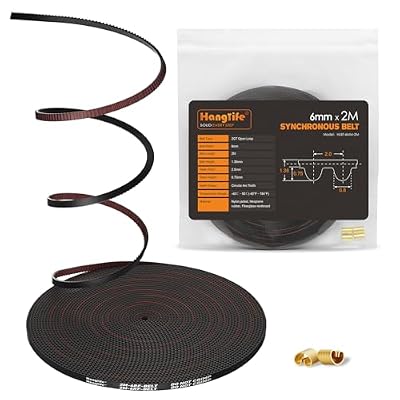
The HANGLIFE belt solves the fiddliest part of a belt swap: terminating the ends. It is a 2-meter length of GT2 belt, 6mm wide with a 2mm pitch, supplied with copper buckles that crimp onto the cut ends. Those buckles hook into common carriage slots and tensioners, suiting Ender-style machines where the stock belt ends are crimped from the factory in exactly this way. At 2 meters, it is sized for a single-axis repair on a typical bedslinger, with a little left to trim.
A crimped buckle beats improvised terminations such as zip ties or folded belt teeth: the crimp spreads the load across the belt end and gives the tensioner a consistent edge to pull against, so the end does not creep as the belt settles. Confirm your carriage accepts a buckled end first, since machines built around toothed clamps may lack the slot a buckle needs.
Specs
| Spec | Value |
|---|---|
| Profile | GT2, open-ended |
| Pitch | 2mm |
| Width | 6mm |
| Length | 2 meters |
| Termination | Copper buckles included |
| Application | 3D printer belt replacement |
QCCAN 21-Piece GT2 Timing Belt and Pulley Set

The QCCAN set takes the opposite approach to a cut-to-length roll. Instead of one long belt, you get eight pre-made closed-loop GT2 belts in assorted lengths, eight 20-tooth pulleys, four tensioner springs, and an Allen wrench, 21 pieces in total. The loops come in 110mm, 112mm, 122mm, 158mm, 200mm, 280mm, 300mm, and 400mm circumferences, all 6mm wide with a 2mm pitch. With no clamped joint, nothing flexes or slips at a termination, and installation is simply slipping the loop over the pulleys; loops in this range suit compact motion systems, short Z drives, and prototyping, where several lengths let you test fit before fixing a pulley spacing.
The bundled pulleys are aluminum alloy with a 20-tooth GT2 profile, and the listing describes a surface oxidation treatment for durability. One detail deserves attention: the listing refers to the pulley bore two ways, mentioning 6mm in one place while the package description lists 5mm bore pulleys. Standard NEMA 17 steppers use 5mm shafts, so verify the bore on the listing before relying on the pulleys. The belts themselves are unambiguous: 6mm wide, 2mm pitch closed loops.
Specs
| Spec | Value |
|---|---|
| Profile | GT2, closed loop |
| Pitch | 2mm |
| Width | 6mm |
| Loop lengths | 110, 112, 122, 158, 200, 280, 300, 400mm |
| Pulleys | 8 pieces, 20 teeth, aluminum alloy |
| Also included | 4 tensioner springs, 1 Allen wrench |
KeeYees 5M GT2 Timing Belt Kit with Pulleys and Idlers

The KeeYees kit is the rebuild option: a 5-meter GT2 belt plus the hardware that wears alongside it. Alongside the open rubber belt, 6mm wide with a 2mm pitch, the box includes four 20-tooth pulleys with 5mm bores, four idlers, four tensioner springs, screws, two mounting blocks, and an Allen wrench. On a printer that has run for years, replacing belt and contact hardware together removes several sources of play in one session.
The drive pulleys are aluminum with dual flanges, a 5mm bore for standard stepper shafts, and a 7mm groove width that takes the 6mm belt with a small margin. The idlers are also 20-tooth aluminum pieces with 5mm bores, so the belt sees a consistent diameter at both ends of the run, keeping tension behavior predictable. Fresh pulleys also stop a new belt wearing unevenly on teeth already polished or nicked by the old one. Choose this kit when a plain belt swap would fix only half the problem: gritty idlers, a loosened pulley, or tired springs.
Specs
| Spec | Value |
|---|---|
| Profile | GT2, open-ended |
| Pitch | 2mm |
| Width | 6mm |
| Length | 5 meters |
| Pulleys | 4 pieces, 20 teeth, 5mm bore, aluminum |
| Also included | 4 idlers, 4 tensioner springs, screws, 2 mounting blocks, Allen wrench |
Hilitand GT2 Open Timing Belt PU with Steel Core 10M

The Hilitand belt is the material outlier here: instead of black rubber with fiberglass cords, it is a white polyurethane belt with a steel core, supplied as a 10-meter open length. It keeps the familiar GT2 dimensions, 6mm wide with a 2mm pitch, so it runs on standard GT2 pulleys, but the construction suits some builds better than others. Ten meters is the workshop option: enough for several full re-belts, a large-format machine, or a small fleet maintained by one person.
The trade-off is bending. Steel cords dislike wrapping around very small pulleys, and repeated tight bends are where this construction ages fastest. On standard 20-tooth pulleys it can serve well, but with especially small drive pulleys or sharp idler turns, a fiberglass-core belt such as the Zeelo or KeeYees options is the safer long-term match. Buy this roll if you specifically want polyurethane and steel, maintain multiple machines, or run long axes where low stretch is the priority.
Specs
| Spec | Value |
|---|---|
| Profile | GT2, open-ended |
| Pitch | 2mm |
| Width | 6mm |
| Length | 10 meters |
| Material | Polyurethane with steel core |
| Color | White |
Who Should Skip It
Skip this whole category if your printer uses a different belt standard. Some machines run GT3 or wider 9mm and 10mm belts, leadscrew-driven axes, or proprietary belt assemblies sold only as complete units, and a 6mm GT2 belt substitutes for none of them. Check the markings on your existing belt first; if it does not say GT2 or 2GT, none of these picks applies.
Also skip the open rolls if you are not comfortable cutting, terminating, and tensioning a belt yourself. A poorly tensioned belt prints worse than a worn one, and a clamp that lets go mid-print can end a long job; a model-specific pre-cut belt is the better spend.
FAQ
How do I know my printer needs a new timing belt?
Look for fraying, missing or rounded teeth, cracks on the belt back, or a belt that keeps losing tension soon after you set it. Print symptoms include shifting layers, oval circles, and inconsistent wall thickness on one axis.
Can I use a 6mm GT2 belt on any FDM printer?
Only on printers designed for it. The belt must match the pulley profile, the 2mm pitch, and the width the idlers and clamps were built for. Many popular machines use exactly this specification, but some use wider belts or a different profile.
How tight should a GT2 belt be?
Tight enough not to sag or skip teeth under a sharp direction change, but not so tight that it strains stepper bearings or bends the shaft. A firm pluck should give a low, clear twang; ringing that suddenly worsens after tensioning usually means you went too far.
Are closed-loop belts better than open belts?
Neither is universally better. Closed loops have no termination joint, removing one flex point, but they only fit the exact pulley spacing they were molded for. Open belts can be cut to any axis and terminated with clamps or buckles, which is why most desktop printers use them.
Final Verdict
For a straightforward repair, the Zeelo 5-meter fiberglass-core roll is the belt most owners should buy: standard dimensions, sensible length, and no hardware you may not need. Choose the HANGLIFE belt for factory-style copper buckles on a single-axis fix, the KeeYees kit when pulleys and idlers are as tired as the belt, and the QCCAN set when your build genuinely uses short closed loops. Keep the Hilitand steel-core roll for long runs and multi-printer workshops, and measure the old belt’s width and pitch before ordering so the replacement drops straight in.
Product and ASIN Reference
| Product | ASIN |
|---|---|
| Zeelo 5 Meters GT2 Open Timing Belt | B0897CJKS1 |
| HANGLIFE GT2 Timing Belt with Copper Buckle | B0D7P77JHJ |
| QCCAN 21-Piece GT2 Timing Belt and Pulley Set | B09X1FN3RC |
| KeeYees 5M GT2 Timing Belt Kit with Pulleys and Idlers | B07JKT5BZQ |
| Hilitand GT2 Open Timing Belt PU with Steel Core 10M | B07BZDM8FH |



Write Your Review
No reviews yet. Be the first to share your experience!