
- Top Pick: ASUS ROG Astral GeForce RTX 5090 32GB GDDR7 OC Edition Gaming Graphics Card
- Best Value: GIGABYTE AORUS GeForce RTX 5090 Master ICE 32G Graphics Card, WINDFORCE Cooling System, 32GB 512-bit GDDR7, GV-N5090AORUSM ICE-32GD Video Card
- Premium Choice: ASUS ROG Astral LC GeForce RTX 5090 32GB GDDR7 OC Edition Gaming Graphics Card
Top Nvidia Rtx 4090 5090 Flagship Picks for 2026
Here are our current top nvidia rtx 4090 5090 flagship picks, compared on real Amazon owner reviews, price, and features. Live prices update below.


Dropped $349.01


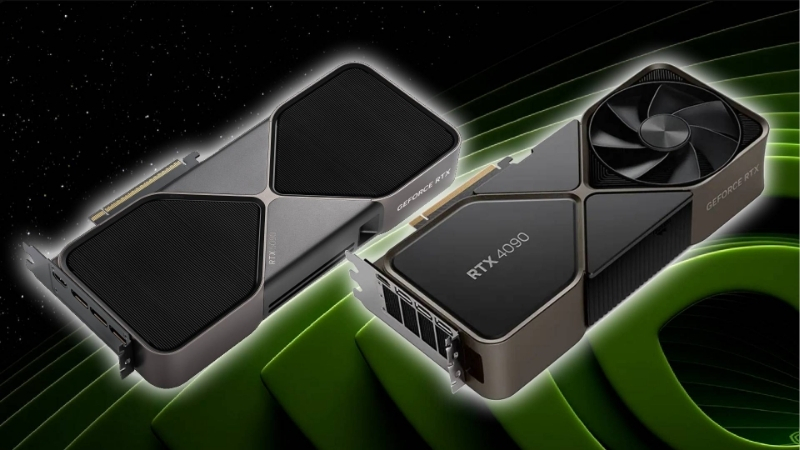
Nvidia RTX 4090 vs 5090 is the ultimate flagship showdown, pitting the reigning Ada champion against Blackwell’s no-limits halo card. The 4090 redefined 4K with 24 GB of GDDR6X; the 5090 raises the bar again with 32 GB of GDDR7 and the DLSS 4 feature stack. This 2026 comparison breaks down the specs, the measured performance gap, the power and value realities, and which flagship deserves your money before the next price increase arrives.
As an Amazon Associate we earn from qualifying purchases at no extra cost to you. Product prices and availability are accurate as of the date shown and are subject to change.



Quick Verdict: Nvidia RTX 4090 vs 5090 at a Glance
Both cards sit at the very top of the consumer stack, so this is less about value and more about how much performance you actually need. The fast answer, full spec sheet, and honest pros and cons are below.
The Fast Answer
The RTX 5090 is the faster card by a clear margin, generally 25 to 35 percent ahead at 4K, with a massive 32 GB buffer and DLSS 4 Multi Frame Generation. For 4K maxed-out gaming, heavy creation, and large AI models, it is the new performance ceiling.
The RTX 4090 remains an elite 4K card and still outperforms everything below the 5090. For many users it delivers more than enough power, and a well-priced 4090 can be the smarter buy if the 5090’s premium and 575 W draw are hard to justify.
If you want the absolute best and the highest VRAM, the 5090 is the answer; if you want flagship 4K performance at a potentially lower cost, the 4090 still delivers. Either way, checking current stock below is worthwhile, as both command premium pricing.
RTX 4090 vs 5090 Specs Comparison
The 5090’s leap is most visible in core count, memory capacity, and bandwidth, all of which scale up substantially.
| Specification | RTX 4090 | RTX 5090 |
|---|---|---|
| Architecture | Ada Lovelace (AD102) | Blackwell (GB202) |
| CUDA Cores | 16,384 | 21,760 |
| Memory | 24 GB GDDR6X | 32 GB GDDR7 |
| Memory Bus | 384-bit | 512-bit |
| Bandwidth | ~1,008 GB/s | ~1,792 GB/s |
| Board Power (TGP) | 450 W | 575 W |
| DLSS Support | DLSS 3 (Frame Gen) | DLSS 4 (Multi Frame Gen) |
| Launch MSRP | $1,599 | $1,999 |
Pros and Cons of Each Card
The 4090 vs 5090 trade-offs are about diminishing returns at the extreme end. Both are exceptional; the question is whether the 5090’s gains are worth its cost and power.
RTX 4090 — Pros: elite 4K performance, 24 GB VRAM, lower 450 W draw than the 5090, strong resale value. Cons: no DLSS 4, large footprint, and prices that have stayed high due to scarcity.
RTX 5090 — Pros: top-tier performance, huge 32 GB GDDR7 buffer, DLSS 4 Multi Frame Generation, ~1.8 TB/s bandwidth. Cons: 575 W power appetite, the highest price in the stack, and steep 2026 Blackwell price pressure.
Deep Dive Face-Off: Nvidia RTX 4090 vs 5090
At this level, raw benchmarks matter less than how the cards behave in your actual workloads and your actual room. The face-off compares them by gaming, setup, and the features that define their longevity.
Gaming Performance and Benchmarks
At 4K, the 5090 pulls ahead by roughly 25 to 35 percent in raster and often more in ray-traced or path-traced titles, where its bandwidth and core count compound. Both cards exceed 60 FPS in nearly everything; the 5090 simply pushes deeper into high-refresh territory.
At 1440p, the two are frequently CPU-limited, so the gap narrows and the 5090’s advantage can shrink to single digits. Below 4K, neither card is being used to its potential, and the 4090 is more than enough.
The analytical reading is that the 5090’s lead is real but most visible at native 4K with maximum settings. If you are not running a high-refresh 4K display, much of that extra power goes unused.
Concrete figures show where the premium lands. In a demanding AAA title at 4K, the 4090 commonly holds 75 to 100 FPS while the 5090 pushes 100 to 130 FPS, and in path-traced games the 5090’s lead can stretch toward 40 percent because its bandwidth and core count compound under heavy ray tracing. With DLSS 4 Multi Frame Generation active, the 5090 can post frame counts the 4090 cannot match in supported titles. At 1440p both cards routinely bump into CPU limits, so the practical lead shrinks to single digits and the 4090 is more than sufficient.
Power, Efficiency, and Real-World Setup
Setup is where the 5090 demands the most planning. Its 575 W board power calls for a 1,000 W or larger power supply and excellent case airflow, and partner cards are physically massive. The 4090’s 450 W is more manageable, though still substantial.
Practically, upgrading from a 4090 to a 5090 may require a power supply review and a check on cooling, as the extra 125 W has to go somewhere. Owners frequently note that the 5090 runs hotter and benefits from a well-ventilated case.
For builders prioritizing simplicity and lower heat output, the 4090 is the easier flagship to live with, while the 5090 rewards a system built around its demands.
The upgrade path deserves a hard look before buying. Moving from a 4090 to a 5090 is not always a simple swap, because the extra 125 W can push a previously comfortable power supply to its limit, and a 1,000 W or larger unit is the safe baseline. Case clearance is the other hurdle, as flagship 5090 partner models are among the largest cards ever sold. Owners upgrading in place frequently report needing a new PSU, additional case fans, or both to keep the 5090 cool and stable, costs that should factor into the comparison.
Features and Future-Proofing
The 5090’s exclusive DLSS 4 Multi Frame Generation is the headline future-proofing feature, capable of multiplying frame rates in supported games beyond what the 4090’s DLSS 3 can achieve. Both cards have outstanding encoders and strong creator capabilities.
The experimental edge worth testing is the 5090’s 32 GB buffer, which opens the door to larger local AI models, 8K editing timelines, and complex 3D scenes that strain even the 4090’s 24 GB. For AI hobbyists and professionals, that extra capacity is the most meaningful difference of all.
For pure gaming, the 4090 will stay relevant for years; for cutting-edge creation and AI, the 5090’s memory and feature set extend its useful life further.
The 32 GB buffer is the clearest forward-looking differentiator. For gamers it is largely insurance, since few titles approach 24 GB today, but for professionals it is transformative: larger language and diffusion models load locally, 8K editing timelines stay responsive, and complex simulations that overflow the 4090’s 24 GB run without compromise. The 5090 also carries Blackwell’s newer media and tensor capabilities, which speed AI-assisted workflows. For a buyer whose work, not just play, justifies the card, that combination is what makes the 5090 worth its premium over the still-excellent 4090.
Pricing, Alternatives, and Final Recommendation
Flagship pricing in 2026 is being shaped by forces beyond Nvidia’s product positioning, and both cards are caught in the same supply squeeze. That context should inform your timing as much as your choice.
How the 2026 Price Surge and H200 News Change the Math
GPU prices are rising in 2026 due to a memory shortage in which advanced memory dominates a card’s cost. The 5090, with its 32 GB of GDDR7, is especially exposed to these increases, and reports suggest premium editions could climb well above its $1,999 launch price as AI demand snaps up high-VRAM cards.
The H200 export approval intensifies the effect. With the U.S. permitting capped H200 sales to China from January 2026, enormous quantities of HBM3E memory are flowing to data-center accelerators, tightening the supply that consumer flagships compete for. High-memory cards like the 5090 feel this pressure first.
For the 4090 vs 5090 decision, the practical conclusion is that both flagships are likely to stay expensive or get more so. A 4090 that has held its value may even be the more stable buy, while a 5090 near MSRP is a window worth acting on quickly.
The figures make the stakes plain. The 5090 launched at $1,999, but with its 32 GB of GDDR7 and AI buyers competing for high-VRAM cards, reports suggest premium editions could climb toward $5,000 over the year. The 4090, at its $1,599 launch price, has held remarkably firm and in many cases trades above it. Neither flagship is following the usual path of getting cheaper, so the patient-buyer strategy that works in normal cycles backfires here. If a particular card fits your workload and appears near its real MSRP, that listing is the opportunity, not a baseline to wait out.
The Alternative if Both Are Too Expensive
If both flagships are out of reach, the RTX 5080 is the sensible step down. It offers 16 GB of GDDR7 and DLSS 4 at a much lower price, delivering strong 4K performance without halo-card cost or power draw.
For creators who need VRAM more than peak frame rates, a used 4090 at a fair price can be the value play, pairing 24 GB with proven performance that still beats everything outside the 5090.
There is also a timing-based alternative: waiting for a specific 5090 partner model rather than buying the first one in stock. Because availability is uneven, the gap between a reasonably priced 5090 and a wildly marked-up one can be enormous, so patience aimed at finding a fair-priced unit, rather than patience hoping for an overall price drop, is the version of waiting that actually pays off. For buyers who do not strictly need 32 GB, stepping down to a 5080 or holding a 4090 avoids that lottery entirely while still delivering excellent 4K performance, which is often the most sensible financial decision at this tier.
Final Verdict: Who Should Buy Which
Buy the RTX 4090 if you want elite 4K gaming and creator performance at a potentially lower price and power draw, and you do not specifically need DLSS 4 or 32 GB of VRAM.
Buy the RTX 5090 if you demand the absolute maximum, run high-refresh 4K, or work with large AI models and complex 3D scenes that benefit from its 32 GB buffer. It is the no-compromise choice for those who can justify the cost.
When you have decided which flagship fits, check the latest price and availability below before the next increase reshapes the Nvidia RTX 4090 vs 5090 landscape.
See More:
Conclusion
The Nvidia RTX 4090 vs 5090 showdown comes down to how much performance you truly need: the 4090 remains an elite 4K and creator card, while the 5090 sets a new ceiling with 32 GB of GDDR7 and DLSS 4. With the 2026 memory shortage and the H200 export shift driving prices upward, the smart move is to choose the flagship that matches your workload and secure it at today’s price rather than waiting for relief the market is unlikely to deliver.
Frequently Asked Questions
What is the best nvidia rtx 4090 5090 in 2026?
The best nvidia rtx 4090 5090 depends on your budget and how you plan to use it. The options compared above are our top-rated picks based on real customer ratings, build quality, and overall value — start with the highest-rated model that fits your budget.
How much should I expect to spend on a nvidia rtx 4090 5090?
Prices vary by brand and features. Budget options cover the essentials, while mid-range and premium models add durability, performance, and extra features. Compare the prices in the list above to find the best value for your needs.
What should I look for when buying a nvidia rtx 4090 5090?
Focus on what matters most for your use case — build quality, compatibility, performance, warranty, and verified customer reviews. Every pick above is selected to balance these factors.
Are budget nvidia rtx 4090 5090 options worth it?
Yes. For most people a well-reviewed budget or mid-range nvidia rtx 4090 5090 delivers excellent value. You only need to spend more if you specifically require premium materials or top-tier performance.
How did we choose these nvidia rtx 4090 5090 picks?
We compare current Amazon ratings, review counts, key features, and price to surface the options with the best real-world value. The list is refreshed as ratings and availability change.






Write Your Review
No reviews yet. Be the first to share your experience!