
- Top Pick: Nvidia GeForce GTX 1080 8GB FE Founders Edition GDDR5X Video Graphics Card (Renewed)
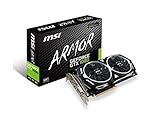
- Best Value: MSI Gaming GeForce GTX 1080 8GB GDDR5X SLI DirectX 12 VR Ready Graphics Card (GTX 1080 ARMOR 8G OC) (Renewed)
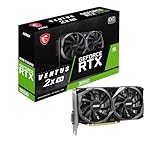
- Premium Choice: MSI Geforce RTX 3050 Ventus 2X Xs 8G Oc Graphics Card Nvidia 8, W128564415 (8G Oc Graphics Card Nvidia 8 Gb Gddr6)
The newer RTX 3050 8GB is actually slower than the GTX 1080 in traditional rasterized games, by about 5-15% depending on the review. So for raw frame rates on a tight used budget the GTX 1080 still wins. The RTX 3050 is the better long-term buy for anyone who wants DLSS, ray tracing, lower power draw and ongoing Game Ready driver support. In short, the 1080 is the cheap used choice for older and esports titles, and the 3050 is the safer choice for new games through upscaling and for a warranty.
- A 2016 Flagship Against a 2022 Budget Card
- Specifications Compared
- Raster Performance: The Old Card Holds On
- Where the RTX 3050 Pulls Ahead
- Power, PSU and Platform Considerations
- Cost per Frame: Launch and Today
- Video Encoding, Displays and Everyday Use
- Used GTX 1080 Buying Checklist
- Decision Table
- Frequently Asked Questions
As an Amazon Associate we earn from qualifying purchases at no extra cost to you.

A 2016 Flagship Against a 2022 Budget Card
The GTX 1080 launched in May 2016 at $599 as NVIDIA’s top Pascal gaming card. The RTX 3050 8GB arrived in January 2022 at $249 as the entry point to Ampere’s RTX lineup. Six years of progress let NVIDIA match most of the 1080’s performance at under half the launch price and with 50 W less power. It didn’t fully catch up, though. The old card’s wider 256-bit memory bus still gives it an edge in bandwidth-heavy scenes.
Specifications Compared
| Specification | GeForce GTX 1080 | GeForce RTX 3050 8GB |
|---|---|---|
| Architecture / process | Pascal, 16 nm | Ampere, 8 nm |
| Release date | 27 May 2016 | 4 January 2022 |
| Launch MSRP | $599 | $249 |
| CUDA cores | 2,560 | 2,560 |
| Boost clock | 1,733 MHz | 1,777 MHz |
| Memory | 8 GB GDDR5X | 8 GB GDDR6 |
| Bus / bandwidth | 256-bit / 320 GB/s | 128-bit / 224.0 GB/s |
| L2 cache | 2 MB | 2 MB |
| TDP | 180 W | 130 W |
| Power connector | 1x 8-pin | 1x 8-pin |
| Interface | PCIe 3.0 x16 | PCIe 4.0 x8 |
| Length / slots | 267 mm / 2-slot | 242 mm / 2-slot |
| Outputs | DisplayPort 1.4, HDMI 2.0b, DL-DVI | 1x HDMI 2.1, 3x DisplayPort 1.4a |
The core counts match, but the cores aren’t equivalent. Ampere counts its doubled FP32 units differently from Pascal, so 2,560 Ampere cores don’t equal 2,560 Pascal cores in games. The more telling figure is bandwidth: the GTX 1080 has about 43% more (320 vs 224 GB/s), and that shows up at higher resolutions.
Raster Performance: The Old Card Holds On
TechSpot (Hardware Unboxed’s written outlet) ran a direct GTX 1080 vs RTX 3050 comparison and found the 3050 about 6% slower overall at 1080p. Results varied widely by game. The 3050 pulled ahead in a few newer DX12 titles such as Cyberpunk 2077, while the GTX 1080 led by over 50% in God of War. Aggregate benchmark databases put the 1080’s lead at roughly 10-20%, and the gap tends to grow at 1440p, where the 1080’s bandwidth matters more.
Roughly speaking, both cards run most current games at 1080p on medium-to-high settings somewhere in the 45-75 fps range, and esports titles well above 100 fps. Actual numbers depend heavily on the game, settings, CPU and driver version. Neither is a good 1440p card for new AAA releases without lowering settings substantially.
Where the RTX 3050 Pulls Ahead
DLSS upscaling
This is the 3050’s biggest advantage. It supports DLSS Super Resolution, including the newer transformer model, which lets a 1080p game render internally at a lower resolution and reconstruct a sharp image. In supported games, DLSS Quality or Balanced mode can turn the 1080’s small raster lead into a clear 3050 win at similar image quality. The GTX 1080 can’t run DLSS. It can use FSR 2/3 or XeSS in DP4a mode, which help but generally look softer at the same internal resolution.
Ray tracing
The 3050 has hardware RT cores and the GTX 1080 doesn’t. Ray tracing on the 3050 is light-duty, practical only at 1080p with DLSS and low RT settings. But a growing number of games list RT-capable hardware as a requirement or default to RT lighting, and Pascal is shut out of those.
Driver support
NVIDIA ended Game Ready driver updates for Maxwell and Pascal GPUs after its 580 driver branch in late 2025. Security updates are scheduled to continue into 2028. A GTX 1080 will keep running existing games, but new releases won’t get day-one optimizations for it. The RTX 3050 remains on the main driver branch.
Power, PSU and Platform Considerations
Both cards use a single 8-pin connector, so neither needs special cabling. PSU sizing with the usual formula of GPU TDP + CPU + about 150 W headroom:
- GTX 1080: 180 W + 95 W (a mainstream 6-core CPU) + 150 W = 425 W, so a quality 450-550 W unit works.
- RTX 3050 8GB: 130 W + 95 W + 150 W = 375 W, so a good 400-450 W unit is enough.
The 3050’s PCIe 4.0 x8 link is worth noting. In an older PCIe 3.0 board it runs at 3.0 x8. Because the card has 8 GB of VRAM, the loss is usually small, a few percent in most reviews, but it’s not zero. The GTX 1080 uses a full x16 link and has no such issue. For case fit, the 3050’s 242 mm reference length is the easier fit, and many partner 3050s are even shorter, single-fan designs that suit compact builds.
Cost per Frame: Launch and Today
At launch, with the GTX 1080 at 100 on a raster performance index and the RTX 3050 at about 90, the cost per point was $5.99 for the 1080 ($599 / 100) and $2.77 for the 3050 ($249 / 90). The 3050 was more than twice the value at its own launch, which is what six years of progress should look like.
Prices today flip that comparison. A used GTX 1080 usually sells for around $80-$120, while a used RTX 3050 8GB typically runs $130-$170, with new stock costing more. On a used-to-used basis, the 1080 delivers more raster frames per dollar. The 3050 earns its premium only if you use DLSS, want lower power draw or need warranty coverage.
Video Encoding, Displays and Everyday Use
Streamers and video editors should look at the encoder as well as the frame rate. The RTX 3050 uses NVIDIA’s newer Turing/Ampere-generation NVENC, which produces noticeably cleaner H.264 and HEVC streams at the same bitrate than Pascal’s encoder. That makes it the better pick for streaming to Twitch or YouTube from the same PC you game on. Neither card can hardware-encode AV1; that arrived with RTX 40. The 3050 also supports NVIDIA Broadcast features such as background noise removal, which use the Tensor cores that Pascal lacks.
The displays you can drive differ too. The 3050’s HDMI 2.1 port handles 4K at 120 Hz on modern TVs, which is useful for couch gaming with lighter titles. The GTX 1080’s HDMI 2.0b tops out at 4K 60 Hz, though its DisplayPort output still handles high-refresh 1440p monitors. The dual-link DVI port on the 1080 is a small bonus for anyone still using an older 1440p DVI-only panel.
Used GTX 1080 Buying Checklist
- Ask for a stress test video showing stable temperatures and no artifacts.
- Expect to replace thermal paste and possibly thermal pads on a card this old.
- Check that the fans spin up smoothly without grinding. Replacement fans are available but add hassle.
- Note the outputs: no HDMI 2.1, so 4K at 120 Hz over HDMI isn’t possible, and newer TVs may need DisplayPort adapters.
Decision Table
| Buyer profile | Pick | Why |
|---|---|---|
| Esports and older games at 1080p, minimum spend | GTX 1080 (used) | Higher raster frames per dollar |
| New AAA releases at 1080p | RTX 3050 8GB | DLSS support and current drivers |
| Wants to try ray tracing | RTX 3050 8GB | Only card here with RT cores |
| Small or low-power build | RTX 3050 8GB | 130 W, shorter card, smaller PSU |
| Older PCIe 3.0 platform, no upscaling | GTX 1080 | Full x16 link and more bandwidth |
| Budget closer to $250 | Neither | Arc B570 or RTX 5050-class cards offer more for new money |
Frequently Asked Questions
Is the RTX 3050 8GB faster than the GTX 1080?
Not in native rasterized games. Published reviews put the GTX 1080 roughly 5-15% ahead on average, more in some titles. The RTX 3050 can come out ahead when DLSS is enabled.
Does the GTX 1080 still get driver updates?
NVIDIA ended Game Ready drivers for Pascal cards after the 580 driver branch in late 2025. Quarterly security updates are planned to continue until about 2028. New games will still run, but they won’t be specifically optimized for Pascal.
Can the GTX 1080 use DLSS?
No. DLSS requires the Tensor cores found on RTX cards. The GTX 1080 can use FSR 2/3 and XeSS in its DP4a mode where games support them.
What PSU do I need for either card?
A quality 450 W unit is generally enough for an RTX 3050 8GB system, and 500-550 W gives a GTX 1080 system comfortable headroom. Both need one 8-pin PCIe connector. Use a known-brand PSU rather than an unbranded one.
Is 8 GB of VRAM enough on either card?
For 1080p at medium-to-high settings, 8 GB still works in most games. Some newer releases need reduced texture settings to avoid stutter. Both cards have the same 8 GB, so VRAM doesn’t separate them.
Ready to decide? Our #1 pick for 2026 is the Architecture / process.
Live price & availability on Amazon.










Write Your Review
No reviews yet. Be the first to share your experience!