
Pick the RX 6950 XT if you mostly play rasterized games at 1080p or 1440p, where Hardware Unboxed measured it roughly 10-23% faster than the RTX 3080 Ti, and it also brings 16 GB of VRAM; pick the RTX 3080 Ti if ray tracing, DLSS or 4K matter more, since it leads clearly with RT enabled and pulls roughly even at 4K.
As an Amazon Associate we earn from qualifying purchases at no extra cost to you.



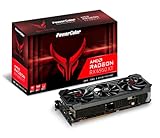
Late-Generation Rivals
These two cards were each vendor’s answer to the high end of 2021-2022. NVIDIA launched the RTX 3080 Ti in May 2021 at $1,199, a near-RTX 3090 with 12 GB of GDDR6X. AMD followed in May 2022 with the RX 6950 XT at $1,099, a refreshed RX 6900 XT with faster memory and higher clocks, the final and fastest RDNA 2 card.
Both are now two generations behind. NVIDIA’s current line is RTX 50 and AMD’s is RX 9000, where the RX 9070 XT and RTX 5070 Ti occupy a similar performance band at much lower power. In the used market, though, the 3080 Ti and 6950 XT remain popular high-end options, and they split wins in an interesting way.
Specification Table
| Specification | RTX 3080 Ti | RX 6950 XT |
|---|---|---|
| Architecture | Ampere | RDNA 2.0 |
| Release date | 31 May 2021 | 10 May 2022 |
| Launch MSRP | $1,199 | $1,099 |
| Shader cores | 10240 CUDA | 5120 stream processors |
| Boost clock | 1665 MHz | 2324 MHz |
| Process | 8 nm | 7 nm |
| Memory | 12 GB GDDR6X | 16 GB GDDR6 |
| Bus / bandwidth | 384-bit / 912.4 GB/s | 256-bit / 576.0 GB/s |
| Cache | 6 MB L2 | 4 MB L2 + 128 MB L3 |
| Interface | PCIe 4.0 x16 | PCIe 4.0 x16 |
| Board power | 350 W | 335 W |
| Power connectors | 1x 12-pin (Founders Edition) | 2x 8-pin |
| Length / width (reference) | 285 mm / 2-slot | 267 mm / 3-slot |
| Outputs | 1x HDMI, 3x DisplayPort | 1x HDMI 2.1, 2x DP 1.4a |
The architectures take different routes to bandwidth. NVIDIA uses a wide 384-bit bus with fast GDDR6X; AMD uses a narrower 256-bit bus with 128 MB of Infinity Cache. The cache works best at lower resolutions, which explains why the 6950 XT’s lead shrinks at 4K.
Performance Breakdown
1080p and 1440p raster
In Hardware Unboxed/TechSpot’s RX 6950 XT launch review, the AMD card was about 23% faster than the RTX 3080 Ti at 1080p and about 11% faster at 1440p across their game suite, where it matched the much pricier RTX 3090 Ti. Other aggregate sources differ, with some showing the cards closer, so a fair summary is that the 6950 XT is typically 5-15% faster at 1440p and more at 1080p in rasterized games.
4K raster
At 4K, the same review noted the RTX 3080 Ti closing in on the 6950 XT. With the Infinity Cache hit rate dropping at higher resolutions, the 3080 Ti’s raw bandwidth helps, and the two are roughly even at 4K, with some game suites favoring NVIDIA by a few percent.
Ray tracing
The RTX 3080 Ti is the clear winner once ray tracing is enabled. Ampere’s second-generation RT cores handle ray-traced effects much more efficiently than RDNA 2’s first-generation ray accelerators. Review data from TechPowerUp and Hardware Unboxed typically shows the 3080 Ti ahead by roughly 20-40% in ray-traced games, and by more in heavy path-traced modes, where the 6950 XT falls well behind.
Frame rates in specific games vary widely with settings, CPU and patch level. As a loose example, a ray-traced title running around 60 fps at 1440p with upscaling on a 3080 Ti might run around 45 fps on a 6950 XT, while a rasterized game at 1440p high might show the reverse, with the 6950 XT ahead.
DLSS, FSR and Frame Generation
The RTX 3080 Ti supports DLSS Super Resolution, including the DLSS 4 transformer model, which typically delivers sharper and more stable image quality than FSR at the same internal resolution. It does not support DLSS Frame Generation, which requires RTX 40 or RTX 50 hardware, but it can use FSR 3 frame generation where games offer it.
The RX 6950 XT uses FSR up to 3.1, including frame generation in supported games, and AMD Fluid Motion Frames at the driver level. FSR 4 officially targets RX 9000 cards. AMD moved RX 6000 cards to a separate driver branch in late 2025, and confirmed they continue to receive game support and optimizations.
The DLSS image quality advantage matters more as you go up in resolution: at 4K with upscaling, the 3080 Ti often delivers a better-looking image at similar frame rates.
VRAM and Long-Term Headroom
The 6950 XT’s 16 GB is a practical advantage. Recent demanding games at 4K with ultra textures and ray tracing can exceed 12 GB, and in those cases the 3080 Ti may require lowering texture quality. At 1440p, 12 GB is generally sufficient. For a card you plan to keep several years, the extra 4 GB on the AMD card is a meaningful buffer.
PSU, Connectors and Case Clearance
Both cards are power hungry. The 3080 Ti is rated at 350 W and the 6950 XT at 335 W.
- RTX 3080 Ti with a 125 W gaming CPU: 350 + 125 + 150 headroom = 625 W, so a 750 W unit is recommended.
- RX 6950 XT with a 125 W gaming CPU: 335 + 125 + 150 headroom = 610 W, so a 750 W unit is also the safe target, especially for factory-overclocked partner cards.
Connector requirements: the 3080 Ti Founders Edition uses a 12-pin connector with an adapter, and partner 3080 Ti cards generally use two or three 8-pin connectors. The reference 6950 XT uses two 8-pin connectors, with some partner models using three.
Size: the reference 6950 XT is 267 mm long but three slots thick, while the 3080 Ti Founders Edition is 285 mm long and two slots thick. Partner versions of both often exceed 300 mm. Check both length and slot clearance, especially in cases with vertical mounts or tight bottom spacing.
Used-Market Value
At launch, the 6950 XT was $100 cheaper and faster in raster, making it the better rasterization value. Normalizing the 3080 Ti to 100 points at 1440p raster and the 6950 XT to about 110, cost per point was about $12.00 for the 3080 Ti and $10.00 for the 6950 XT.
Used, the RTX 3080 Ti typically sells in the $350-$450 range and the RX 6950 XT in the $350-$450 range as well, so prices are often close. With pricing near parity, the decision comes down to whether ray tracing and DLSS or raster speed and VRAM matter more to you.
When buying either used, check for mining history, GDDR6X memory temperatures on the 3080 Ti, hotspot temperatures on the 6950 XT and fan condition on both.
Who Should Buy Which
| Player type | Better card |
|---|---|
| 1080p/1440p high-refresh competitive gamer | RX 6950 XT |
| Ray tracing and path tracing enthusiast | RTX 3080 Ti |
| 4K player relying on upscaling | RTX 3080 Ti |
| Heavy texture mods, long ownership | RX 6950 XT |
| Streamer wanting a mature hardware encoder | RTX 3080 Ti |
| Case limited to two slots | RTX 3080 Ti (Founders Edition) |
Verdict
The RX 6950 XT is the better rasterization card at 1080p and 1440p and carries more VRAM, while the RTX 3080 Ti wins in ray tracing, upscaling quality and 4K scaling. Neither is a bad choice at similar used prices; the deciding factor is whether ray-traced games and DLSS are central to how you play.
Frequently Asked Questions
Is the RX 6950 XT faster than the RTX 3080 Ti?
In rasterized games at 1080p and 1440p, usually yes; Hardware Unboxed measured the 6950 XT about 11% faster at 1440p and 23% faster at 1080p at launch. At 4K the two are roughly even. With ray tracing enabled, the 3080 Ti is clearly faster.
Which card is better for ray tracing?
The RTX 3080 Ti. Its second-generation RT cores and DLSS support give it a lead of roughly 20-40% in ray-traced games, and more in path-traced modes. The 6950 XT’s first-generation ray accelerators fall behind in heavy RT workloads.
Is 12 GB on the RTX 3080 Ti enough?
It is enough for 1440p in nearly all current games. At 4K with maximum textures and ray tracing, a few demanding titles can exceed 12 GB, requiring texture settings to be lowered. The 6950 XT’s 16 GB offers more headroom.
What power supply do these cards need?
A quality 750 W power supply is a sensible target for either card with a typical gaming CPU. Both are rated around 335-350 W and can spike higher. Partner cards with three 8-pin connectors may benefit from 850 W.
Should I buy a current card instead?
Current cards like the RX 9070 XT or RTX 5070 Ti deliver comparable or better performance with lower power draw, newer upscaling and warranty coverage. They usually cost more than a used 3080 Ti or 6950 XT, so the older cards make sense mainly at clearly lower prices.
Ready to decide? Our #1 pick for 2026 is the Architecture.
Live price & availability on Amazon.










Write Your Review
No reviews yet. Be the first to share your experience!