
- Top Pick: EVGA GeForce RTX 2080 Ti Black Edition Gaming, 11GB GDDR6, Dual HDB Fans & RGB LED Graphics Card 11G-P4-2281-KR (Renewed)
- Best Value: GIGABYTE GeForce RTX 2080 Ti Gaming OC 11GB Graphic Cards GV-N208TGAMING OC-11GC (Renewed)
- Premium Choice: Gigabyte GeForce RTX 4060 WINDFORCE OC 8G Graphics Card, 2X WINDFORCE Fans, 8GB 128-bit GDDR6, GV-N4060WF2OC-8GD Video Card
The older RTX 2080 Ti is the faster card, roughly 13-25% ahead at 1080p and 1440p and further ahead at 4K, so it is the better pick for raw performance and VRAM if you can find a healthy used one at a fair price; the newer RTX 4060 is the better choice for efficient, quiet 1080p builds that benefit from DLSS Frame Generation and a 115 W power draw. Despite being two generations newer, the RTX 4060 is not an upgrade over an RTX 2080 Ti.
As an Amazon Associate we earn from qualifying purchases at no extra cost to you.

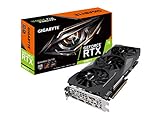

Old Flagship vs New Mainstream
The RTX 2080 Ti was NVIDIA’s top consumer gaming card of the Turing generation, with a huge 352-bit memory bus and 11 GB of VRAM. The RTX 4060 is an entry-to-midrange Ada Lovelace card built for efficiency: fewer CUDA cores, a narrow 128-bit bus, 8 GB of VRAM and a large 24 MB L2 cache. Ada’s architecture and high clocks close much of the gap, but not all of it.
| Specification | GeForce RTX 2080 Ti | GeForce RTX 4060 |
|---|---|---|
| Architecture | Turing | Ada Lovelace |
| Release date | 20 September 2018 | 18 May 2023 |
| Launch MSRP | $999 | $299 |
| CUDA cores | 4352 | 3072 |
| Boost clock | 1545 MHz | 2460 MHz |
| Process | 12 nm | 5 nm |
| Power (TDP) | 250 W | 115 W |
| Memory | 11 GB GDDR6 | 8 GB GDDR6 |
| Memory bus | 352-bit | 128-bit |
| Memory bandwidth | 616.0 GB/s | 272.0 GB/s |
| L2 cache | 5.5 MB | 24 MB |
| Interface | PCIe 3.0 x16 | PCIe 4.0 x8 |
| Power connectors | 2x 8-pin | Single 8-pin on most retail cards |
| Length / width | 267 mm / 2-slot | 240 mm / 2-slot |
| Display outputs | 1x HDMI 2.0, 3x DisplayPort 1.4a, 1x USB Type-C | 1x HDMI 2.1, 3x DisplayPort 1.4a |
Spec listings sometimes show a 12-pin connector for the RTX 4060, but retail RTX 4060 cards almost all use one standard 8-pin plug, and a few low-power models use even less.
Gaming Benchmarks
Rasterized performance
According to Tom’s Hardware’s 2022-2024 GPU hierarchy, the RTX 2080 Ti leads the RTX 4060 by about 6% at 1080p medium, about 13% at 1080p ultra, roughly 24% at 1440p ultra and around 36% at 4K ultra. TechPowerUp’s RTX 4060 review placed the newer card at roughly RTX 2080 level, which is a step below the 2080 Ti. Benchmark aggregators report a 10-33% gap depending on the game sample, so the direction is consistent across sources: the older card is faster, and the gap grows with resolution.
Roughly speaking, a game averaging in the mid-80s fps on an RTX 4060 at 1080p ultra tends to run in the mid-90s on an RTX 2080 Ti. At 1440p ultra, low-60s fps on the RTX 4060 becomes mid-70s on the RTX 2080 Ti. These approximate ranges vary with game, settings, CPU and driver version.
Ray tracing
The RTX 4060 has newer third-generation RT cores, but the RTX 2080 Ti’s larger chip still wins. Tom’s Hardware’s ray tracing results put the RTX 2080 Ti about 22% ahead at 1080p ultra and about 28% ahead at 1440p ultra. Neither card is suited to heavy ray tracing without upscaling.
Where the RTX 4060 Fights Back
DLSS Frame Generation
Both cards support DLSS 4 Super Resolution with the transformer model and NVIDIA Reflex. Only the RTX 4060 supports DLSS Frame Generation, which can raise displayed frame rates well above the RTX 2080 Ti’s in supported games. Multi Frame Generation is limited to the RTX 50 series, so neither card gets it. Frame generation adds latency and works best from a base of around 50-60 fps, so it complements rather than replaces raw performance.
Efficiency and noise
At 115 W versus 250 W, the RTX 4060 uses less than half the power. That means smaller coolers, quieter operation and less heat dumped into the case. Over time it also saves money: a 135 W difference at three hours of gaming per day comes to roughly 148 kWh per year, or about $25 at $0.17 per kWh.
Modern media engine
The RTX 4060’s encoder supports AV1, which the RTX 2080 Ti lacks. For streamers and anyone recording gameplay on platforms that accept AV1, that is a real quality-per-bitrate advantage. The RTX 4060 also has HDMI 2.1 output.
VRAM: 11 GB Beats 8 GB
The RTX 2080 Ti’s 11 GB buffer gives it more room in modern games. Many 2025-2026 titles use more than 8 GB at 1080p ultra textures and especially at 1440p. On the RTX 4060, those games may stutter or require lowering texture quality, while the RTX 2080 Ti usually handles them at 1440p high. Tom’s Hardware’s 2026 ray tracing results also show 8 GB cards falling off sharply at higher resolutions. For long-term use at 1440p, 11 GB is the safer amount of the two.
Power Supply, PCIe Link and Fit
Using GPU power plus CPU power plus about 150 W of headroom:
- RTX 2080 Ti: 250 W + 125 W + 150 W = about 525 W, so a quality 600-650 W unit (NVIDIA recommended 650 W).
- RTX 4060: 115 W + 125 W + 150 W = about 390 W, so 450-550 W (NVIDIA recommends 550 W).
The RTX 2080 Ti needs two 8-pin connectors, while the RTX 4060 usually needs one. On PCIe 3.0 motherboards, the RTX 4060 runs at PCIe 3.0 x8, which typically costs a little performance and more when VRAM overflows; the RTX 2080 Ti’s full x16 link avoids that. Both are dual-slot cards, and the 240 mm RTX 4060 is slightly shorter than the 267 mm RTX 2080 Ti, with many compact single- and dual-fan RTX 4060 models available for small cases.
Price per Frame on the Used Market
Launch prices ($999 versus $299) no longer apply to the RTX 2080 Ti. Broad typical ranges today are roughly $250-$330 used for an RTX 2080 Ti and roughly $200-$250 used for an RTX 4060, with new RTX 4060 stock usually a bit higher. Working at 1440p with the RTX 2080 Ti about 24% faster:
- RTX 2080 Ti at $290: $290 / 1.24 = about $234 per RTX 4060-equivalent unit of performance
- RTX 4060 at $240: $240 per unit
In other words, the two are close to even on price per frame at typical used prices. The RTX 2080 Ti gives more speed and VRAM; the RTX 4060 gives efficiency, frame generation and usually a newer, less worn card.
Pick X If, Pick Y If
| Pick the RTX 2080 Ti if… | Pick the RTX 4060 if… |
|---|---|
| You play at 1440p and want the most native performance. | You play at 1080p and value DLSS Frame Generation. |
| You want more than 8 GB of VRAM on a budget. | Your PSU is 450-550 W or your case is small. |
| Your motherboard is PCIe 3.0. | You stream and want AV1 encoding. |
| You can inspect or test the used card before buying. | You prefer a newer card, possibly with warranty. |
Also note that both are previous-generation or older. The RTX 5060, which replaced the RTX 4060 at a similar launch price, adds Multi Frame Generation, and the RTX 5060 Ti 16GB offers more VRAM, so compare those before buying either.
Frequently Asked Questions
Is the RTX 4060 better than the RTX 2080 Ti?
Not in raw performance. Tom’s Hardware’s data puts the RTX 2080 Ti about 13% ahead at 1080p ultra and about 24% ahead at 1440p ultra. The RTX 4060 wins on power efficiency and DLSS Frame Generation support.
Can the RTX 2080 Ti use DLSS 4?
It supports DLSS 4 Super Resolution with the transformer model, as every RTX card does. It cannot use DLSS Frame Generation or Multi Frame Generation. In games that include FSR 3 frame generation, that is an alternative.
Is 8 GB of VRAM on the RTX 4060 a problem?
At 1080p with high settings, it is usually fine. Some recent games exceed 8 GB at ultra textures or 1440p, which causes stutter. The RTX 2080 Ti’s 11 GB gives more margin.
Do I need to upgrade my PSU for an RTX 2080 Ti?
Possibly, if you are coming from a low-power card. NVIDIA recommended a 650 W power supply with two 8-pin connectors. The RTX 4060 works with 550 W and usually a single 8-pin.
What should I check when buying a used RTX 2080 Ti?
Check temperatures and fan noise under load, look for artifacts in a stress test, and ask about its history. Many units are seven or more years old, so thermal paste and pads may need replacing. A seller who allows returns lowers the risk.
Which card runs cooler and quieter?
The RTX 4060 in most cases, because it draws less than half the power of the RTX 2080 Ti. Many RTX 4060 models stay quiet even under sustained load. An RTX 2080 Ti with a large partner cooler can also be quiet, but it releases far more heat into the case.
Ready to decide? Our #1 pick for 2026 is the Architecture.
Live price & availability on Amazon.









Write Your Review
No reviews yet. Be the first to share your experience!