
- Top Pick: ASUS TUF Gaming NVIDIA GeForce RTX 4080 Super OC Edition Gaming Graphics Card (PCIe 4.0, 16GB GDDR6X, HDMI 2.1a, DisplayPort 1.4a), 3 Year Warranty
- Best Value: ASUS ROG Astral LC GeForce RTX 5090 32GB GDDR7 OC Edition Gaming Graphics Card
- Premium Choice: ASUS ROG Astral GeForce RTX 5090 32GB GDDR7 OC Edition Gaming Graphics Card
Top Rtx 4080 Super 5090 Halo Picks for 2026
Here are our current top rtx 4080 super 5090 halo picks, compared on real Amazon owner reviews, price, and features. Live prices update below.
- Top Rtx 4080 Super 5090 Halo Picks for 2026
- The Quick Verdict: 4080 Super vs 5090 in 30 Seconds
- Deep Dive: Measuring What the Canyon’s Width Buys
- 2026 Market Forces: The Halo Premium and the Survivor’s Floor
- Final Verdict: Pros, Cons, and the Sane Middle
- Conclusion
- Related Guides
- Frequently Asked Questions
- Related Articles


4080 super vs 5090 spans the widest canyon in Nvidia’s lineup: on one rim, the Ada generation’s $999 refresh — discontinued, trading at $700–$850, still benchmarking like the high-end card it was built to be; on the other, the $1,999 Blackwell halo card with 32GB of GDDR7, a 575W appetite, and the unapologetic mission of being the fastest consumer GPU on Earth. More than double the money separates them in 2026’s market, and the question buyers actually face is whether the halo’s stratosphere — 60–75% more performance, triple-digit bandwidth gains, the complete DLSS 4 arsenal — translates into experiences a high-refresh 4K panel can display, or whether the canyon’s far rim is a destination only creators and AI workloads genuinely need. This comparison measures the canyon honestly, in frames, watts, dollars, and use cases.
As an Amazon Associate we earn from qualifying purchases at no extra cost to you.


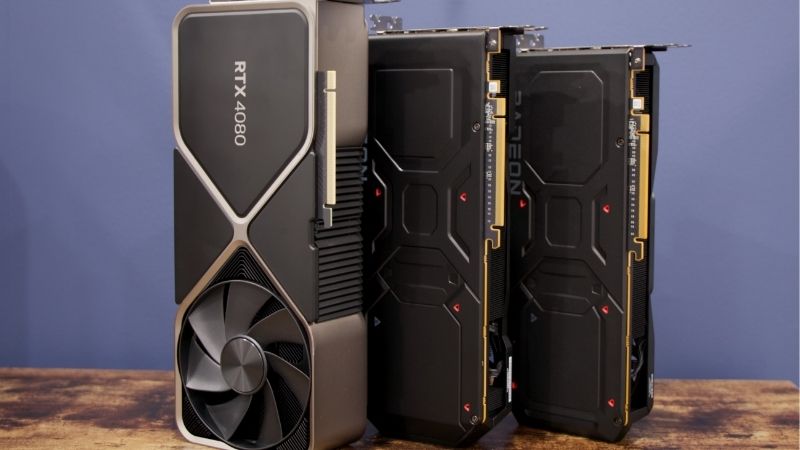
The Quick Verdict: 4080 Super vs 5090 in 30 Seconds
The fast answer: the RTX 5090 is 60–75% faster, carries 32GB of GDDR7 at a staggering 1,792GB/s, and owns DLSS 4 Multi Frame Generation — it wins everything measurable by margins no other matchup approaches. The buying answer is narrower: for pure gaming, even at 4K, the halo’s premium buys headroom most panels cannot display, and the 4080 Super at $700–$850 — or better, the new $999 RTX 5080 — delivers the playable experience at half the outlay. The 5090’s genuine constituency is specific: 4K/240Hz panel owners, local-AI builders who need 32GB, and creators whose render time is billable. Inside that constituency, nothing else exists; outside it, the canyon is not worth crossing. Check both cards’ live prices first — the halo’s market behavior is half this story.
The Halo’s Ledger: What $1,999 Actually Buys
The 5090’s specifications read like a different product category: 21,760 Blackwell CUDA cores — more than double the 4080 Super’s 10,240 — 32GB of GDDR7 on a 512-bit bus producing 1,792GB/s, fourth-generation RT cores at flagship scale, and the full DLSS 4 stack with Multi Frame Generation. Benchmark aggregates place it 60–75% ahead at 4K, the gap widening in path-traced showcases where its RT array simply outclasses everything.
The demands scale with the silicon: 575W of board power, a 1000W+ PSU recommendation, the 16-pin connector at its full rating, and coolers sized like small appliances. The halo asks for a build designed around it — and at this tier, buyers generally oblige.
The High-End Survivor: What $750 Still Buys
The 4080 Super’s 2026 case is the same one that made it Ada’s value flagship: 16GB of GDDR6X at 736GB/s, 130–170 fps at 1440p ultra, 60–85 fps native at 4K with DLSS Quality lifting results past 100 in most titles, and DLSS 3 Frame Generation doubling supported single-player experiences. At $700–$850 used and clearance, it delivers roughly 60% of the halo’s performance for 40% of the money.
Its deductions are the discontinued card’s standard set: no Multi Frame Generation ever, maintenance-mode drivers, warranty status varying listing by listing, and the used market’s diligence tax — all priced into the band, none erasable from it.
Specs Comparison Table
The canyon, measured line by line.
| Specification | RTX 4080 Super | RTX 5090 |
|---|---|---|
| Architecture | Ada Lovelace (AD103) | Blackwell (GB202) |
| CUDA Cores | 10,240 | 21,760 |
| VRAM | 16GB GDDR6X | 32GB GDDR7 |
| Memory Bandwidth | 736 GB/s | 1,792 GB/s |
| TGP / PSU | 320W / 750W | 575W / 1000W+ |
| Frame Generation | DLSS 3 (2x) | DLSS 4 MFG (up to 4x) |
| 4K Performance | ~100% (baseline) | ~160–175% |
| Launch MSRP | $999 | $1,999 |
| 2026 Availability | Used/clearance, $700–$850 | New, frequently above MSRP |
Deep Dive: Measuring What the Canyon’s Width Buys
A 60–75% gap at more than double the price demands resolution-by-resolution honesty about where the difference displays, a hard look at the workloads where 32GB stops being a luxury, and the platform audit the halo’s 575W drags into every build conversation.
Gaming Benchmarks: Where the Halo’s Lead Displays
At 4K, the canyon is real and visible: the 5090’s 100–140 fps native ultra against the 4080 Super’s 60–85 — the difference between feeding a 4K/144Hz panel without assistance and managing toward it with upscaling. Path-traced showcases stretch the lead past 80%, and Multi Frame Generation pushes presented rates past 200 fps where the older card’s 2x ceiling caps far lower. On 4K/240Hz glass, the halo is the only card that makes the panel honest.
At 1440p, the canyon narrows experientially: the 4080 Super already saturates 165Hz panels at ultra, the 5090’s surplus feeds only the rare 480Hz esports displays, and CPU limits begin refereeing both cards. At this resolution the halo is measurably faster and visibly unnecessary.
The display-honesty rule governs the gaming verdict: the 5090’s premium buys frames a 4K/240Hz panel displays, a 4K/144Hz panel partially displays, and everything below mostly wastes.
Beyond Gaming: Where 32GB Changes the Question
The halo’s second constituency is not optional about it: local AI work — model inference and fine-tuning at sizes 16GB cannot load — 3D rendering with production-scale scenes, and video pipelines holding 8K timelines all treat the 32GB buffer as admission rather than luxury. In those workloads the 4080 Super is not a discount alternative; it is a wall.
The professional math reframes the price: render farms and AI practitioners amortize the $1,999 against billable time, where a 60–75% throughput gain pays for the canyon in weeks. The card’s market behavior — frequently selling above MSRP since launch — is this constituency outbidding gamers, the same dynamic that has governed every high-VRAM flagship since the AI era began.
Acoustics scale with the silicon as well: well-cooled 5090 trims stay civil under load but move serious air doing it, and small rooms register the difference in summer — a lived-experience line item halo reviews mention as often as the frame rates.
The Platform Audit: What 575W Demands
The halo taxes the build around it: a 1000W+ PSU (a $150–$250 line item for most upgraders), case clearance and airflow engineered for a 575W exhaust, room thermals that summer makes literal, and electricity costs running $60–$100 per year above the 4080 Super’s for a daily user. The 16-pin connector’s full-load history also makes cable seating and PSU quality non-negotiable diligence at this wattage.
The 4080 Super’s 320W reads almost modest by contrast — a 750W PSU, ordinary flagship cooling, and thermals any good mid-tower manages. Between the cards sits not just $1,200 of GPU but several hundred dollars of platform, a total-cost truth the canyon’s width hides.
2026 Market Forces: The Halo Premium and the Survivor’s Floor
Two stories govern both rims of the canyon: the United States approving Nvidia’s H200 AI chip exports to China, and the sustained rise in laptop and component prices. The halo card sits closer to the AI economy than any consumer GPU ever has — and the mechanics show in both price tags.
H200 Exports and the Halo’s Gravity
The H200 approval channels enormous demand into Nvidia’s leading-edge wafer and memory supply — and the 5090, built on the same flagship-class pipeline with the largest consumer VRAM buffer ever shipped, is the consumer card most exposed to AI gravity. The pattern shows in its market life: street prices holding at or above the $1,999 MSRP, with premium trims commanding $2,200+, as professional demand absorbs allocation gamers expected.
For buyers inside the halo’s constituency, the implication is uncomfortable but clear: this card’s discounts are structurally rare, and an at-MSRP listing is the event worth acting on.
Component Inflation and the Survivor’s Band
The 4080 Super’s floor obeys the same physics from below: memory costs rising for consecutive quarters — laptop prices already following — anchor used values to expensive new alternatives, and its 16GB buffer keeps local-AI entry buyers in its bidding pool. Tracking shows the $700–$850 band holding for consecutive quarters where history predicted decline.
The crossover discipline applies here as everywhere: above $850, the survivor collides with the new $999 RTX 5080 — warrantied, MFG-equipped, 10–15% faster — and the listing answers itself.
Depreciation diverges across the canyon too: the halo’s AI-anchored demand has made it the rare GPU reselling near purchase price, while the survivor depreciates on the discontinued curve — liquidity the professional desk can legitimately count.
The Timing Read Across the Canyon
Both rims reward decisiveness: halo buyers should treat $1,999–$2,099 contacts as action signals against a structurally drifting market, and survivor buyers should execute in the $700–$780 band while running the 5080 crossover check on every listing. Neither rim has a visible discount catalyst this year.
Anchor everything to live numbers: check the RTX 5090’s current Amazon price and what 4080 Super listings actually ask today — the canyon’s real width on shopping day is the only measurement that binds.
Final Verdict: Pros, Cons, and the Sane Middle
The canyon has a winner on each rim for different buyers — and a bridge card that catches most readers honestly evaluating both. The ledger closes it out.
Pros and Cons of Each Card
RTX 5090 — Pros: the fastest consumer GPU, period — 60–75% ahead with the canyon widening in RT; 32GB of GDDR7 admits workloads nothing else under $3,000 touches; the full DLSS 4 arsenal; the only honest 4K/240Hz card. Cons: $1,999+ with structural upward pressure; 575W demands a platform built around it; gaming-only buyers fund headroom their panels cannot display.
RTX 4080 Super — Pros: 60% of the halo’s performance for 40% of the money; 16GB handles all current gaming at 4K; flagship coolers throughout the supply; DLSS 3 and proven field service. Cons: discontinued, with the full used-market ledger; no MFG ever; collides with the new 5080 above $850; maintenance-mode trajectory.
The Sane Middle: RTX 5080
The bridge deserves its paragraph: the $999 RTX 5080 delivers 16GB of GDDR7 at 960GB/s, performance 10–15% above the 4080 Super, the complete DLSS 4 stack including MFG, a 360W platform demand ordinary builds absorb, and a full warranty — the modern high end at exactly half the halo’s money. For 4K/144Hz gaming, it is the rational ceiling; the canyon beyond it belongs to the constituencies named above.
Its presence disciplines both rims: the survivor must price below it to exist, and the halo must justify itself against it workload by workload.
Who Should Buy Which
Buy the RTX 5090 if you own 4K/240Hz glass, run local AI at sizes 16GB walls out, or bill for render time — inside that constituency it has no substitute and its premium amortizes honestly. Buy the RTX 4080 Super at $700–$780 if you want flagship-class 4K gaming at the canyon’s floor and accept the used ledger knowingly.
And if the honest self-audit lands on “4K gaming, no AI, no billable renders” — the $999 RTX 5080 is where this comparison quietly sends you.
See More:
Conclusion
The 4080 super vs 5090 canyon measures honestly: the halo card’s 60–75% lead, 32GB of GDDR7, and DLSS 4 arsenal are real, displayable, and worth double the money — but only to the specific constituency of 4K/240Hz owners, local-AI builders, and billable creators whose workloads convert headroom into value. For everyone else, the 4080 Super at $700–$780 delivers flagship-class 4K gaming at the canyon’s floor, and the new $999 RTX 5080 splits the difference with warranty and Multi Frame Generation intact. With H200 gravity holding the halo above MSRP and component inflation firming every floor beneath it, the market punishes hesitation on both rims: tap through to check the latest RTX 5090 and RTX 4080 Super prices on Amazon, audit your actual workload against the constituency list, and buy the rim — or the bridge — your panel and pipeline genuinely demand.
Frequently Asked Questions
What is the best 4080 super 5090 in 2026?
The best 4080 super 5090 depends on your budget and how you plan to use it. The options compared above are our top-rated picks based on real customer ratings, build quality, and overall value — start with the highest-rated model that fits your budget.
How much should I expect to spend on a 4080 super 5090?
Prices vary by brand and features. Budget options cover the essentials, while mid-range and premium models add durability, performance, and extra features. Compare the prices in the list above to find the best value for your needs.
What should I look for when buying a 4080 super 5090?
Focus on what matters most for your use case — build quality, compatibility, performance, warranty, and verified customer reviews. Every pick above is selected to balance these factors.
Are budget 4080 super 5090 options worth it?
Yes. For most people a well-reviewed budget or mid-range 4080 super 5090 delivers excellent value. You only need to spend more if you specifically require premium materials or top-tier performance.
How did we choose these 4080 super 5090 picks?
We compare current Amazon ratings, review counts, key features, and price to surface the options with the best real-world value. The list is refreshed as ratings and availability change.

Write Your Review
No reviews yet. Be the first to share your experience!