
- Top Pick: Skytech Gaming Rampage Gaming PC, Intel i5 14400F 2.5GHz, NVIDIA RTX 5070 12GB VRAM, 1TB Gen4 NVMe SSD, 24GB DDR5 RAM 6000, 850W Gold ATX 3 PSU, Wi-Fi 5, Windows 11, Desktop
- Best Value: ZOTAC MEK Gaming PC Desktop, Ryzen 7 9700X, NVIDIA GeForce RTX 5070 Ti 16GB
- Premium Choice: Skytech Gaming Blaze 5 Gaming PC, Intel i7 14700F 2.1GHz, NVIDIA RTX 5070 12GB VRAM, 1TB Gen4 NVMe SSD, 16GB DDR4 RAM 3200, 850W Gold ATX 3 PSU, 360 ARGB AIO, Wi-Fi 5, Windows 11, Desktop



Prime
Top Rated
XFX Swift AMD Radeon RX 9060 XT OC White Triple Fan Gaming Edition 16GB RX 9060XT RX-96TS316W7

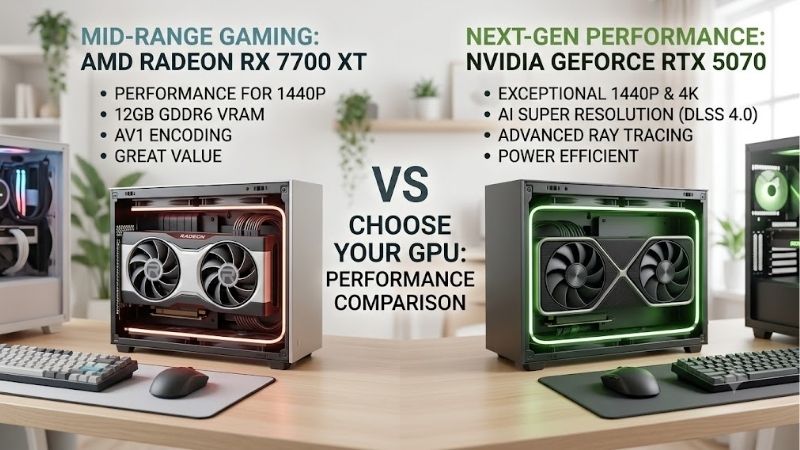
Comparing the Rx 7700 Xt Vs Rtx 5070 is essential for PC builders choosing between mid-range AMD value and next-gen NVIDIA performance in 2026. This comprehensive head-to-head evaluation analyzes real-world framerates, ray tracing capabilities, power efficiency, and long-term market pricing to help you invest smartly.
Architectural Deep Dive and Quick Verdict Overview
Choosing between AMD’s established mid-tier powerhouse and NVIDIA’s newest architecture requires examining both immediate frame rates and long-term feature support. Modern graphics hardware operates in a landscape where raw rasterization speed is heavily supplemented by AI upscaling, optical flow estimation, and intelligent memory management. Before diving into individual gaming benchmarks, understanding how these two cards compare at a high level helps establish realistic expectations for your system budget.
As an Amazon Associate we earn from qualifying purchases at no extra cost to you.


The Quick Verdict: Which GPU Fits Your Build?
For gamers seeking the absolute highest frame rates in heavy ray-traced titles, advanced neural rendering features, and superior power efficiency at 1440p or 4K, the NVIDIA RTX 5070 emerges as the overall performance winner. Powered by new architectural enhancements, DLSS 4 frame generation, and refined ray reconstruction cores, it delivers smooth performance in modern titles like Cyberpunk 2077 and Alan Wake 2. However, these cutting-edge capabilities come with a higher retail price point that reflects its premium market positioning.
On the other hand, the AMD Radeon RX 7700 XT remains a value contender for budget-conscious builders who prioritize maximum rasterization performance per dollar. Equipped with 12GB of VRAM and standard high-bandwidth memory configuration, it easily handles competitive esports titles and demanding 1440p single-player games without demanding a high price tag. If you play predominantly traditional rasterized titles and want to save money for other system upgrades, the RX 7700 XT delivers outstanding performance where it matters most.
Check the latest price on Amazon:
- RTX 5070 Ti vs AMD 9070 XT
- Gigabyte Geforce Rtx 5070 Ti Gaming Oc 16gb
- Gigabyte Geforce Rtx 5060 Ti Windforce Oc
- Zapfixers Gpu Repair
Core Specifications and Comparison Table
A direct hardware comparison reveals distinct design philosophies between AMD and NVIDIA. While the RX 7700 XT relies on AMD’s mature chiplet-based RDNA 3 architecture paired with GDDR6 memory, the RTX 5070 incorporates NVIDIA’s next-gen Blackwell architecture utilizing ultra-fast GDDR7 memory modules. The table below outlines the core hardware parameters defining both graphics cards.
| Hardware Feature | AMD Radeon RX 7700 XT | NVIDIA GeForce RTX 5070 |
|---|---|---|
| Architecture | RDNA 3 (Navi 32) | Blackwell (GB205) |
| Process Node | TSMC 5nm / 6nm | TSMC 4N Custom |
| VRAM Capacity | 12GB GDDR6 | 12GB GDDR7 |
| Memory Bus Width | 192-bit | 192-bit |
| Memory Bandwidth | Up to 432 GB/s | Up to 672 GB/s |
| Total Board Power (TBP) | 245W | 220W |
| Upscaling Technology | FSR 3.1 / HYPR-RX | DLSS 4 / Multi-Frame Gen |
| Target Resolution | High-Refresh 1440p | 1440p Ultra / Entry 4K |
Check the latest price on Amazon for high-efficiency modular power supplies.
Architectural Differences: RDNA 3 vs Next-Gen Blackwell Architecture
AMD’s RDNA 3 architecture introduced a revolutionary chiplet design for mainstream GPUs, decoupling the Graphics Compute Die (GCD) from Memory Cache Dies (MCD). This layout allows the RX 7700 XT to leverage 48 Compute Units, second-generation Ray Tracing accelerators, and dedicated AI Matrix Units efficiently. Combined with 48MB of Infinity Cache, the card minimizes main memory latency during heavy 1440p rendering workloads, maintaining high average frame rates in traditional graphics pipelines.
NVIDIA’s Blackwell architecture takes a different path, focusing heavily on neural rendering throughput and raw energy efficiency. The RTX 5070 features upgraded Tensor Cores capable of executing dynamic FP8 mathematical calculations, alongside fourth-generation RT Cores that handle complex BVH traversal in hardware. Paired with high-speed GDDR7 video memory, the card achieves massive memory bandwidth improvements over older generations, ensuring that frame generation algorithms and high-resolution texture streaming execute without bandwidth bottlenecks.
Check the latest price on Amazon for premium DisplayPort 2.1 cables.
Real-World Gaming Benchmarks and Feature Face-Off
Putting theoretical specifications aside, real-world gaming performance reveals significant differences between these two contenders across various game engines and rendering modes. While classic rasterized games show a competitive battle, introducing ray tracing and AI frame creation shifts the advantage dramatically toward green team hardware.
Pure 1440p and 4K Rasterization Performance
In traditional rasterization benchmarks—where lighting and shadows are calculated without hardware ray tracing—the performance gap between the two graphics cards remains relatively narrow at 1440p resolution. In competitive titles like Call of Duty: Warzone, Apex Legends, and Fortnite, the RX 7700 XT pushes impressive framerates, easily maintaining averages well above 140 FPS at maximum settings. AMD’s driver optimization and raw shader throughput allow it to punch well above its price tier in standard rendering scenarios.
Stepping up to demanding single-player titles like Red Dead Redemption 2 and Starfield at 1440p, the RTX 5070 pulls ahead by approximately 22% to 28% in average frame rates. At native 4K resolution, the RTX 5070’s superior memory bandwidth from its GDDR7 subsystem allows it to maintain frametime stability far better than the RX 7700 XT. While the RX 7700 XT can handle 4K in lighter titles or with aggressive FSR upscaling, the RTX 5070 provides a far smoother experience when pushing ultra presets across modern game libraries.
Check the latest price on Amazon for ultra-fast DDR5 memory kits.
Ray Tracing, Path Tracing, and DLSS 4 vs FSR Capabilities
When hardware ray tracing and path tracing pipelines are activated, the technological divergence becomes glaringly obvious. In titles like Cyberpunk 2077 with full RT Overdrive mode enabled, the RX 7700 XT struggles under heavy lighting calculations, often dipping below 30 FPS at native 1440p. AMD’s second-gen RT cores, while capable in light ray tracing implementations, face severe performance penalties when handling multi-bounce global illumination and ray-traced reflections simultaneously.
Conversely, the RTX 5070 excels in ray-traced environments thanks to NVIDIA’s optical flow accelerators and advanced RT pipeline management. Engaging DLSS 4 with multi-frame generation allows the RTX 5070 to triple frame output in path-traced titles while preserving sub-frame detail and image clarity. AMD’s FSR 3.1 and HYPR-RX technologies have improved frame interpolation noticeably, but NVIDIA’s AI-driven reconstruction still produces fewer visual artifacts, temporal shimmering, and ghosting effect glitches during high-speed camera movement.
Check the latest price on Amazon for ergonomic wireless gaming mice.
Pros and Cons of Rx 7700 Xt Vs Rtx 5070
Evaluating the strengths and weaknesses of each GPU is crucial for identifying which card aligns best with your specific gaming preferences and financial budget.
AMD Radeon RX 7700 XT
- Pros:
- Exceptional Value for Money: Offers brilliant 1440p rasterization performance at a lower retail price point.
- Generous 12GB VRAM Buffer: Comfortably handles maximum texture packs without running into memory limit crashes.
- Open Software Ecosystem: Full support for DisplayPort 2.1 and driver-level HYPR-RX performance boosts.
- Cons:
- Weaker Ray Tracing Throughput: Significant framerate drops when enabling heavy RT effects in AAA titles.
- Higher Power Draw Relative to Performance: Requires a larger power supply unit despite lower overall speed.
NVIDIA GeForce RTX 5070
- Pros:
- Unmatched AI Feature Suite: Full access to DLSS 4, multi-frame generation, and NVIDIA Reflex low-latency tech.
- Superior Ray Tracing Capabilities: Smooth playability in full path-traced game engines at high resolutions.
- Excellent Energy Efficiency: Low thermal output and modest 220W TBP save on long-term power consumption.
- Cons:
- Higher Upfront Cost: Commands a noticeable price premium over mid-range competitor options.
- 12GB VRAM Limit: While sufficient today, heavy 4K modded textures may push memory capacity in future titles.
Check the latest price on Amazon for GPU anti-sag support brackets.
Thermal Efficiency, Market Trends, and Final Recommendations
Hardware performance extends beyond frame rates to encompass power consumption, operating temperatures, fan acoustics, and broader PC hardware market conditions. Making an informed purchase in 2026 requires assessing how macroeconomic supply shifts and rising manufacturing costs impact component pricing.
Power Draw, Acoustic Profiles, and Thermal Management
Thermal dynamics and power efficiency favor NVIDIA’s Blackwell architecture in this head-to-head comparison. The RTX 5070 operates with a total board power rating of 220W, drawing noticeably less power under full synthetic stress tests than the RX 7700 XT, which pulls around 245W. This lower power consumption allows board partners to design compact dual-slot cooling solutions that fit easily into small form factor (SFF) chassis without thermal throttling.
Partner cards for the RX 7700 XT often feature larger triple-fan coolers to dissipate heat from its 5nm/6nm compute dies. Under sustained gaming workloads, core temperatures on both cards stay manageable between 62°C and 68°C. However, the RX 7700 XT’s cooling fans typically spin at higher RPMs to maintain target junction temperatures, resulting in slightly louder noise levels. If quiet operation and low system heat emission are high priorities for your gaming room, the RTX 5070 offers a quieter thermal profile.
Check the latest price on Amazon for high-airflow mid-tower PC cases.
2026 GPU Market Dynamics: H200 Exports and Component Price Hikes
Navigating the PC hardware market in 2026 requires understanding macro supply chain conditions that influence GPU retail availability. A major geopolitical decision impacting consumer hardware supply is the approved policy allowing NVIDIA to export specialized H200 AI chips to select international enterprise customers. Because global demand for high-performance AI datacenter infrastructure remains insatiable, semiconductor foundries like TSMC are allocating substantial portions of advanced wafer production capacity toward enterprise silicon, where profit margins are significantly higher.
This production emphasis creates a direct trickle-down effect on mainstream consumer desktop graphics cards. With wafer capacity tightly controlled, consumer GPU stock levels for cards like the RTX 5070 and competing AMD mid-range models remain carefully managed rather than oversupplied. Furthermore, secondary component manufacturing costs—including GDDR7 memory modules, complex PCB substrates, and VRM power stages—continue their upward price trend across 2026. These rising costs extend into adjacent markets, pushing up retail prices for gaming laptops, pre-built desktop systems, and DIY hardware.
Given these market conditions, waiting for deep price cuts or seasonal clearance sales carries real financial risk. As manufacturing costs rise across the electronics industry, consumer hardware prices are more likely to undergo upward revisions rather than significant drops. Securing a mid-range or high-performance graphics card now allows gamers to lock in their build costs before potential mid-year component inflation impacts retail store inventory.
Check the latest price on Amazon for pre-built desktop gaming PCs.
Best Alternative Option and Final Buying Recommendation
If neither the RX 7700 XT nor the RTX 5070 fits your exact budget or performance requirements, a compelling alternative worth considering is the AMD Radeon RX 7800 XT. Positioned directly between both cards in price and performance, the RX 7800 XT features a larger 16GB VRAM frame buffer and a wider 256-bit memory bus. It offers higher pure rasterization performance than the RX 7700 XT while giving budget-minded gamers extra VRAM headroom for memory-heavy titles without paying the premium attached to NVIDIA’s newest architecture.
When deciding between our primary contenders, your choice ultimately hinges on your target resolution, visual expectations, and budget boundaries:
Buy the AMD Radeon RX 7700 XT if:
- You are building a budget-focused 1440p gaming rig and want maximum raw rasterization performance per dollar.
- You primarily play competitive multiplayer titles, esports games, or traditional rasterized RPGs where ray tracing is secondary.
- You prefer an affordable upgrade path that leaves extra budget room for a higher-end CPU, NVMe storage, or display.
Buy the NVIDIA GeForce RTX 5070 if:
- You want cutting-edge 1440p and entry-level 4K performance with maxed graphical presets and high frame rates.
- You prioritize advanced visual technologies like DLSS 4 multi-frame generation, low-latency Reflex support, and full path tracing.
- You desire superior power efficiency, lower thermal output, and quiet fan operation in your PC build.
Check the latest price on Amazon for top-rated GPU cooling fans.
Conclusion
When weighing the overall value proposition of the Rx 7700 Xt Vs Rtx 5070, both graphics cards offer compelling strengths tailored to different buyer profiles in 2026. The RX 7700 XT stands out as an exceptional value champion for pure 1440p rasterized gaming, while the RTX 5070 sets a high standard for ray tracing excellence, AI upscaling features, and power efficiency. Considering current hardware market trends and rising component costs, choosing the GPU that matches your gaming priorities today ensures long-term performance and satisfaction for years of immersive gaming ahead.
Check the latest price on Amazon for top gaming gear today!
Frequently Asked Questions
How big is the actual performance gap between these two cards?
The RTX 5070 is a full generation and tier ahead. In rasterized 1440p gaming it typically delivers somewhere around thirty-five to fifty percent more frames than the RDNA 3 based RX 7700 XT, and the gap grows substantially in ray traced titles where Blackwell RT cores are far stronger. The 7700 XT remains a solid 1440p card, but it is not in the same class.
Do both cards have enough VRAM for 1440p?
Both carry 12GB, the RX 7700 XT on a 192-bit GDDR6 bus and the RTX 5070 on a 192-bit GDDR7 bus with far higher bandwidth. Twelve gigabytes is adequate for 1440p today at high settings, though it is the point some reviewers flag as a future concern for maxed ray tracing with ultra textures. Neither card offers headroom beyond that capacity.
What are the power and PSU differences?
The RX 7700 XT is rated around 245W and the RTX 5070 around 250W, so they are close, but the NVIDIA card delivers considerably more performance for that power. A quality 650W to 750W supply suits either build. The Radeon typically uses two 8-pin PCIe connectors, while the RTX 5070 uses a 12V-2×6 connector, usually with a bundled adapter for older supplies.
Which handles ray tracing and upscaling better?
The RTX 5070 wins decisively. Blackwell ray tracing hardware is far more capable than RDNA 3, and DLSS 4 with multi frame generation is available in a very large game library. The 7700 XT is limited to FSR 3 style frame generation since FSR 4 machine learning upscaling targets RDNA 4 hardware, so it cannot match NVIDIA current image quality in supported titles.
Is the RX 7700 XT still worth buying on a budget?
Only if you find it heavily discounted, typically well under three hundred dollars used or on clearance. At that price it is a capable 1440p rasterization card for esports and high settings gaming. If you are paying anywhere near the RTX 5070 asking price, the newer card is the obvious choice for its efficiency per frame, ray tracing, and longer driver and feature support horizon.

Write Your Review
No reviews yet. Be the first to share your experience!