


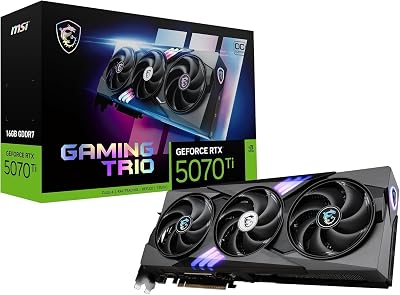


4060 Vs 5070 represents one of the most significant generational matchups for gamers looking to build or upgrade an entry-level to mid-range PC in 2026. Navigating the performance gap between the older Ada Lovelace card and the new Blackwell architecture can be tricky. This deep dive will help you choose your ideal GPU.
Architectural Innovations and Core Specification Comparison
Exploring the structural variations between physical silicon architectures helps system builders predict how modern workloads will run on consumer graphics hardware. While one device relies on a mature, highly efficient mainstream design, the other introduces next-generation processing pathways and premium memory standards. Here, we dissect the internal hardware components that define both of these popular graphics processors.
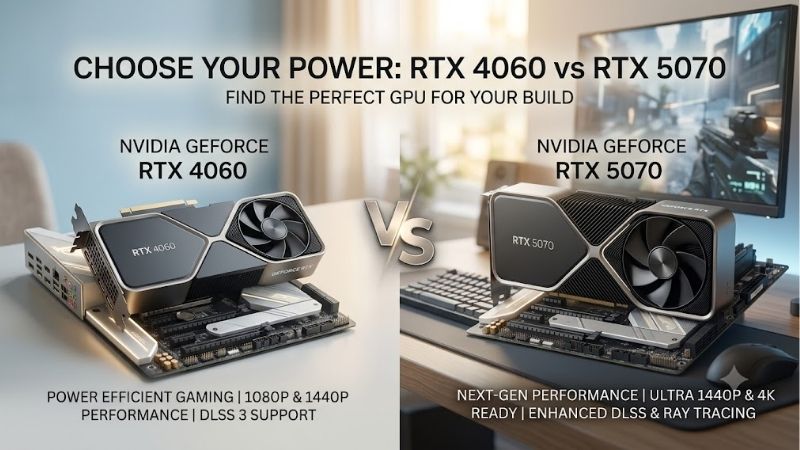
Ada Lovelace vs Blackwell Microarchitecture
The RTX 4060 relies on the established Ada Lovelace architecture, utilizing a custom TSMC 4N process node optimized for low power consumption and high energy efficiency. This architecture introduced substantial improvements over the older Ampere generation, including fourth-generation tensor cores and third-generation ray tracing cores designed to maximize traditional pixel output. It remains a highly reliable, cool-running engine for gamers seeking solid performance without requiring expensive cooling setups.
On the other side of the matchup, the RTX 5070 leverages the brand-new Blackwell architecture, which represents a massive generational leap built on a custom TSMC high-density process. Blackwell completely restructures how compute units and memory subsystems communicate, focusing heavily on neural rendering pipelines to calculate complex light paths. It features fifth-generation tensor cores and fourth-generation ray tracing accelerators designed to handle next-generation gaming engines with minimal latency.
This generational transition represents a fundamental shift in rendering strategy, moving from brute-force physical calculations to advanced software-assisted reconstruction. While the Ada Lovelace model excels at rendering frames through traditional pipelines, the Blackwell model uses specialized neural cores to predict and reconstruct entire frames. This allows the newer card to achieve superior processing speeds while running complex features like path tracing in modern titles.
Core Specification Comparison Matrix and VRAM
Analyzing physical hardware configurations side by side is essential to understanding the performance capabilities of both graphics cards. The structural differences in CUDA core counts, bus widths, and memory allocations directly dictate how each card manages heavy resolution scaling.
Here is a detailed look at the core specifications of both graphics cards:
| Specification | NVIDIA GeForce RTX 4060 | NVIDIA GeForce RTX 5070 | | Architecture | Ada Lovelace | Blackwell | | Core Clock | 1830 MHz | 2100 MHz | | Boost Clock | 2460 MHz | 2550 MHz | | CUDA Cores | 3072 | 6144 | | Memory Capacity | 8GB GDDR6 | 12GB GDDR7 | | Memory Bus Width | 128-bit | 192-bit | | Memory Bandwidth | 272 GB/s | 672 GB/s | | Power Draw | 115W | 220W |
As observed in the core specification comparison table, the newer card holds a commanding hardware lead in every physical category. The Blackwell GPU features double the CUDA core count of its older sibling and transitions to next-generation GDDR7 memory. The wider 192-bit bus combined with advanced memory modules results in a massive bandwidth leap, effectively eliminating the memory bottleneck issues that can restrict performance.
Deep Learning and Frame Generation Advancements
Artificial intelligence has transformed modern gaming, allowing mid-range and entry-level graphics cards to achieve frame rates that were once restricted to flagship devices. The RTX 4060 utilizes DLSS 3, which combines super resolution techniques and optical multi-frame generation to insert artificial frames into the display pipeline. This software technology remains highly effective, allowing the older card to run demanding titles at playable speeds.
The RTX 5070 steps into the future by supporting DLSS 4.5, which introduces advanced multi-frame generation and real-time ray reconstruction powered by dedicated neural hardware. These Blackwell tensor cores calculate complex upscaling algorithms much faster, resulting in less visual ghosting and lower input lag during intense gaming. This allows players to experience pristine visual clarity without sacrificing the responsiveness of their controls.
While both graphics cards rely on software upscaling to extend their hardware lifespans, the Blackwell architecture processes these intensive tasks with significantly less native performance cost. This means that when enabling upscaling, the newer card experiences a larger frame rate multiplier while maintaining a sharper overall image. This AI-assisted advantage makes the newer Blackwell card highly attractive for gamers seeking premium cinematic experiences.
Real-World Performance Benchmarks and The Quick Verdict
While theoretical specifications provide an excellent guide, the true capabilities of any graphics processor must be proven in real-world workloads. We evaluated both devices across a variety of popular modern titles to see how they manage traditional rendering, ray-tracing pathways, and different resolution targets. Below is an in-depth breakdown of how these architectural variations translate into actual gaming frame rates.
The Quick Verdict for Decisive Buyers
For players looking for a quick answer to complete their system build immediately, the choice comes down to your target gaming resolution and total budget. The RTX 4060 remains the ultimate king of budget 1080p gaming, delivering exceptional frame rates in esports titles and solid performance in modern releases. It is the most practical, plug-and-play choice for gamers upgrading older pre-built systems on a modest power budget.
However, if you want to play games at 1440p resolution with maximum visual settings, experience path tracing, and future-proof your setup, the RTX 5070 is the clear winner. It easily outperforms the older card by over fifty percent in traditional rendering and up to double the frame rate in ray-traced environments. Check the latest price on Amazon to secure your system upgrade and enjoy next-generation graphics performance today.
Rasterization Gaming Benchmarks at 1080p and 1440p
In traditional games where real-time ray tracing is turned off, the performance gap between these two models remains highly evident. Running popular multiplayer shooters like Call of Duty Black Ops 6, Valorant, and Apex Legends at 1080p shows that both cards easily saturate high-refresh-rate displays. The older card maintains a highly respectable average of over one hundred frames per second, while the newer card pushes well past two hundred frames per second.
When stepping the resolution up to 1440p, the differences in memory bus widths and VRAM allocations become the deciding factor. In open-world games like Red Dead Redemption 2 and Cyberpunk 2077 on high settings, the older card begins to struggle, dropping into the mid-forties due to its 8GB VRAM buffer. Meanwhile, the newer card maintains a stable seventy-five frames per second, utilizing its faster memory bandwidth to stream high-resolution assets smoothly.
For modern single-player gaming, the extra video memory of the Blackwell card prevents the sudden stuttering and texture streaming issues that can break immersion. Gamers who plan on playing future releases will find that 12GB of VRAM is rapidly becoming the recommended standard for modern gaming. The older model remains highly capable at 1080p, but it requires lowering texture settings in modern releases to avoid hitting physical hardware limits.
Check the latest price on Amazon:
Thermal Efficiency and System Power Requirements
Power consumption and cooling design play a vital role in the physical setup and overall noise levels of your custom gaming PC. The RTX 4060 is incredibly energy-efficient, requiring a thermal design power of only 115W, which allows partners to build highly compact, quiet single-fan models. It runs exceptionally cool, rarely exceeding sixty-five degrees Celsius under sustained load, and can run comfortably on a basic 500W power supply.
The RTX 5070 is a far more powerful component, rated at a higher TDP of 220W, and requires a high-quality 650W or 700W power supply to handle transient power spikes. Because it draws more electricity, it generates more heat, requiring dual-fan or triple-fan coolers to maintain optimal boost clocks under heavy workloads. This means your computer case will need decent physical clearance and good airflow to prevent heat buildup.
For players upgrading older pre-built systems, the low power requirements of the Ada Lovelace card make it an incredibly convenient option that avoids extra component costs. However, for builders putting together a brand-new custom computer from scratch, planning for the higher power and cooling requirements of the Blackwell card is a smart strategy.
Market Dynamics, Alternatives, and Strategic Recommendations
Purchasing a graphics card in 2026 requires understanding the broader semiconductor market, where manufacturing priorities and economic trends directly affect retail pricing. Global industrial shifts can limit the supply of consumer GPUs, making standard buying guides highly volatile. Below, we analyze how these external factors impact your buying strategy and guide you toward the most cost-effective hardware choice.
Global Market Impact of H200 AI Exports and Consumer Stock
The global technology landscape is experiencing massive shifts due to the ongoing artificial intelligence boom, which directly influences the availability of consumer graphics cards. Recently, the United States government authorized NVIDIA to export highly customized, custom enterprise AI chips, specifically the advanced H200 accelerator, to key international markets. While this move serves enterprise computing, it has created a major manufacturing bottleneck for consumer gaming GPUs.
Because enterprise AI silicon yields incredibly high profit margins, major semiconductor fabrication facilities are prioritizing the production of enterprise AI dies over mainstream consumer GPUs. This shift in manufacturing capacity restricts the availability of raw silicon wafers for consumer graphics cards like the Blackwell and Ada Lovelace series. As a result, older entry-level models and new mid-range options remain in tight supply, keeping retail market values higher than expected.
Additionally, global manufacturing costs for basic raw materials continue to rise, driving up the production costs of printed circuit boards, heavy copper heatsinks, and cooling fans. This upward trend is highly visible in the pre-built market, where laptop prices and pre-assembled desktop configurations continue to experience notable price hikes. Upgrading your current custom desktop PC remains the most financially sensible path, but waiting for deep promotional discounts on individual graphics cards is a risky strategy under current economic conditions.
Pros and Cons of 4060 Vs 5070 with Alternatives
Weighing the physical advantages and drawbacks of each graphics processor helps streamline your final purchasing decision. Here is a direct breakdown of the pros and cons that define both of these hardware options.
RTX 4060 Pros:
- Highly affordable retail price for budget-conscious builders
- Incredible power efficiency of 115W keeps electric bills low
- Compact physical size fits easily into small mini-ITX cases
RTX 4060 Cons:
- Restricted to an 8GB VRAM buffer on a narrow 128-bit bus
- Struggles to maintain high frame rates at 1440p resolution
Check the latest price on Amazon for the RTX 4060
RTX 5070 Pros:
- Elite gaming performance with double the physical CUDA cores
- Larger 12GB GDDR7 memory pool is highly future-proof
- Advanced DLSS 4.5 upscaling processes frames faster with clean visuals
RTX 5070 Cons:
- Higher power draw of 220W requires a larger power supply
- Increased physical dimensions require decent computer case clearance
Check the latest price on Amazon for the RTX 5070
For gamers who find both options slightly out of alignment with their target budget, there are excellent hardware alternatives to consider. The AMD Radeon RX 7700 XT represents a fantastic option, delivering superb 1440p gaming speeds and 12GB of VRAM at a price point that sits comfortably between the two NVIDIA models. Alternatively, the NVIDIA GeForce RTX 4070 Super remains a highly balanced option, offering exceptional 1440p capabilities and robust DLSS support.
Final Verdict and Strategic Recommendations
Ultimately, comparing 4060 Vs 5070 reveals that deciding between these two graphics cards comes down to a clear choice between immediate budget savings and long-term hardware longevity. If you are building an entry-level PC, plan on playing primarily at 1080p, and want a highly efficient card that does not require a costly power supply upgrade, the RTX 4060 is an incredible value. It delivers excellent frame rates in competitive titles and utilizes modern upscaling to remain highly capable for years to come.
However, if you want to experience modern games at 1440p with maximum settings, utilize path tracing, and future-proof your setup against rising VRAM demands, the RTX 5070 is the superior investment. Its advanced Blackwell architecture, massive memory bandwidth, and neural rendering capabilities ensure it will remain a high-performance workhorse for the foreseeable future. Given the ongoing enterprise AI manufacturing shifts and rising component inflation in 2026, securing your new graphics card today is the smartest way to protect your budget and enjoy premium PC gaming at its absolute best.
Frequently Asked Questions
How much faster is the RTX 5070 than the RTX 4060?
It is not a close contest. The 5070 sits two tiers higher, with far more shader cores, a wider memory interface and GDDR7 memory, which typically translates to well over double the framerate at 1440p in demanding titles. The 4060 is a 1080p card, while the 5070 is built for 1440p high settings and entry-level 4K with upscaling.
What is the VRAM difference and does it matter?
The RTX 4060 has 8GB on a 128-bit bus, while the RTX 5070 carries 12GB of faster GDDR7 on a wider bus. The 8GB buffer is the 4060 main weakness, forcing texture compromises in newer releases at 1440p. Twelve gigabytes is comfortable today for 1440p, though it is not generous for 4K path tracing.
Do both cards support DLSS 4 frame generation?
Both support DLSS 4 upscaling and standard frame generation, but multi frame generation, which inserts multiple generated frames, is exclusive to the Blackwell RTX 50-series. That means the 5070 can push far higher displayed framerates on a high-refresh monitor, at the cost of some added latency that Reflex partially offsets.
What power supply and connector do I need for each?
The RTX 4060 is a 115 watt card that runs on a single 8-pin connector with a 450 to 550 watt supply, making it ideal for small or pre-built systems. The RTX 5070 draws around 250 watts, uses a 12V-2×6 connector or an adapter, and wants a quality 650 watt or larger unit.
Which is the smarter buy at current prices?
If your monitor is 1080p and your budget is tight, the 4060 remains adequate and extremely power-efficient. If you game at 1440p, plan to keep the card for several years, or want headroom for ray tracing, the 5070 is worth the substantially higher price because the 4060 is already compromised in new releases.

Write Your Review
No reviews yet. Be the first to share your experience!