


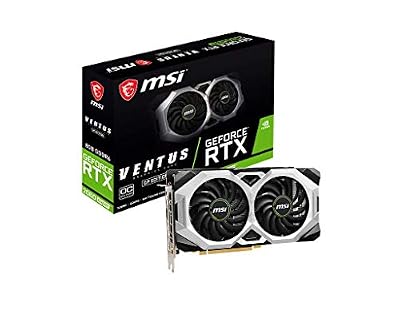
Deciding between the 2060 Super Vs 3060 remains one of the most hotly debated topics for budget-conscious gamers and PC builders in 2026. Both graphics cards represent major milestones in NVIDIA’s history of offering high-quality mid-range performance, but they approach the market with distinct hardware advantages and different architectural generations. As modern gaming standards evolve and demanding applications require more sophisticated rendering techniques, selecting the right hardware foundation for your system is more critical than ever.
Quick answer: Our top pick in 2026 is the Technical Specification — our #1 rated choice. See the full ranked comparison, alternatives and buying advice below.
The Quick Verdict: Direct Face-Off and Specs Comparison
Before diving deep into real-world frame rates and specific software performance, it is helpful to look at the foundational architectures that power these chips. Comparing the raw hardware specifications of these two graphics processors gives us a clear look at how NVIDIA’s engineering team pivoted between generations.
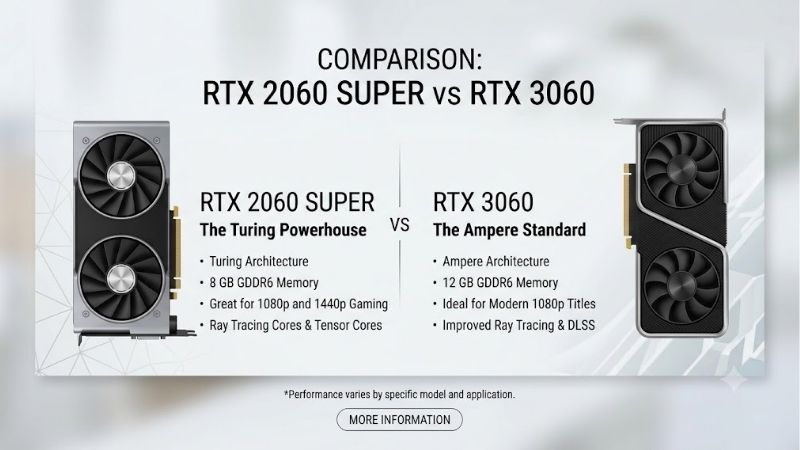
Spec Sheet and Key Architecture Differences
The RTX 2060 Super is built on the 12nm Turing architecture, which introduced real-time ray tracing and AI-powered super-sampling to mainstream PC gaming. On the other side, the RTX 3060 utilizes the newer 8nm Ampere architecture, bringing improved ray tracing cores, upgraded Tensor cores, and a much larger frame buffer. The most striking difference between the two lies in their memory configurations: the older Turing card features a wider bus width but a lower memory capacity, while the Ampere card offers a generous VRAM buffer on a narrower memory interface.
| Technical Specification | NVIDIA GeForce RTX 2060 Super | NVIDIA GeForce RTX 3060 (12GB) |
|---|---|---|
| Architecture | Turing (TU106) | Ampere (GA106) |
| Process Node | 12nm FFN | 8nm Samsung |
| CUDA Cores | 2,176 | 3,584 |
| Base / Boost Clock | 1,470 / 1,650 MHz | 1,320 / 1,777 MHz |
| Memory Capacity | 8GB GDDR6 | 12GB GDDR6 |
| Memory Bus Width | 256-bit | 192-bit |
| Memory Bandwidth | 448 GB/s | 360 GB/s |
| TDP (Power Draw) | 175W | 170W |
This architectural shift highlights a classic hardware trade-off. While the RTX 2060 Super commands higher raw memory bandwidth thanks to its 256-bit bus, the RTX 3060 has access to a massive 12GB frame buffer, which has become incredibly vital for modern high-resolution textures and AI workloads in 2026.
The Quick Verdict: Which Card Wins Today?
If you are looking for a quick buying decision, the RTX 3060 is the overall winner for the vast majority of PC builders and gaming enthusiasts in 2026. The combination of its massive 12GB VRAM buffer and the structural benefits of the newer Ampere architecture gives it a significant edge in modern titles and creative software. While the RTX 2060 Super holds its own in older DX11 and DX12 games, modern software suites are increasingly hungry for onboard video memory, making 8GB cards sweat under heavy workloads.
The RTX 3060 also benefits from slightly better ray tracing performance and superior efficiency, making it the more forward-looking choice for long-term systems. However, if you find a heavily discounted RTX 2060 Super on the used market, it still remains a highly capable card for standard 1080p gaming setups.
Check the latest price on Amazon:
Pros and Cons of Each GPU in 2026
To make a fully informed choice, it is helpful to analyze the distinct advantages and disadvantages of both cards. By analyzing user feedback across hardware communities and technical forums, we can weigh the practical realities of owning either option.
For the RTX 2060 Super, the high memory bandwidth represents a major strength, allowing it to maintain stable frame pacing in legacy titles. However, the 8GB VRAM pool is becoming a notable limitation as modern games push high-resolution textures at 1080p and 1440p resolutions.
RTX 2060 Super Pros:
- High memory bandwidth ($448$ GB/s) ensures excellent 256-bit memory bus performance.
- Excellent raw 1080p gaming performance in older DX11 titles.
- Robust thermal solutions across various partner cards.
RTX 2060 Super Cons:
- Limited to 8GB VRAM, which triggers performance throttling in modern 2026 games.
- Older Turing architecture lacks the structural efficiency of Ampere.
- Harder to find in brand-new condition, leaving buyers reliant on the used market.
For the RTX 3060, the generous 12GB memory pool provides peace of mind for gaming and content creation workloads. Conversely, its narrower 192-bit memory bus can limit raw pixel throughput compared to its predecessor in specific memory-bound situations.
RTX 3060 Pros:
- Large 12GB GDDR6 frame buffer prevents memory bottlenecking in modern titles and AI software.
- Upgraded Ampere architecture features 2nd-gen RT cores and 3rd-gen Tensor cores.
- Highly efficient 170W power design runs cooler and quieter on average.
RTX 3060 Cons:
- Narrower 192-bit bus width results in lower memory bandwidth ($360$ GB/s) than the 2060 Super.
- Raw rasterization performance gains over the 2060 Super can be marginal in older games.
- Retail pricing remains highly competitive due to market factors.
Deep Dive Performance and Macroeconomic Factors in 2026
Moving beyond theoretical specifications, evaluating these graphics cards requires assessing how they handle real-world software demands. Additionally, we must look at the broader global economy, which plays a massive role in hardware pricing, production priorities, and general availability in 2026.
Gaming and Creative Performance Breakdown
In real-world gaming benchmarks, the performance differential between these two cards often depends heavily on VRAM consumption and the rendering engine used. At 1080p resolution with high settings, both cards comfortably exceed 60 frames per second in most popular esports and AAA titles. However, when transitioning to modern, VRAM-heavy titles released in recent years, the RTX 3060 pulls ahead because it avoids the memory-related stuttering that plagues 8GB cards.
When looking at mathematical rendering metrics, we can represent the performance efficiency ratio as $R = P_{3060} / P_{2060S}$, where $R ge 1.15$ in modern workloads that utilize advanced ray tracing and DLSS algorithms. In content creation suites like Blender or Adobe Premiere, the RTX 3060’s additional 4GB of video memory allows for larger scenes, more complex assets, and faster preview rendering, making it the clear favorite for digital artists.
How H200 AI Chip Shipments Bottleneck Consumer GPUs
The mid-range GPU market in 2026 has been heavily impacted by major shifts in geopolitical trade policies and enterprise manufacturing strategies. Specifically, the US government’s authorization allowing NVIDIA to ship its advanced H200 AI chips to China has caused a massive realignment of global semiconductor production. Because enterprise-grade AI processors yield significantly higher profit margins than consumer gaming hardware, major foundries have prioritized AI silicon over standard desktop graphics processors.
This prioritization has resulted in limited manufacturing wafers being allocated to consumer GPUs, directly constraining the supply of mainstream cards. As a result, older mid-range cards like the RTX 3060 and RTX 2060 Super have retained high market demand, as budget-conscious buyers are priced out of high-end consumer options. This makes optimizing your purchase timing for these dependable mid-range graphics processors highly strategic.
Rising Component Costs and Inflationary Pressures
In addition to the enterprise production bottlenecks, 2026 has seen consistent price hikes across PC components and laptops due to rising manufacturing costs and material inflation. Everything from power supplies to cooling solutions has become more expensive to produce and ship globally. If you have been planning a system upgrade, waiting for prices to drop significantly may result in paying premium retail prices down the road.
Because component price hikes show no immediate signs of slowing down, securing a reliable mid-range GPU today is the smartest way to protect your building budget. Choosing a high-value card like the RTX 3060 allows you to construct a highly capable workstation or gaming PC without overspending.
Check the latest price on Amazon to secure your components before the next wave of price increases.
Smart Buying Strategies and the Ultimate 2026 Alternative
Maximizing your performance per dollar means understanding the secondary costs of your PC build, such as power efficiency and cooling. We must also explore alternative hardware options to ensure you are getting the absolute best deal available on the market.
Power Consumption, Thermals, and System Requirements
Operating costs and system thermal management are vital considerations for any system builder looking to maximize hardware longevity. The RTX 2060 Super has a specified TDP of 175W, while the RTX 3060 is rated at a slightly lower 170W. Under sustained gaming loads, the architectural efficiency of Ampere allows the RTX 3060 to maintain a power draw ratio of $W_{3060} < W_{2060S}$ while running significantly cooler.
This lower heat generation means that partner models of the RTX 3060 often operate with quieter fan profiles, keeping your desktop environment peaceful during intensive tasks. Both cards run comfortably on a standard 550W power supply, making them highly accessible for upgrades in pre-built systems without requiring an expensive power supply replacement.
The Smart 2026 Alternative: RTX 4060 or RX 6700 XT
For buyers who find the pricing of these two cards too close to modern generation options, exploring the modern alternative is a highly logical step. The NVIDIA RTX 4060 or AMD’s RX 6700 XT represent excellent alternatives that offer distinct technical advantages. The RTX 4060, powered by the Ada Lovelace architecture, introduces DLSS 3 Frame Generation, allowing you to double your frame rates in supported titles while consuming significantly less power.
If you prefer raw rasterization performance and high memory buffers, the AMD Radeon RX 6700 XT features 12GB of VRAM and a wider memory interface that excels at 1440p gaming. Looking at these alternative models ensures you do not miss out on newer technologies if your budget allows for a slightly larger investment.
Check the latest price on Amazon for the latest mid-range GPU models.
Final Verdict and Buyer Recommendations
Choosing between the RTX 2060 Super and the RTX 3060 ultimately comes down to your current system needs and your target budget. If you are a strict 1080p gamer playing esports titles like Valorant, League of Legends, or Counter-Strike 2, a used RTX 2060 Super remains a budget-friendly powerhouse. It offers excellent core performance that easily satisfies the needs of competitive players.
However, if you are looking to build a versatile workstation for video editing, local AI generation, or modern AAA games with high-resolution texture packs, the RTX 3060 is the undisputed champion. Its 12GB of VRAM and superior architectural longevity make it the most sensible and future-proof purchase for mid-range systems in 2026.
Conclusion
In conclusion, comparing the 2060 Super Vs 3060 highlights the evolving demands of modern PC gaming and creative software. While the RTX 2060 Super remains a robust 1080p card for legacy titles, the RTX 3060’s modern architecture and 12GB VRAM make it the far more robust choice for 2026. Given the current geopolitical pressures, AI-driven manufacturing constraints, and rising retail component prices, securing your mid-range upgrade now is a smart way to guarantee top-tier performance for your home setup.
Frequently Asked Questions
Which card handles 1440p gaming better?
The RTX 3060, mainly because of memory. Both deliver similar shader throughput, but at 1440p with high textures the 2060 Super 8GB buffer fills first, causing frametime spikes that no amount of raw speed fixes. The 3060 12GB pool keeps frame delivery smooth even when average framerates between the two are nearly identical.
Is the 2060 Super wider memory bus an advantage?
It is, in isolation. The 2060 Super uses a 256-bit bus giving roughly 448 GB/s, while the 3060 uses 192-bit for about 360 GB/s. That bandwidth advantage is why the older card keeps pace in bandwidth-sensitive rasterised workloads, but it cannot compensate when a game simply needs more than 8GB of capacity.
Which is better for video editing and content creation?
The RTX 3060. Its 12GB buffer handles higher-resolution timelines and heavier effects stacks, and its newer NVENC generation plus AV1 decode support improves playback and export workflows in Premiere Pro, DaVinci Resolve and Handbrake. It is also the more practical card for entry-level local AI and Stable Diffusion work.
Do they need different power supplies?
No meaningful difference. The 2060 Super is rated at 175 watts and the 3060 at 170 watts, both using a single 8-pin PCIe connector on typical partner designs. A quality 550 watt unit is comfortable for either card paired with a mainstream six or eight-core processor.
Which one holds its value better?
The RTX 3060 does, and it is likely to stay useful longer. Its VRAM capacity, newer encoder and Ampere-generation driver support keep it relevant, while the 2060 Super is a Turing card that will reach legacy driver status sooner. On the used market the 3060 consistently commands a noticeable premium for those reasons.
Ready to decide? Our #1 pick for 2026 is the Technical Specification.
Live price & availability on Amazon.

Write Your Review
No reviews yet. Be the first to share your experience!