


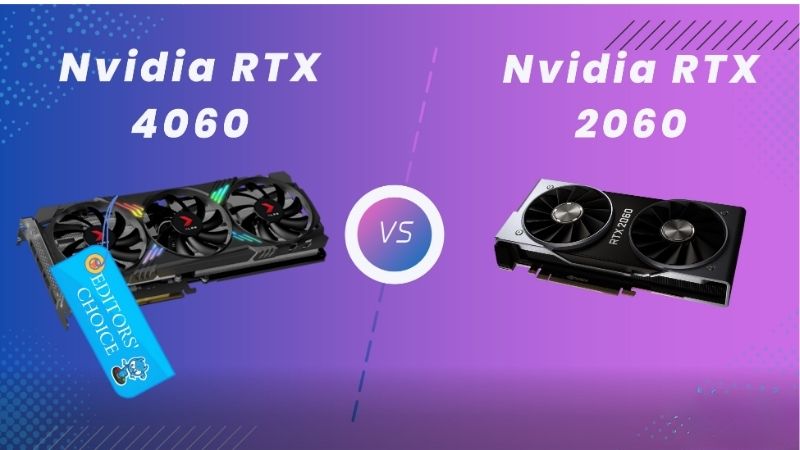
RTX 4060 vs 2060 produces a result that looks like an error until you know where to look. The RTX 2060 has a wider memory bus and more bandwidth than the RTX 4060 — 336 GB/s against 272 — and it loses by 25–30% anyway. That is not a typo and it is not a benchmark quirk. It is Nvidia making a deliberate architectural trade that most spec sheets do not show, and understanding it explains a great deal about how modern GPUs are built.
Quick answer: Our top pick in 2026 is the Architecture — our #1 rated choice. See the full ranked comparison, alternatives and buying advice below.
The Quick Verdict
The RTX 4060 wins by roughly 25–30% in rasterization, draws 45W less, and gets Frame Generation, which the 2060 cannot have. The 2060’s 6GB is the harder limit — it is the specification that decides whether recent titles are playable at all.
Where the 2060 Holds Up
Both cards are RTX, so both have RT cores and Tensor cores, and both run DLSS 4.5. Both sit on Nvidia’s supported driver branch — Turing was explicitly excluded from the October 2025 deprecation that ended Game Ready support for Maxwell, Pascal, and Volta. The 2060 is not abandoned.
The Variant That Changes the Question
There is an RTX 2060 12GB. It is not a 6GB card with more memory — it runs 2,176 CUDA cores against the 6GB model’s 1,920, and draws 184W against 160W. It is a different, faster product wearing the same name, and it solves the 2060’s biggest weakness.
Comparison Table
Four years and two architectures apart. The rows that matter are the two most people skip.
| Spec | RTX 2060 6GB (2019) | RTX 4060 (2023) | Note |
|---|---|---|---|
| Architecture | Turing (TU106) | Ada Lovelace (AD107) | Two generations |
| CUDA cores | 1,920 | 3,072 | 4060, +60% |
| RT cores | Yes (1st gen) | Yes (3rd gen) | 4060, better |
| Tensor cores | Yes (2nd gen) | Yes (4th gen) | 4060, better |
| L2 cache | 3MB | 24MB | 4060, 8x |
| VRAM | 6GB GDDR6 | 8GB GDDR6 | 4060, +2GB |
| Bus width | 192-bit | 128-bit | 2060, wider |
| Bandwidth | 336 GB/s | 272 GB/s | 2060, +24% |
| TDP | 160W | 115W | 4060, −45W |
| Upscaling | DLSS 4.5 | DLSS 4.5 | Identical |
| Frame generation | No | Yes (FG, not MFG) | 4060 |
| Driver status 2026 | Full support | Full support | Identical |
| Launch MSRP | $349 | $299 | 4060 |
The Cache Row Explains the Contradiction
Turing’s TU106 carries 3MB of L2 cache. Ada’s AD107 carries 24MB — eight times as much.
That is the whole answer. A large L2 means most memory requests never reach the VRAM at all; they are served from cache at a fraction of the latency and none of the bandwidth cost. Nvidia narrowed the bus from 192-bit to 128-bit, which is cheaper to manufacture, and compensated with cache.
So the 2060’s bandwidth advantage is a real number describing a problem the 4060 largely does not have. Bandwidth matters when you have to go to memory. Ada goes far less often.
The honest caveat: this bet weakens as resolution climbs. At 4K the working set outgrows even 24MB and the narrow bus starts to show, which is a large part of why the RTX 4060 is a 1080p card. Against a 2060, though, you are not comparing 4K — neither card does that.
Deep Dive Face-Off
Four criteria, from where the gap is smallest to where it decides everything.
Rasterization: A Modest 25–30%
The RTX 4060 leads by roughly 25–30% in most titles. That is 60% more cores plus two architectural generations, moderated by memory that went backwards on paper.
Framed honestly, this is not a good generational showing. The RTX 4060 was criticised at launch for exactly this — a 128-bit bus replacing a 192-bit predecessor, and 8GB in 2023. Four years delivering 25–30% is unremarkable.
It is still real, and it is not where this comparison is settled.
VRAM: Where the 2060 Actually Falls Over
6GB is the number that matters, and it is well past its limits. Modern titles at 1080p high routinely exceed it, and when VRAM fills the symptom is not a lower average frame rate — it is severe stutter as assets swap over the PCIe bus.
This is why the real-world gap frequently exceeds the 25–30% benchmark figure. In titles that exceed 6GB, the 2060 is not 30% slower; it is unplayable while the 4060 is fine. Averages hide that. 1% lows do not.
The 4060’s 8GB is itself criticised and it is meaningfully better than 6GB at 1080p. The difference between “sometimes tight” and “regularly exceeded” is larger than 2GB suggests.
Frame Generation: The One-Sided Feature
Both cards run DLSS 4.5 upscaling, which Nvidia says draws 23 of every 24 pixels on screen. On cards this size that is not a bonus — it is what makes recent titles playable, and the 2060 gets it in full.
What the 2060 does not get is Frame Generation, which requires RTX 40 or newer. Neither card gets Multi Frame Generation, which is RTX 50 only, and DLSS 5 — arriving this autumn with real-time neural rendering — is expected to need RTX 50 silicon.
Be precise about what Frame Generation does. It inserts AI-generated frames between rendered ones, improving smoothness without improving responsiveness, because generated frames carry no new input. On a card of this size it is best used to take a playable 50–60 FPS to a smooth 100, not to rescue 30. Used that way it is a genuine advantage and not a transformative one.
Power and Practical Fit
The 4060 draws 115W against the 2060’s 160W. On a machine of the 2060’s vintage, an upgrade that reduces power demand is the rare one where the PSU is not a hidden second purchase.
Both are compact cards, so clearance is not a concern in either direction. And on a 2019 card, thermal paste has had years to dry — a 2060 throttling at 83°C will underperform every benchmark you have read, and a repaste plus an undervolt costs an afternoon and recovers performance you have quietly been losing.
Worth checking before you conclude your 2060 is too slow. A card that has been throttling for two years feels like an old card and is frequently a dirty one.
The Trade Nvidia Made, and Whether It Was Right
Worth sitting with, because it recurs across the whole current lineup and explains several otherwise baffling products.
Cache is expensive in die area and cheap in bandwidth. Memory bus width is the reverse: cheap in die area, expensive in board complexity, power, and the number of memory modules you must buy. Nvidia chose cache.
At 1080p the bet pays. At 4K it does not, which is why Ada’s low-end cards are firmly 1080p products in a way their predecessors were not. The RTX 2060 could stretch to 1440p in a way the 4060 struggles to, despite being slower overall — its wider bus holds up better as the working set grows past cache.
The decision also looks different in 2026 than it did in 2023. Fewer memory modules per card is exactly the right position to be in when memory is the constrained input. What read as cost-cutting has become supply resilience — the same reason AMD’s GDDR6 choice on the RX 9070 XT aged better than its critics expected.
The Alternative
The RTX 4060 is the obvious comparison and in 2026 it is not the right buy.
The RTX 5060: Strictly Better, Often Cheaper
At $299 MSRP with 3,840 Blackwell CUDA cores, 8GB of GDDR7 at 448 GB/s and 145W, the RTX 5060 beats the 4060 on every axis: 25% more cores, 65% more bandwidth, and Multi Frame Generation.
It has also held nearest to list of anything in the current lineup, trading around $339 as of July 2026 — frequently at or below a new RTX 4060, which is now in short supply rather than on clearance.
For a 2060 owner this is the upgrade. Same physical class, similar power envelope, and a runway that includes DLSS 5 this autumn.
The RTX 2060 12GB: The Cheap Fix
If your complaint is stutter rather than frame rate, the 12GB 2060 is worth knowing about. 2,176 cores, twice the VRAM, same 336 GB/s, and it appears on the used market for considerably less than any new card.
It does not gain you Frame Generation and it is still Turing. But if 6GB is what breaks your evenings, doubling it for used-market money is the cheapest solution available.
Keeping the 2060
Legitimate for esports and older titles. The card still runs CS2, Valorant, and anything from before roughly 2021 at good frame rates, and Turing remains on the supported driver branch with DLSS 4.5 available.
The limit is the 6GB. That is not fixable and it is what will decide this for you.
What the 2026 Market Means for the Timing
The performance case is clear. Whether to act on it now is a market question, and the market has been unusual.
Prices Flattened, Not Fallen
Component pricing has continued trending upward, memory foremost. The positive news is real but weak: the steep late-2025 climb has flattened, and Framework has reported a stretch of relative stability while still warning that volatility remains. New supply is opening — OEMs can source DDR5 from Chinese suppliers such as CXMT, and Micron is building two Idaho fabs — but neither produces until 2027–2028.
It has also become more selective at the top. At CES 2026, board partners reported the RTX 5070 Ti and RTX 5060 Ti 16GB as end of life while Nvidia disputed the claim, and Nvidia’s allocation has visibly shifted toward 8GB parts. For someone shopping the entry tier, that is the good news — those are the tiers still in normal supply.
The Practical Read
Prices stopped rising sharply and have not dropped. The supply that would drop them is three years out. The cards on shelves now are approximately the cards on shelves in 2028, at approximately these prices.
Your 2060 is not in trouble on drivers — Turing is supported and will be for years. The problem is 6GB, and no driver, upscaler, or market correction fixes that.
If your 1% lows are collapsing in the games you actually play, the arithmetic is unsentimental. It is worth comparing what the RTX 5060 and 5060 Ti cost today — they are the two tiers nearest list price and the two Nvidia is clearly still making.
See More:
- Nvidia beta
- Nvidia CUDA 11.8
- Check CUDA version
- Nvidia GPU for gaming
- PNY GeForce RTX 5080 16GB OC review
Final Verdict and Recommendation
The RTX 4060 vs 2060 verdict inverts the spec sheet in a way that is genuinely instructive. The RTX 2060 has a 192-bit bus against the 4060’s 128-bit and delivers 24% more bandwidth — and loses by 25–30%, because Ada’s 24MB of L2 cache against Turing’s 3MB means the newer card rarely needs to go to memory at all. Bandwidth is only worth what you have to use.
But the decisive number is 6GB. In titles that exceed it, the 2060 is not 30% slower — it stutters while the 4060 runs fine, and that is a different category of problem.
Do not buy an RTX 4060. Buy an RTX 5060: 25% more cores, 65% more bandwidth, Multi Frame Generation, and it has held nearer to list than the older card. Look at the RTX 2060 12GB if your budget is genuinely fixed and stutter is your complaint — it is the cheapest fix for the actual problem. Keep the 2060 6GB if you play esports and it is fine, because Turing keeps its drivers and nobody should spend $339 for frames they cannot perceive. Run a repaste first — on a card this age, a good deal of the slowness people attribute to obsolescence turns out to be dried thermal compound.
Frequently Asked Questions
How can the RTX 4060 be faster with less memory bandwidth?
The 2060 uses a 192-bit bus for roughly 336GB per second, while the 4060 uses a 128-bit bus for about 272GB per second. Ada compensates with a much larger 24MB L2 cache that keeps far more traffic on the die, so fewer requests reach the memory. Effective bandwidth in real workloads ends up higher despite the narrower bus.
How much faster is it in practice at 1080p?
Expect roughly twenty to thirty percent more frames at 1080p in rasterised titles, with a bigger gap in ray traced workloads because Ada has third generation RT cores. In games supporting DLSS 3 frame generation the displayed frame rate gap is far larger still, since the 2060 cannot use frame generation at all.
Is 8GB on the 4060 better than 6GB on the 2060?
Yes, and it is one of the clearest wins. The extra 2GB lets you hold high texture settings in modern titles where the 2060 has to drop to medium to avoid frame time spikes. Neither card is comfortable at 1440p ultra textures, but the 4060 has meaningfully more headroom at 1080p.
What are the power and PSU differences?
The 4060 draws about 115W against roughly 160W for the 2060, both on a single 8-pin connector. That makes the 4060 a genuinely easy drop-in upgrade for a prebuilt with a modest supply, and it runs cooler and quieter in the same case. A 450W to 500W quality unit is comfortable for either.
Does the PCIe x8 link on the 4060 matter?
The 4060 uses eight PCIe 4.0 lanes. On a PCIe 4.0 motherboard the impact is negligible. On an older PCIe 3.0 board the link halves to the equivalent of PCIe 3.0 x8 and you can lose a few percent, more in scenes that spill past the 8GB buffer. It is worth factoring in on very old platforms.
Ready to decide? Our #1 pick for 2026 is the Architecture.
Live price & availability on Amazon.

Write Your Review
No reviews yet. Be the first to share your experience!