
- Top Pick: Xbox Architecture: A feared competitor (Architecture of Consoles: A practical analysis (single article) Book 13)
- Best Value: Broadcom and the New AI Chip Race: How Custom ASICs, Google’s TPUs, Meta’s AI Plans, and the Demand for Powerful Silicon Could Shape the Future of Artificial Intelligence
- Premium Choice: NVIDIA DELL R27V4 NVIDIA Quadro P1000 GPU 4GB Graphics Video Card
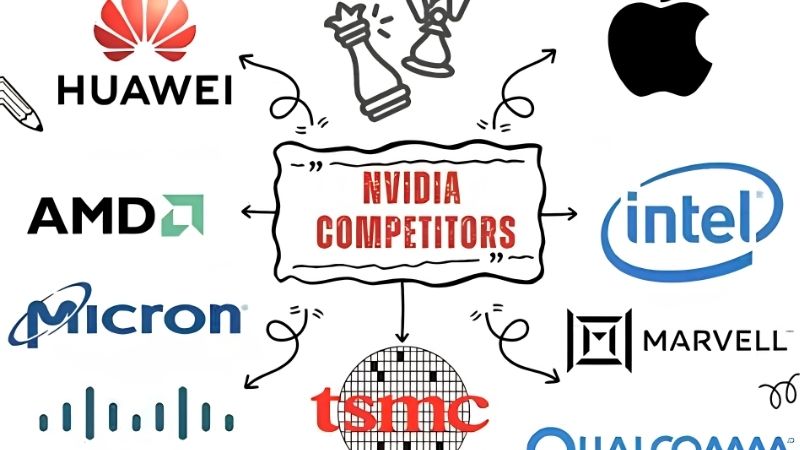
Nvidia competitors in 2026 form a crowded and fast-moving field, even as Nvidia holds a commanding lead in AI chips. Rivals range from long-time GPU makers like AMD and Intel to hyperscalers building their own silicon and a wave of specialized AI-chip startups. This article maps the full landscape, explains how Nvidia stays ahead, and weighs what the alternatives mean for buyers.


Nvidia’s Traditional GPU Rivals
The oldest competition comes from other makers of graphics and accelerator chips. These are the companies that have battled Nvidia the longest.
As an Amazon Associate we earn from qualifying purchases at no extra cost to you.




AMD, the Closest Competitor
What makes AMD Nvidia’s most credible challenger is that it competes across both of Nvidia’s major arenas rather than just one. In gaming, its Radeon cards offer a genuine alternative for PC builders, and its chips power major game consoles, keeping it relevant to a huge audience. In the data center, its Instinct accelerators are increasingly taken seriously by large customers seeking a second source to Nvidia. Even so, the gulf in scale remains vast, and AMD’s task is less about overtaking Nvidia than about steadily capturing a meaningful minority share of a rapidly expanding market.
Advanced Micro Devices is Nvidia’s nearest rival, competing directly in both gaming graphics with its Radeon line and in the data center with its Instinct accelerators, such as the MI300 and MI325X series.
AMD has been winning some notable data-center deals, including deployments with large customers like Meta and Microsoft, and its AI chip revenue is growing quickly.
Still, AMD’s data-center AI sales remain a fraction of Nvidia’s, which posts data-center revenue in the tens of billions of dollars every quarter, underlining how large the gap remains.
Intel’s GPU and AI Push
Intel’s position is complicated by the fact that it is simultaneously trying to fix its core manufacturing business while breaking into markets Nvidia already dominates. Its consumer graphics effort has improved but remains a distant challenger, and its data-center AI ambitions have repeatedly been reset as strategies shifted. The company’s deep engineering resources and manufacturing heritage mean it cannot be dismissed, but turning those assets into competitive AI accelerators with a mature software stack is a long, uphill campaign against a rival that keeps extending its lead each year.
Intel is the other veteran challenger, offering Arc GPUs for consumers and pursuing AI workloads through its accelerator efforts, having wrestled for years to establish a foothold against Nvidia.
Under CEO Lip-Bu Tan, Intel refocused its AI strategy around rack-scale systems, pivoting to a next-generation accelerator and unveiling new data-center chips as it tries to regain relevance.
Intel’s challenge is steep, since it must catch up in both hardware performance and the software ecosystem while also strengthening its core manufacturing business.
The Gaming vs Data-Center Battle
The economic stakes of these two fronts could hardly be more different, which shapes where competition is fiercest. Gaming graphics cards sell in large volumes at consumer prices, making it a meaningful but comparatively modest business. Data-center AI accelerators, by contrast, command premium prices and generate the overwhelming majority of Nvidia’s revenue and profit, so it is there that rivals most want a foothold and there that Nvidia defends most fiercely. A competitor strong in gaming may be irrelevant in AI, and it is AI where the real money and the real battle now lie.
Nvidia faces its rivals on two very different fronts. In gaming, AMD is the main alternative, and consoles powered by AMD chips keep that competition alive even as Nvidia dominates PC graphics cards.
In the data center, the stakes are far higher, since AI accelerators command premium prices and drive the bulk of Nvidia’s revenue, making it the battleground everyone wants to contest.
Understanding this split matters, because a company can be a strong gaming rival yet barely register in AI, or vice versa, and few compete effectively across both.
The Custom-Silicon Challengers
Some of Nvidia’s most important competition now comes from companies that also happen to be its biggest customers, plus a wave of specialists. This is the fastest-changing part of the landscape.
Hyperscaler Chips
The relationship between Nvidia and these cloud giants is one of the most fascinating dynamics in the industry, because they are customers and competitors at the same time. Each has strong incentives to reduce its dependence on Nvidia by designing chips tuned to its own workloads, yet none can fully abandon Nvidia’s GPUs given their versatility and the maturity of the surrounding software. The result is a hedged coexistence in which the hyperscalers run their own silicon for certain tasks while continuing to buy enormous quantities of Nvidia hardware for everything else.
The largest cloud providers increasingly design their own AI chips to reduce reliance on Nvidia. Google’s TPU line is the most mature, while Amazon builds Trainium and Inferentia chips and Microsoft has its Maia accelerators.
These custom application-specific chips can offer better performance per watt for the provider’s own workloads, and industry forecasts expect such chips to grow faster than general-purpose GPUs in the near term.
The twist is that these hyperscalers remain among Nvidia’s biggest buyers, splitting their compute between their own silicon and Nvidia’s GPUs rather than abandoning one for the other.
Broadcom, Marvell and the ASIC Enablers
These enablers occupy a clever strategic position, profiting from the custom-chip trend without having to win any single winner-take-all battle. By supplying the design expertise and networking technology that hyperscalers need to build their own accelerators, they benefit whenever a cloud provider decides to roll its own silicon, regardless of which provider succeeds. This makes them an indirect but growing competitive pressure on Nvidia, since every successful custom chip they help create represents workloads that might otherwise have run on Nvidia GPUs, even though they never sell a GPU themselves.
Behind many hyperscaler chips stand Broadcom and Marvell, which provide the design services and networking technology that power a large majority of custom AI silicon.
Rather than selling GPUs, these firms help others build tailored accelerators, positioning themselves to benefit from the custom-chip trend regardless of which cloud provider wins.
Broadcom in particular has become a significant force, working with partners including OpenAI on bespoke inference chips, making it an indirect but important competitive factor for Nvidia.
AI-Chip Startups
The strategy for these startups is rarely to beat Nvidia across the board, which would be nearly impossible, but to dominate a specific niche where their architecture holds a real edge. A design optimized purely for inference, or for extremely large models, can outperform a general-purpose GPU on that narrow task while faltering elsewhere. This specialization is both their strength and their vulnerability, since a concentrated architectural bet can win handsomely if the market moves its way or falter badly if model architectures evolve in an unexpected direction, leaving the startup’s design stranded.
A cohort of well-funded startups targets specific slices of the market. Cerebras builds enormous wafer-scale chips and completed a major public listing in 2026, while Groq focuses on ultra-fast inference with its specialized processors.
Others, including SambaNova, d-Matrix, and Etched, pursue novel architectures aimed at running AI models more efficiently than general-purpose GPUs for particular workloads.
These challengers rarely threaten Nvidia’s breadth, but each can carve out profitable niches where its specialized design outperforms a general GPU, chipping away at the edges of Nvidia’s dominance.
How Nvidia Stays Ahead
Despite the crowded field, Nvidia has kept a commanding lead. Understanding why explains the true shape of the competition.
The CUDA and Systems Moat
The depth of this software moat is easy to underestimate from the outside. Years of AI research, tooling, and developer habit have been built on top of CUDA, meaning that switching to a rival chip is not just a hardware decision but a costly re-engineering effort that can slow a team down for months. Combined with Nvidia’s move toward selling fully integrated systems, where the chips, interconnects, networking, and software are tuned to work together out of the box, this lock-in gives customers powerful reasons to stay even when a competing chip looks appealing in isolation.
Nvidia’s deepest advantage is not any single chip but its CUDA software platform, which most AI developers build on and which creates real switching costs for anyone considering a rival.
The company also increasingly sells complete systems rather than bare chips, bundling GPUs, high-speed interconnects, networking, and software into rack-scale platforms that competitors struggle to match at the system level.
This combination of software lock-in and integrated systems is what keeps customers loyal even when individual competing chips look attractive on paper.
Market Share and the Road Ahead
Nvidia held an estimated majority of the AI GPU segment through the mid-2020s, a share so large that rivals are competing for the remainder rather than for leadership.
Analysts expect that share to erode gradually rather than collapse, potentially slipping over several years as custom chips and AMD gain ground, but Nvidia keeps moving the target with new architectures roughly every year to eighteen months.
Its rapid cadence, with the Blackwell generation already giving way to a next-generation superchip design, makes it hard for competitors to catch a stationary target.
Pros and Cons for Buyers
For buyers weighing alternatives, there are genuine pros and cons. The pro of choosing a competitor can be lower cost or better efficiency for a specific workload, as some rival chips undercut Nvidia’s pricing or excel at inference.
Cloud-based access to alternatives like Google’s TPUs can also spare startups the expense of buying Nvidia hardware outright, lowering the barrier to serious AI work.
The con is that leaving Nvidia often means leaving CUDA and its mature ecosystem, which can raise engineering effort, limit flexibility, and create risk if a specialized chip does not fit a changing model architecture.
See More:
The Bottom Line on Nvidia Competitors
In 2026, Nvidia competitors span traditional rivals like AMD and Intel, hyperscaler custom silicon such as Google TPU and AWS Trainium, ASIC enablers like Broadcom, and startups including Cerebras and Groq, yet none has broken Nvidia’s dominance thanks to its CUDA moat and system-level integration. Expect its lead to narrow slowly rather than vanish. For a closer look at how Nvidia and AMD stack up in practice, explore our detailed GPU reviews and comparison guides.
Frequently Asked Questions
Who competes with NVIDIA in AI data centre accelerators?
AMD is the closest merchant-silicon rival with its Instinct MI series, which competes strongly on memory capacity and bandwidth. Intel offers Gaudi accelerators. Beyond those, hyperscalers build their own: Google TPUs, Amazon Trainium and Inferentia, and custom designs from Broadcom and Marvell for various cloud customers. Startups including Cerebras and Groq target specific training or inference niches.
Why has no competitor displaced NVIDIA yet?
The barrier is software and systems, not raw silicon. CUDA and its libraries underpin nearly two decades of AI code, and NVIDIA also sells the networking, rack designs and reference systems that make large clusters work. AMD’s ROCm has improved substantially but still trails in breadth and maturity, so migration carries engineering cost and schedule risk.
Who competes in consumer gaming graphics?
AMD Radeon is the long-standing rival, with RDNA 4 narrowing the ray tracing gap and FSR 4 improving upscaling quality. Intel Arc competes at the budget end with aggressive pricing and a solid media engine. Qualcomm and Apple compete indirectly through integrated graphics in laptops and handhelds rather than in discrete add-in cards.
Are the cloud providers customers or competitors?
Both, which is the structural tension in NVIDIA’s business. Amazon, Google, Microsoft and Meta are among its largest customers while simultaneously developing in-house silicon to reduce dependence and cost. Custom chips typically handle high-volume internal inference workloads first, with frontier training remaining on NVIDIA hardware, so the substitution is gradual rather than sudden.
What would a genuine competitive threat look like?
A rival platform reaching parity on total cost of ownership for real workloads, backed by a software stack that frameworks support out of the box, plus enough supply of advanced packaging and high-bandwidth memory to ship at volume. Watch for major AI laboratories publicly training frontier models on non-NVIDIA hardware, which would be the clearest signal.



Write Your Review
No reviews yet. Be the first to share your experience!