
- Top Pick: ASRock Radeon RX 9060 XT Challenger 16GB OC, RDNA 4, 3290MHz Boost, 16GB GDDR6 128-bit, PCIe 5.0, Dual Fans, 0dB Silent, LED Indicator, DisplayPort 2.1a, HDMI 2.1b
- Best Value: ASRock Radeon RX 9060 XT Steel Legend 8GB GDDR6 OC Graphics Card | 3320 MHz Boost | Triple Fan | 0dB Cooling | Metal Backplate | PCIe 5.0 | DisplayPort 2.1a, HDMI 2.1b
- Premium Choice: ASRock Radeon RX 9060 XT Challenger Pro 16GB OC Graphics Card, RDNA 4, 3290MHz Boost, 16GB GDDR6 128-bit, PCIe 5.0, Triple Fan, 0dB Silent, LED Switch

Prime
Editor's Pick
ASUS Dual Radeon RX 9060 XT 16GB GDDR6 Graphics Card, AMD, for Desktop (PCIe 5.0, HDMI 2.1b, DisplayPort 2.1a, 2.5-Slot, Axial-tech Fan, 0dB Technology, and More)

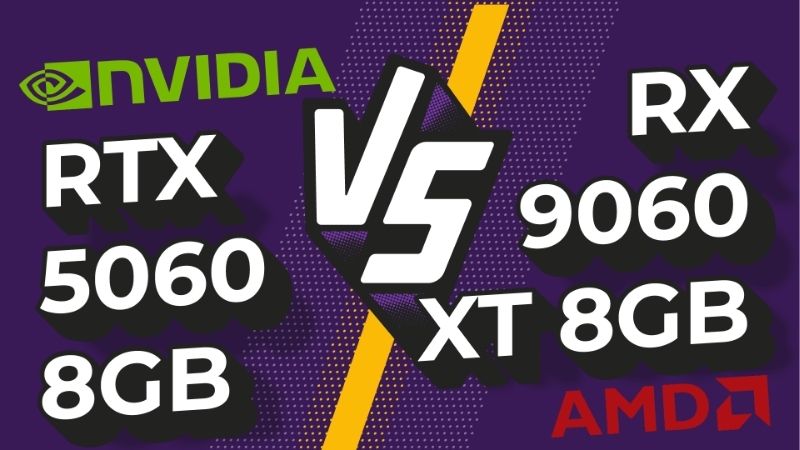
9060 XT 16GB vs 5060 8GB is the mid-range decision that hinges almost entirely on one number: memory. You want the specs cross-referenced in a table you can scan in seconds, a clear winner in every category, and a straight answer on whether the extra VRAM actually matters for the games you play, all without sitting through a long video that saves its verdict for the end. This page lays out the frame rates, the memory story, and a firm recommendation so you can decide with confidence and buy the same day.
The Quick Verdict: 9060 XT 16GB vs 5060 8GB at a Glance
If you only read one part of this comparison, make it this one. The RX 9060 XT 16GB is the stronger raw-performance and future-proofing pick for 1440p and high-refresh 1080p, while the RTX 5060 8GB wins on power efficiency, DLSS 4 image quality, and the lowest sticker price. Neither card is a mistake; they simply target slightly different buyers, and the three sub-sections below break the verdict down by category before we get into the detailed deep dive.
As an Amazon Associate we earn from qualifying purchases at no extra cost to you.




Who Wins on Raw Performance and VRAM
In rasterized 1080p and 1440p gaming, the RX 9060 XT 16GB generally posts higher average frame rates, and its lead widens as texture settings and resolution climb toward the demanding end. The gap is driven partly by the core itself and heavily by the 16GB buffer, which keeps the card fed in exactly the situations where the 8GB RTX 5060 begins to run out of room.
The RTX 5060 stays competitive when ray tracing is switched on and in titles specifically tuned for DLSS, where NVIDIA’s pipeline claws back frames that raw specs alone would not deliver. That advantage is real, but it is situational rather than universal. For the raster-first library most players own, that keeps the AMD card ahead in everyday use.
Performance verdict: the 9060 XT 16GB wins raw frames and VRAM headroom across the board, while the 5060 only keeps pace when ray tracing and upscaling are doing the heavy lifting for it.
Who Wins on Price and Efficiency
The RTX 5060 8GB targets roughly $299, which makes it the cheaper entry point into current-gen NVIDIA hardware, and it sips power at around 145W. The RX 9060 XT 16GB sits near $349 and draws more, so the trade boils down to roughly $50 for double the memory capacity.
For efficiency-focused or small-form-factor builds, the 5060 is simply easier to power and cool, and it slots into weak prebuilts without drama. For buyers who want the card to age gracefully and delay their next upgrade, the extra $50 on the 16GB Radeon is usually money very well spent. Lower running costs and quieter operation over years of use only sweeten that case further.
Value verdict: choose the 5060 for the lowest upfront price and the quietest low-power build, and the 9060 XT 16GB for the best price-to-longevity ratio over the life of the card.
Comparison Table: Specs Side by Side
Here is the condensed spec sheet so you can weigh both cards at a glance without hunting through separate product pages. The prices are approximate reference figures rather than fixed quotes, so always confirm the live listing before you commit to either card.
| Spec | RX 9060 XT 16GB | RTX 5060 8GB |
|---|---|---|
| VRAM | 16GB GDDR6 | 8GB GDDR7 |
| Typical board power | ~150W to 180W | ~145W |
| Power connector | 1x 8-pin | 1x 8-pin |
| Upscaling | FSR 4 | DLSS 4 + Multi Frame Gen |
| Best resolution | 1440p, 1080p high-refresh | 1080p, light 1440p |
| Reference price | ~$349 | ~$299 |
The table makes the trade-off obvious at a glance: more memory and raw power on the AMD side, newer GDDR7, lower power draw, and the more mature DLSS 4 feature set on the NVIDIA side. Keep that balance in mind as we break down each factor in detail below.
Deep Dive Face-Off: Where Each Card Pulls Ahead
The headline specs only hint at what daily use feels like. This section breaks the matchup down by the three factors that actually decide it: the VRAM divide at 1440p, the competing upscaling technologies, and the practical build requirements you have to plan around before you order either card. Each one is a place where one card quietly pulls ahead of the other.
The 16GB vs 8GB VRAM Divide at 1440p
Memory is the entire story of this comparison, and it is impossible to overstate. The RTX 5060 ships with 8GB, which is fine for many 1080p titles today but is already a ceiling in newer games that lean on high-resolution texture packs and detailed asset streaming. The RX 9060 XT 16GB doubles that pool, and that headroom is the heart of the decision.
At 1440p and in texture-heavy games, an 8GB card starts swapping data in and out of memory, which crushes the 1% lows and produces visible stutter even when the average FPS counter still looks perfectly healthy. The 16GB card sidesteps that wall and holds smoother frame pacing, which is exactly why it feels more consistent as games get heavier over the next few years. A healthy average frame rate can still hide the stutter an 8GB card produces once its memory fills.
If you game only at 1080p and upgrade every couple of years, 8GB remains livable and the 5060 is fine. If 1440p or a long upgrade cycle is your plan, the 9060 XT 16GB is the clearly safer buy in this 9060 xt 16gb vs 5060 8gb decision, and it is hard to argue otherwise once you see how modern titles behave.
DLSS 4 vs FSR 4 and Frame Generation
This is where NVIDIA fights back hardest. DLSS 4 with Multi Frame Generation is widely supported and often produces cleaner image reconstruction than FSR, and it is the RTX 5060 biggest technological advantage. In ray-traced titles especially, it can lift the 5060 above what its raw specifications would suggest.
AMD counters with FSR 4, which has meaningfully narrowed the quality gap, plus the raw horsepower and the larger buffer that let the 9060 XT push higher base frame rates before any upscaling is even applied. The forward-looking angle is that both technologies keep improving through driver updates, so the effective value of whichever card you buy should grow over time rather than stagnate, and NVIDIA’s longer track record here remains a genuine plus.
Feature verdict: NVIDIA leads on upscaling maturity and ray tracing, AMD leads on raw output and memory capacity, and the games you actually play decide which of those advantages matters more to you.
Power, PSU, and Case Compatibility
On the practical side, the RTX 5060 at roughly 145W is the easier install by a clear margin. A quality 450W to 550W power supply handles it comfortably, and compact partner models drop into small cases and modest prebuilts without any fuss at all.
The RX 9060 XT 16GB draws more, landing in the 150W to 180W range depending on the specific model, so plan for a 550W to 650W supply and double-check case clearance, since some board-partner designs are longer or use bulkier coolers. Measuring your case before ordering saves an annoying return down the line.
Both cards use a single 8-pin connector, so neither forces you onto a new PSU standard or an adapter. If you are dropping a card into an aging prebuilt with a modest, no-name supply, the lower-draw 5060 is the safer, no-surprises choice, and that convenience carries real value. For a first-time builder, avoiding a PSU headache on install day is worth more than a few percent of frame rate.
Pricing, Market Timing, and the Smart Buy
A mid-range GPU decision in 2026 is also a timing decision, because component prices have been unusually volatile. This section explains what is actually happening in the market so you can judge whether to buy now or wait, a factor that reshapes the 9060 xt 16gb vs 5060 8gb value math as much as the raw specifications do.
Why Mid-Range GPU Prices Stay Elevated
Laptop and PC component prices have trended upward, and graphics cards have not escaped the pressure. Memory costs in particular have kept board prices high, which is precisely why the $50 gap between an 8GB and a 16GB card deserves real thought rather than a reflexive grab for the cheaper option.
For a budget buyer, paying once for more VRAM can end up cheaper than upgrading again into an even more expensive market a couple of years down the road. That reality tilts the frugal choice toward the durable card far more often than people expect when they are focused only on the sticker price.
Practical read: elevated pricing rewards buying the card with the longer useful life, which tilts the argument toward the 16GB Radeon for anyone who intends to hold onto their GPU rather than flip it quickly. Put simply, the longer you plan to keep the card, the more the memory argument favors the AMD option.
The Supply Relief Coming in 2027-2028
There is genuine good news here, but it is modest and it sits in the future rather than the present. Prices have stopped climbing as steeply as they did at the end of 2025, and some hardware makers have reported a relatively stable stretch, even while they continue to warn that further swings are possible.
New supply is opening up too: OEMs can source DDR5 from Chinese suppliers such as CXMT, and Micron is building two new plants in Idaho to expand output. The catch is timing, because those fabs do not come online until roughly 2027 to 2028, so any meaningful relief for buyers is still a couple of years away.
Timing read: prices have leveled off rather than fallen, and genuine cost relief is years out, so waiting indefinitely for a dramatic crash is a gamble. Buying the right-sized card now is the pragmatic move.
Pros, Cons, and an Alternative
Here is the honest pros and cons summary for the 9060 xt 16gb vs 5060 8gb choice, drawn from the consistent patterns in owner feedback for each card, so you know the trade-offs before you spend a cent.
RX 9060 XT 16GB pros: more VRAM for 1440p and future titles, stronger raw performance, and better longevity. Cons: higher power draw, FSR still trailing DLSS in some titles, and larger boards you must measure for fit.
RTX 5060 8GB pros: the lowest price, excellent efficiency, DLSS 4 and strong ray tracing, and effortless small-case fit. Cons: only 8GB VRAM, weaker at 1440p, and a shorter comfortable lifespan. If neither quite fits, a step-up alternative such as an RTX 5060 Ti 16GB adds both memory and speed, while a used prior-generation card is the cheapest fallback of all. Check the live price on all three before you commit, because the current deal often decides the winner.
See More:
- RX 9060 XT vs RTX 4060
- NVIDIA Jetson price
- NVIDIA GeForce GTX 1650 driver
- Intel Iris Xe graphics driver
Final Verdict: Who Should Buy the 9060 XT 16GB vs 5060 8GB
To settle the 9060 xt 16gb vs 5060 8gb debate: buy the RX 9060 XT 16GB if you game at 1440p, keep hardware for several years, or simply want the most frames and memory per dollar in a market where upgrading later will almost certainly cost more. Buy the RTX 5060 8GB if you want the lowest price, the quietest low-power build, easy small-case fit, or the strongest DLSS 4 and ray-tracing experience at 1080p. Both are solid cards, and the right pick comes down entirely to your resolution and how long you plan to keep the GPU. Use the button below to check the latest live price and availability before you order, so you lock in the best deal while pricing and stock are still on your side.
Frequently Asked Questions
Does the 16GB Radeon really beat the RTX 5060 at 1440p?
In memory heavy titles yes, and often by a wide margin in frame time consistency rather than raw averages. Both cards use a 128-bit bus and sit in the same class, but the RTX 5060 stutters when a game exceeds 8GB while the RX 9060 XT 16GB keeps streaming textures smoothly.
What does NVIDIA offer that AMD does not here?
Stronger ray tracing throughput, DLSS 4 with multi frame generation, NVIDIA Smooth Motion for games without native frame generation, the widely praised NVENC encoder for streaming, and CUDA support that many creative and AI applications assume. Those features are the real argument for the RTX 5060 despite its smaller frame buffer.
How do power draw and cooling compare?
The RTX 5060 draws about 145 watts, and the RX 9060 XT ranges from roughly 150 to 182 watts depending on the model. Both are dual fan class cards that run cool and quiet, and both are satisfied by a quality 550 watt supply using standard 8-pin PCIe connectors.
Which one ages better?
The 16GB card, most likely. Game memory requirements have risen consistently and capacity cannot be upgraded after purchase, whereas a shader deficit can be masked with upscaling. Unless you specifically need NVIDIA features, the larger frame buffer is the more defensible choice for a build you plan to keep.
Is either card suitable for 4K gaming?
Neither is a 4K card. The 128-bit memory bus on both limits bandwidth well before shader count becomes the issue. You can play older or less demanding titles at 4K with aggressive upscaling, but for modern AAA games at 4K you need to step up to a 5070 Ti class product or higher.

Write Your Review
No reviews yet. Be the first to share your experience!