
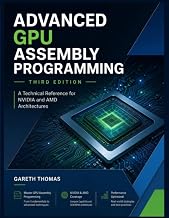
- Top Pick: Advanced GPU Assembly Programming Third Edition: A Technical Reference for NVIDIA and AMD Architectures (GPU Expert Engineering: Mastering Design, Programming, and Optimization)
- Best Value: NVIDIA GPU Performance Engineering: A Comprehensive Guide to PTX, SASS, CUDA Optimization, Kernel Analysis, Memory Hierarchies, Warp Execution, and High-Throughput Parallel Computing
- Premium Choice: Modern GPU Architecture Third Edition: Volume 2 — Acceleration, Integration, and Physical Design (GPU Expert Engineering: Mastering Design, Programming, and Optimization)
Two architecture names dominate the Nvidia cards most people own today: Ampere, which powered the RTX 30 series, and Ada Lovelace, the engine behind the RTX 40 series. Understanding what actually changed between them explains why a newer card can be dramatically faster while drawing similar power, and why features like DLSS 3 frame generation only work on one of the two. This is the knowledge that turns a confusing spec sheet into a confident buying decision.
Below we break down the real differences in manufacturing process, cache design, ray tracing, and AI upscaling, then point to the technical references worth reading if you want to go deeper. Whether you are choosing a used RTX 3070 or a current RTX 40-class card in 2026, knowing the architecture underneath is the difference between paying for marketing and paying for performance.
As an Amazon Associate we earn from qualifying purchases at no extra cost to you.


⚡ Save on Your Next PC — Amazon Prime
Prime members get fast free shipping on the systems above, plus early access to Prime Day & Black Friday PC deals. New members get a 30-day free trial.
Watch: Understanding Nvidia GPU Architecture: Ada Lovelace vs. Ampere — Video Review
How to Choose
- Process node first: Ada Lovelace is built on a custom TSMC 4N node versus Ampere’s Samsung 8nm; the denser node is why Ada packs far more transistors and runs more efficiently per watt.
- Weigh the L2 cache jump: Ada dramatically enlarged on-die L2 cache (up to 72 MB on top cards), reducing memory traffic and boosting effective bandwidth, a bigger real-world gain than raw core counts suggest.
- Check DLSS generation support: Only Ada’s 4th-gen Tensor Cores support DLSS 3 frame generation; Ampere is capped at DLSS 2 super resolution, a decisive factor for high-refresh gaming.
- Compare ray tracing tiers: Ada’s 3rd-gen RT Cores roughly double ray-triangle throughput over Ampere’s 2nd-gen, so path-traced titles are far more playable on Ada.
- Right-size VRAM to your workload: Architecture aside, match memory capacity to your resolution and creative apps; 8 GB is entry, 12-16 GB is the modern sweet spot.
The Best Picks Reviewed
Modern GPU Architecture, Third Edition (Volume 1: Foundations)
This is the ideal starting reference. It builds the mental model, streaming multiprocessors, warps, memory hierarchy, that you need before Ampere-versus-Ada comparisons make sense. Read this first and the rest of the discussion clicks into place.
Modern GPU Architecture, Third Edition (Volume 2: Acceleration & Integration)
Volume 2 picks up where the foundations leave off, covering the accelerator blocks, RT and Tensor Cores, that most distinguish Ada from Ampere. It is the natural companion for understanding why generational feature support diverges.
NVIDIA GPU Performance Engineering: A Comprehensive Guide to PTX, SASS
For developers and enthusiasts who want to profile real workloads, this guide connects architecture to measured performance. It explains how cache sizes and scheduler changes translate into frames and compute throughput rather than staying theoretical.
Mastering PTX and SASS: Low-Level GPU Programming
The most technical pick here, aimed at people writing or optimizing kernels. If you want to understand exactly how Ada’s instruction scheduling and larger cache change code behavior, this is the deep end of the pool.
Mastering NVIDIA Blackwell Architecture
To see where the lineage is heading, this Blackwell reference frames Ampere and Ada as steps toward Nvidia’s newest designs. It is a useful forward-looking bookend once you understand the two generations in the title.
Frequently Asked Questions
Is Ada Lovelace always faster than Ampere?
Tier for tier, yes, thanks to the newer node, larger cache, and faster cores. But a high-end Ampere card like the RTX 3090 can still outperform a low-end Ada card, so compare specific models, not just architecture names.
Why can’t my Ampere card use DLSS 3 frame generation?
Frame generation relies on the Optical Flow Accelerator and 4th-gen Tensor Cores that debuted with Ada. Ampere hardware lacks them, so it is limited to DLSS 2 super resolution, though it still benefits from that.
Does the bigger L2 cache on Ada really matter?
Yes. The enlarged cache keeps more data on-die, cutting trips to slower VRAM. That effectively raises usable bandwidth and is a major reason Ada gains performance without a proportional increase in memory bus width.
Should I buy a used Ampere card in 2026?
Used Ampere cards can be excellent value for 1080p and 1440p gaming if priced right. Just accept you will miss DLSS 3 and pay more in power draw, and prioritize models with 10 GB or more VRAM for longevity.
Final Thoughts
Ampere and Ada Lovelace are close in philosophy but a full generation apart in execution: a denser process, far more cache, and next-tier RT and Tensor Cores. In 2026, Ada is the smarter buy if DLSS 3 and path tracing matter to you, while well-priced Ampere still delivers strong value. Ground your decision in the architecture, and the reference titles above will keep paying dividends long after the purchase.


Write Your Review
No reviews yet. Be the first to share your experience!