
- Top Pick: Skytech Gaming Rampage Gaming PC, Intel i5 14400F 2.5GHz, NVIDIA RTX 5070 12GB VRAM, 1TB Gen4 NVMe SSD, 24GB DDR5 RAM 6000, 850W Gold ATX 3 PSU, Wi-Fi 5, Windows 11, Desktop
- Best Value: ZOTAC MEK Gaming PC Desktop, Ryzen 7 9700X, NVIDIA GeForce RTX 5070 Ti 16GB
- Premium Choice: Skytech Gaming Blaze 5 Gaming PC, Intel i7 14700F 2.1GHz, NVIDIA RTX 5070 12GB VRAM, 1TB Gen4 NVMe SSD, 16GB DDR4 RAM 3200, 850W Gold ATX 3 PSU, 360 ARGB AIO, Wi-Fi 5, Windows 11, Desktop
Top Rtx 4070 Rtx 5070 Same Picks for 2026
Here are our current top rtx 4070 rtx 5070 same picks, compared on real Amazon owner reviews, price, and features. Live prices update below.
- Top Rtx 4070 Rtx 5070 Same Picks for 2026
- The Quick Verdict: RTX 4070 vs RTX 5070 in 30 Seconds
- Deep Dive: Measuring a Single Generation
- 2026 Market Forces: How Long Does the Old Card Linger?
- Final Verdict: Pros, Cons, and the Cross-Aisle Option
- Conclusion
- Related Guides
- Frequently Asked Questions
- Related Articles


Dropped $2.52


Save $80.99
RTX 4070 vs RTX 5070 is the purest successor matchup in Nvidia’s lineup: the same market slot, the same target buyer, and — at launch — essentially the same money, with the 5070’s $549 MSRP arriving below the 4070’s original $599. Successor comparisons usually end in one sentence, but this one earns a full analysis for two reasons. First, the 4070 lingers on shelves at clearance prices that periodically undercut its replacement by $60–$100, turning a settled question back into a live one. Second, the old card retains one genuine technical crown — efficiency — that certain builds value above frames. This comparison maps the generational gains precisely, identifies the exact discount at which the old card becomes rational again, and reads the 2026 market forces deciding how long that scenario survives.
As an Amazon Associate we earn from qualifying purchases at no extra cost to you. Product prices and availability are accurate as of the date shown and are subject to change.


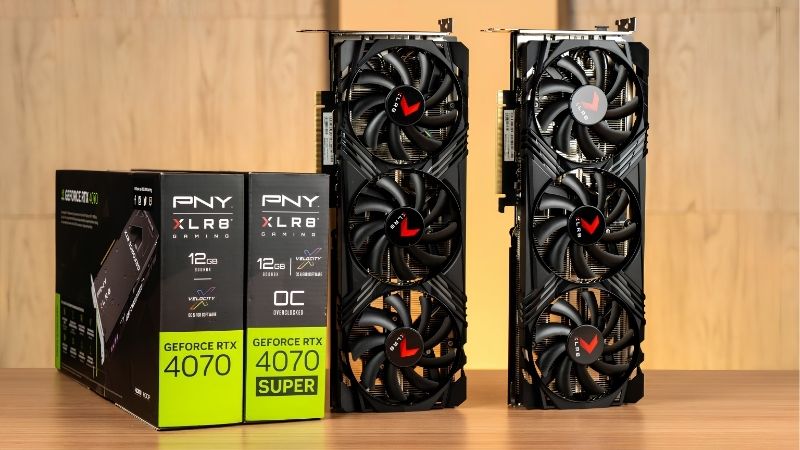
The Quick Verdict: RTX 4070 vs RTX 5070 in 30 Seconds
The fast answer: at equal prices, the RTX 5070 wins without discussion — roughly 20–25% faster, GDDR7 with a third more bandwidth, DLSS 4 Multi Frame Generation the 4070 will never receive, and a current-generation warranty with years of driver optimization ahead. The 4070’s claim survives in exactly two scenarios: clearance listings $80 or more below the 5070’s live price, and power-constrained builds where its 200W draw — 50W under its successor — is the binding requirement. For everyone else, buy the new generation. Check both cards’ current Amazon prices first, because the entire residual debate lives inside that gap.
What One Generation Bought at This Price Point
The successor ledger: 6,144 Blackwell CUDA cores against 5,888 Ada cores — a modest 4% on paper that architecture converts into a 20–25% real-world lead — plus 12GB of GDDR7 at 672GB/s versus 12GB of GDDR6X at 504GB/s, a 33% bandwidth jump on identical capacity. Fourth-generation RT cores add a disproportionate ray-tracing gain on top, running 30–40% ahead in RT-heavy scenes.
The feature delta is the generation’s real signature: DLSS 4 Multi Frame Generation presenting up to four frames per rendered frame where the 4070 caps at two, the transformer upscaler running at full speed, and dual AV1 encoders one generation newer for streamers.
The Old Card’s Surviving Crown: Efficiency
The 4070 holds one title its successor did not take: at 200W against 250W, it remains the most efficient card ever sold in this performance class — cooler, quieter on identical heatsinks, friendlier to marginal 650W power supplies, and available in compact two-slot designs that the 250W card mostly abandoned. Small-form-factor builders and prebuilt upgraders with fixed PSUs constitute its last natural constituency.
Per frame, the math still favors the newcomer — 25% more performance for 25% more power is parity, and Blackwell’s idle and light-load draw is actually lower. But as a peak-watts constraint, 200W versus 250W decides real builds, and honesty requires recording it.
Specs Comparison Table
One generation at one price point, line by line.
| Specification | RTX 4070 | RTX 5070 |
|---|---|---|
| Architecture | Ada Lovelace (2023) | Blackwell (2025) |
| CUDA Cores | 5,888 | 6,144 |
| VRAM | 12GB GDDR6X | 12GB GDDR7 |
| Memory Bandwidth | 504 GB/s | 672 GB/s |
| TGP (Power) | 200W | 250W |
| Frame Generation | DLSS 3 (2x) | DLSS 4 MFG (up to 4x) |
| AV1 Encoders | Single, first-gen | Dual, newer generation |
| Launch MSRP | $599 | $549 |
| 2026 Status | Clearance, ~$480–$550 | New, in production |
Deep Dive: Measuring a Single Generation
Generational gaps at the same price point are the industry’s honest report card, and this one grades across three sections: benchmark behavior at the resolutions this tier serves, the frame-generation divide that widens with every release, and the clearance arithmetic that defines the old card’s exact survival price.
Benchmarks at 1440p: The 20–25% Reality
At this tier’s home resolution, the gap is consistent and visible: the 5070’s 100–130 fps at high-to-ultra against the 4070’s 80–105 across AAA aggregates — the difference between feeding a 144Hz panel comfortably and managing toward it. The newer card’s 1% lows separate further than its averages, with GDDR7’s bandwidth producing flatter frame-time graphs in dense scenes where the 504GB/s card begins to ripple.
Ray-traced workloads stretch the lead to 30–40% as the RT-core generation compounds, promoting settings the 4070 treats as occasional toggles into the 5070’s defaults. At 4K — a stretch for both 12GB cards — the bandwidth gap matters most, though neither is this comparison’s recommendation for UHD ambitions.
At 1080p and in esports titles, both saturate any panel sold, and the decision reverts entirely to price and features.
VRAM parity hides a subsystem gap worth naming: both cards carry 12GB, but GDDR7’s 672GB/s drains and refills that buffer a third faster, which is why the successor degrades more gracefully in the exact overflow scenarios that produce the older card’s rare stutters. Identical capacity, different composure under pressure.
The Frame-Generation Divide That Keeps Widening
Both cards generate frames; only one multiplies them. The 4070’s DLSS 3 doubles supported titles to smooth effect; the 5070’s MFG presents up to four frames per render, converting a 90 fps base into 180–220 on screen — and the supported library grows monthly through 2026 while Ada’s 2x ceiling is hardware-permanent. Both receive the improved transformer upscaler; the multiplier remains exclusive.
The temporal point matters more than the snapshot: driver optimization now targets Blackwell first, several engines have gained measurable 5070 performance post-launch, and the generational software gap between these two cards will be wider in 2028 than it is today. Buying the successor buys the trajectory.
Clearance Arithmetic: The Old Card’s Survival Price
The break-even computes cleanly: 20–25% less performance prices the 4070 fairly at 20–25% less money, which against a $549 successor sets its rational ceiling at $440–$460 — before counting the feature and warranty gaps that argue for an even deeper discount. Real clearance listings at $480–$520 therefore sit above the old card’s honest value, surviving on shopper inertia rather than arithmetic.
The actionable rule: at $440 or below, the 4070 is a defensible value buy for efficiency-bound and budget-locked builds; between $440 and the 5070’s live price, it is the wrong purchase wearing a discount sticker. Few comparisons reduce to one number this cleanly — this one does.
2026 Market Forces: How Long Does the Old Card Linger?
Two current stories govern this matchup’s remaining lifespan: the United States approving Nvidia’s H200 AI chip exports to China, and the sustained rise in laptop and component prices. One inflates the successor’s street price; the other props up the clearance card’s floor — together they decide how often the survival-price scenario actually appears.
H200 Demand and the Successor’s Street Drift
The H200 approval directs enormous demand into Nvidia’s advanced wafer and GDDR7 supply — the 5070’s production pipeline. The post-surge pattern recurs reliably: street prices drift 5–15% above MSRP within a quarter or two, which on a $549 card means $27–$82, and 2026’s MSRP listings already behave like brief events.
Every dollar of successor drift widens the gap to clearance stock and extends the old card’s relevance — the ironic mechanism by which AI demand keeps a discontinued GPU alive on shelves.
Component Inflation and the Clearance Floor
The counter-force: memory costs rising for consecutive quarters and laptop prices already following anchor all GPU pricing upward, including remaining 4070 inventory. Clearance listings firm up instead of cascading down, the sub-$480 windows appear briefly and clear in days, and each quarter drains the stock that makes the scenario possible at all.
Tracking shows the trajectory: the old card’s discount events grow rarer and shallower, and the survival-price encounter — $440 or below — is already an uncommon sighting headed toward extinction.
Resale completes the arithmetic for anyone who upgrades on a cycle: a current-generation card bought today resells on the normal curve in three years, while a discontinued card bought at clearance enters the used market already two generations old when it exits your machine. The $60–$100 saved at checkout returns $80–$120 less at resale — clearance discounts on outgoing GPUs are partly a loan against your own future listing.
The Practical Play for This Matchup
Strategy reduces to a decision tree: check the 5070’s live price first; at $549–$580, buy it and close the question. Only if successor drift is severe should the clearance hunt open — and only a $440-or-below listing should end it in the old card’s favor, with the 200W constraint as the sole standing exception at higher prices.
Run the tree against today’s numbers: check both cards’ current Amazon listings, and let the live gap — not the discount theater — make the call.
Final Verdict: Pros, Cons, and the Cross-Aisle Option
A successor matchup ends predictably, but the ledger and one alternative deserve the record before the final profiles.
Pros and Cons of Each Card
RTX 5070 — Pros: 20–25% faster with markedly better 1% lows; DLSS 4 MFG and the widening Blackwell software trajectory; dual AV1 encoders; launched cheaper than its predecessor; full warranty and years of optimization ahead. Cons: 250W abandons the compact two-slot niche; street prices drift above the $549 MSRP; 12GB is adequate rather than generous at this tier’s ambitions.
RTX 4070 — Pros: the efficiency crown at 200W — coolest, quietest, most PSU-tolerant in class; complete 1440p experience; genuinely rational below $440. Cons: a full generation behind in performance and features with the gap widening; 2x frame-generation ceiling is permanent; clearance pricing usually sits above its honest value; dwindling stock makes hunting it a countdown.
Thermal behavior rounds out the successor’s case: despite the higher 250W rating, Blackwell’s idle and video-playback draw runs lower than Ada’s, so desktop-heavy users — the majority of any PC’s actual hours — pay the wattage premium only while gaming.
The Cross-Aisle Option: RX 9070 at the Same Money
Shoppers at this exact price point owe one glance across the aisle: AMD’s RX 9070 trades at the same $549 tier with 16GB of VRAM — the capacity neither Nvidia card offers here — and raster performance competitive with the 5070, conceding the DLSS ecosystem and some ray-tracing throughput in exchange. FSR 4 has closed most of the upscaling-quality gap.
For buyers whose anxiety is VRAM longevity rather than frame generation, it reframes the whole question; for DLSS-committed libraries, the 5070 holds. Either way, the cross-check costs one search and occasionally saves a regret.
Who Should Buy Which
Buy the RTX 5070 in every default scenario at this price point — successor matchups exist to produce exactly this sentence, and the 20–25% gap plus MFG plus warranty earns it. Buy the RTX 4070 only at $440 or below, or when a 200W ceiling is a hard constraint your PSU or case enforces.
And if 16GB tempts you more than frame multiplication, price the RX 9070 before closing the tab — the same money sometimes buys a different answer.
See More:
Conclusion
The rtx 4070 vs rtx 5070 matchup delivers the verdict successor comparisons should: the new generation wins at equal money with 20–25% more performance, DLSS 4 Multi Frame Generation, better encoders, and a widening software trajectory — while the old card retains exactly two refuges, a genuine $440-or-below clearance and the 200W efficiency constraint. The 2026 market is closing both refuges on schedule, with H200-driven drift inflating the successor and component inflation firming the clearance floor until the stock simply ends. Tap through to check the latest RTX 5070 and RTX 4070 prices on Amazon, run the one-number test today’s gap provides, and buy the generation the arithmetic actually endorses.
Frequently Asked Questions
What is the best rtx 4070 rtx 5070 in 2026?
The best rtx 4070 rtx 5070 depends on your budget and how you plan to use it. The options compared above are our top-rated picks based on real customer ratings, build quality, and overall value — start with the highest-rated model that fits your budget.
How much should I expect to spend on a rtx 4070 rtx 5070?
Prices vary by brand and features. Budget options cover the essentials, while mid-range and premium models add durability, performance, and extra features. Compare the prices in the list above to find the best value for your needs.
What should I look for when buying a rtx 4070 rtx 5070?
Focus on what matters most for your use case — build quality, compatibility, performance, warranty, and verified customer reviews. Every pick above is selected to balance these factors.
Are budget rtx 4070 rtx 5070 options worth it?
Yes. For most people a well-reviewed budget or mid-range rtx 4070 rtx 5070 delivers excellent value. You only need to spend more if you specifically require premium materials or top-tier performance.
How did we choose these rtx 4070 rtx 5070 picks?
We compare current Amazon ratings, review counts, key features, and price to surface the options with the best real-world value. The list is refreshed as ratings and availability change.










Write Your Review
No reviews yet. Be the first to share your experience!