
- Top Pick: SVBONY SV225 Alt-Azimuth Mount, Load-Bearing 10kg, Adjustable Angle Mount
- Best Value: Sky Watcher Star Adventurer GTI Mount Head Kit with Counterweight and CW bar – Full GoTo EQ Tracking Mount for Portable and Lightweight Astrophotography
- Premium Choice: Celestron CG-4 Manual German Equatorial Mount with Steel Tripod
The best telescope mounts for steady, clear viewing are equatorial mounts for long-exposure astrophotography and computerized alt-azimuth (GoTo) mounts for easy visual observing, with the right choice depending on your telescope’s total payload weight, whether you need field rotation-free tracking, and how much setup time you are willing to spend.
- Mount Types Compared: Alt-Azimuth vs Equatorial vs Dobsonian
- How to Match Payload Capacity to Your Telescope
- Tracking, GoTo, and Guiding: What Actually Matters
- Decision Matrix: Which Mount Class Fits Your Situation
- Setup Complexity and Portability Considerations
- Key Features to Prioritize for Steady Views
- FAQ
Mount stability determines image sharpness more than aperture alone. An undersized mount introduces vibration, tracking error, and star trailing, while an overbuilt mount adds unnecessary weight and cost. Understanding payload capacity, mount geometry, and tracking systems is essential before choosing.
As an Amazon Associate we earn from qualifying purchases at no extra cost to you.


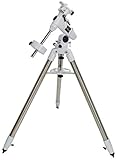

Mount Types Compared: Alt-Azimuth vs Equatorial vs Dobsonian
All telescope mounts fall into three core families. Each moves differently and solves a different problem for visual or photographic use.
1. Alt-Azimuth (Alt-Az) Mounts
Alt-az mounts move up-down (altitude) and left-right (azimuth). They are intuitive to point and require no polar alignment. Manual versions like the Vixen Porta II are lightweight and fast to set up. Computerized GoTo alt-az mounts such as the Celestron NexStar Evolution and Sky-Watcher AZ-GTi add motors and a hand controller that can automatically slew to thousands of objects after a simple 2- or 3-star alignment.
Best for: Lunar and planetary visual observing, casual deep-sky viewing, grab-and-go setups, and beginners who prioritize ease of use.
Limitation: They track by moving in both axes simultaneously, which causes field rotation during long exposures. This makes them unsuitable for deep-sky astrophotography beyond short planetary video stacks, unless you add a field de-rotator.
2. Equatorial Mounts
Equatorial mounts have one axis aligned to Earth’s rotational axis (the Right Ascension or polar axis). Once polar aligned, they track the sky by moving in a single axis, eliminating field rotation. German Equatorial Mounts (GEMs) are the standard for serious astronomy.
There are two tiers: manual / motorized equatorial mounts and full GoTo equatorial mounts like the Celestron Advanced VX, Sky-Watcher EQ6-R Pro, iOptron CEM40, and Celestron CGX. All require polar alignment before observing.
Best for: Long-exposure deep-sky astrophotography, precise tracking for high magnifications, and serious visual observers who want slow-motion controls on one axis.
Limitation: Heavier, more complex to set up, and requires counterweights. Setup time is 15-30 minutes including polar alignment.
3. Dobsonian Mounts
A Dobsonian is a simplified alt-az mount that uses a rocker box and Teflon bearings to support a Newtonian reflector. Models like the Sky-Watcher Classic Dobsonian and Orion SkyLine Dobsonian offer the largest aperture per dollar with rock-solid stability.
Best for: Pure visual deep-sky observing on a budget where maximum aperture and mechanical simplicity matter.
Limitation: No native tracking unless you purchase a GoTo Dobsonian variant or add an equatorial platform. Not suitable for long-exposure astrophotography.
| Mount Type | Typical Payload Range | Setup Time | Tracking Method | Astrophotography Suitability |
|---|---|---|---|---|
| Manual Alt-Az | 5 – 15 lbs (2 – 7 kg) | 2 – 5 minutes | Manual push-to | Planetary video only |
| GoTo Alt-Az (e.g., NexStar Evolution) | 12 – 35 lbs (5 – 16 kg) | 5 – 10 minutes | Dual-axis motors + GoTo | Planetary/lunar, short exposures <30s |
| GoTo German Equatorial (e.g., Advanced VX, EQ6-R Pro) | 20 – 44 lbs (9 – 20 kg) | 15 – 30 minutes | Single-axis sidereal + GoTo + guiding port | Excellent for long exposure |
| Center-Balanced Equatorial (e.g., iOptron CEM40) | 40 lbs (18 kg) | 15 – 25 minutes | Single-axis sidereal + GoTo + guiding | Excellent, lower weight for capacity |
| Dobsonian | 20 – 100+ lbs (OTA dependent) | 3 – 8 minutes | Manual or optional GoTo | Not recommended |
How to Match Payload Capacity to Your Telescope
The most common mistake is buying a mount rated just barely above the telescope’s weight. Manufacturer payload ratings are maximum mechanical limits, not optimal performance limits. For steady viewing and especially for imaging, you must include every accessory.
The 50% Rule for Astrophotography
For visual observing, you can safely load a mount to 70-75% of its rated capacity. For long-exposure astrophotography, limit the total imaging payload to 50-60% of the rated capacity to leave headroom for guiding accuracy and wind resistance.
Worked Calculation: Is Your Mount Overloaded?
Assume you have an 8-inch Schmidt-Cassegrain OTA weighing 12.5 lbs, plus accessories:
- Optical tube: 12.5 lbs
- 2-inch diagonal + eyepiece or camera: 1.5 lbs
- Finder scope + bracket: 0.8 lbs
- Imaging camera + guide scope + guide camera: 3.2 lbs
- Dovetail plate, cables: 1.0 lb
- Total payload = 19.0 lbs
On a mount rated for 30 lbs like the Celestron Advanced VX (rated 30 lbs), your visual load is 63% of capacity — acceptable for visual. For astrophotography, the ideal limit is 30 x 0.50 = 15 lbs. At 19 lbs you are at 63%, which will produce marginal guiding and wind sensitivity. You would need to step up to a 40-44 lb class mount like the Sky-Watcher EQ6-R Pro or iOptron CEM40, where 19 lbs is only 43-47% of capacity, giving you stable tracking with headroom.
Always add 2-3 lbs as a buffer for future accessories.
Tracking, GoTo, and Guiding: What Actually Matters
Manual vs Motorized vs GoTo
Manual mounts are cheapest but require you to nudge the telescope continuously at high power. Single-axis motor drives (RA drive) keep an object centered once polar aligned, which is enough for visual tracking. Full GoTo systems use two motors, encoders, and an onboard computer to find and track any object automatically after alignment. For mounts like the Celestron CGX or Sky-Watcher EQ6-R Pro, GoTo accuracy after a 2-star alignment plus calibration stars is typically within 1-5 arcminutes.
Periodic Error and Autoguiding
Every worm gear has periodic error — a small, repeating tracking wobble, usually 10-30 arcseconds peak-to-peak on mid-range GEMs. For visual use you will never see it. For astrophotography with exposures over 60 seconds, it creates elongated stars.
Higher-end mounts reduce periodic error with PEC (Periodic Error Correction) and include an ST-4 autoguiding port. An autoguider uses a small guide camera watching a star and sends corrections to the mount every 1-3 seconds. This is required for deep-sky imaging at focal lengths above 400mm. If you plan to image at 1000mm or more, do not buy a mount without an autoguiding port.
Polar Alignment Requirements
Equatorial tracking quality lives or dies on polar alignment. An error of 1 degree causes noticeable drift in a few minutes at high magnification. Modern aids make this fast:
- Polar scope: Align reticle to Polaris using date/time scales — accuracy ~0.5 degrees, usually $0 extra but included on most GEMs.
- PoleMaster / iPolar electronic polar camera: Achieves ~30 arcseconds accuracy in 2-3 minutes, usually $150-$300 as an add-on.
- Software plate solving (N.I.N.A., SharpCap): Most accurate method, uses camera to solve and correct alignment without seeing Polaris.
Decision Matrix: Which Mount Class Fits Your Situation
Use this matrix to map your primary goal to the right investment level. Prices reflect general market ranges in 2026 for the mount head and tripod only, without optical tube.
| If Your Situation Is… | Choose This Mount Class | Example Models | General Price Range |
|---|---|---|---|
| Beginner, visual only, telescopes under 15 lbs, want fastest setup | GoTo Alt-Az | Celestron NexStar SE, Sky-Watcher AZ-GTi | usually $400 – $900 |
| Visual observer, 8-inch Dobsonian, want maximum aperture | Dobsonian (Manual or GoTo) | Sky-Watcher Classic, Orion SkyLine | usually $500 – $1,400 |
| Want to try astrophotography with small refractor (<20 lbs total) | Lightweight GoTo Equatorial | Sky-Watcher Star Adventurer GTi, iOptron CEM26, Celestron Advanced VX | usually $800 – $1,600 |
| Serious deep-sky imaging, 20-30 lb payload, long exposures | Mid-range Heavy Equatorial | Sky-Watcher EQ6-R Pro, iOptron CEM40, Celestron CGX | usually $1,500 – $2,800 |
| Travel / hiking, camera + lens or 60-80mm refractor | Compact Star Tracker | Sky-Watcher Star Adventurer 2i, iOptron SkyGuider Pro | usually $300 – $600 |
Setup Complexity and Portability Considerations
Weight and assembly time are practical dealbreakers. A mount that is too heavy stays in storage.
- Alt-az GoTo: Mount head 12-25 lbs, tripod 8-12 lbs. One trip to the yard, no counterweights. Ideal if you have stairs or limited storage.
- Lightweight GEM (Advanced VX class): Head ~17 lbs, tripod ~18 lbs, plus 12-20 lbs of counterweights. Two trips, 15-minute setup.
- Heavy GEM (EQ6-R Pro / CGX class): Head 35-45 lbs, tripod 20-25 lbs, plus 20-30 lbs of counterweights. Requires careful lifting. Better for a permanent pier or observatory, or a backyard where you can leave the tripod assembled.
If you must carry gear more than 50 feet or up stairs, stay under a 30 lb head weight. Center-balanced designs like the iOptron CEM series place weight over the tripod center and can carry the same payload with a lighter head, reducing strain.
Key Features to Prioritize for Steady Views
Beyond capacity, look for these stability-related specs that do not show in marketing photos:
- Tripod material and diameter: Steel tripods with 1.75-2 inch legs dampen vibration in 2-3 seconds versus 5-8 seconds for thin aluminum legs. This is the difference between a shaky view at 200x and a settled one.
- Bearing and worm gear size: Larger 40-50mm worms and ball bearings on both axes provide smoother slow-motion and less backlash than small spur gears.
- Dovetail compatibility: Ensure the mount includes both Vixen and Losmandy D-plates or an adapter. Most modern GEMs do, but compact trackers are Vixen-only.
- Power requirements: GoTo GEMs typically draw 2-3A at 12V while slewing and 0.8-1.5A while tracking. A 50Ah lithium power station will run an EQ6-R Pro for 20-30 hours of tracking, but only 6-8 hours of continuous slewing in cold weather. Plan battery capacity accordingly.
- Vibration suppression pads: Inexpensive rubber pads under tripod feet can cut damping time by 30-50% on concrete or decks.
FAQ
Can I use an alt-az mount for astrophotography?
Yes, but only for short exposures. Alt-az mounts are excellent for lunar and planetary imaging where you stack thousands of short video frames. For deep-sky nebulae and galaxies requiring 2-5 minute exposures, field rotation will blur the edges of the image. Use an equatorial mount or an alt-az with a wedge and de-rotator, though a wedge makes an alt-az as complex as an equatorial anyway.
How accurate does polar alignment need to be?
For visual observing, within 1 degree is fine. For unguided astrophotography up to 60 seconds, aim for within 0.5 degrees. For guided long exposures over 2 minutes, aim for within 5 arcminutes. Electronic polar cameras and plate solving make this achievable in minutes.
Should I buy a mount or a telescope first?
Buy the mount first if astrophotography is your goal. A $1,200 mount with an $800 telescope will outperform an $800 mount with a $1,500 telescope in stability and tracking. You can always upgrade the optical tube later, but an unstable mount cannot be fixed with a better telescope.
Ready to decide? Our #1 pick for 2026 is the Manual Alt-Az.
Live price & availability on Amazon.





Write Your Review
No reviews yet. Be the first to share your experience!